

Dr.Tanmayi Dhamankar,Dr.Mihir Trilok Kothari
Abstract:
Aim: To report effectiveness of dichoptic treatment in residual amblyopia in adults with Sanet Vision Integrator and VTS4. Method: Retrospective case series carried out at tertiary eye care centre in urban setting. 23 eyes of 18 adults (=/> 18 years of age) with residual amblyopia (no response/plateau with at least 6 hours of daily patching for at least 3 months with optical correction) of anisometropic, isoametropic, strabismic or mixed type, unilateral or bilateral, who underwent office based dichoptic training for any duration were included. Best corrected visual acuity(BCVA),fusion & stereopsis at baseline and final follow up were recorded. Results: Mean age:22.5 years. Mean number of sessions: 18. BCVA before and after treatment :0.5 and 0.2 respectively (p<0.001).Mean of 2.4 lines of improvement after treatment in distance and near BCVA. Fusion developed in 6 out of 9 patients. Steroacuity developed in 2 out of 6 patients. Mean follow up : 3 months with sustained improvement in all patients. Conclusion: Office based dichoptic treatment with Sanet Vision Intergrator & VTS4 shows promising results in residual amblyopia in adults.
Keywords:Adult amblyopia, dichoptic treatment, VTS4, Sanet Vision Integrator, novel amblyopia treatment
Introduction:
Amblyopia is defined as “Decrease of visual acuity in one eye caused by abnormal binocular interaction occurring in one or both eyes as a result of pattern vision deprivation during visual immaturity for which no cause can be detected during the physical examination of the eyes and in which appropriate cause is reversible by therapeutic measure.”1 It is a developmental anomaly that results from physiological alterations in the visual cortex and impairs form vision. Mean prevalence of amblyopia is estimated to be between 2-5 %.2 Permanent monocular visual impairment due to amblyopia is a risk factor for blindness if the dominant eye is injured or if the fellow eye is affected by disease later in life and hence early treatment is crucial. In addition to reduced visual acuity, amblyopia causes low and high-level visual deficits like reduced contrast sensitivity, high levels of spatial uncertainty, spatial distortion, and impaired reading abilities. 3,4,5,6,7,8
For years, the primary treatment for amblyopia has been patching or penalizing the normal eye, thus “forcing” the brain to use the weaker amblyopic eye, but it is often assumed that amblyopia cannot be treated beyond the critical period of development, considered to be upto 7-8 years. But more recently, a large gamut of studies have shown that amblyopia is treatable even beyond this age well into adulthood, by various novel techniques.9,10,11,12,13
The present study aims to evaluate the effectiveness of office based dichoptic training for adults with residual amblyopia.
Methods:
It was a retrospective case series carried out at a tertiary eye care centre in an urban setting. Adults (=/> 18 years of age) with residual amblyopia (no response/plateau with at least 6 hours of daily patching for at least 3 months with appropriate optical correction) of anisometropic, isoametropic, strabismic or mixed type, unilateral or bilateral, who underwent office based dichoptic training at the centre for any duration were included. Amblyopia was defined as at least 2 lines interocular difference or binocular visual acuity <20/30 (0.18 LogMAR).14 Anisometropic amblyopia was defined as amblyopia in the presence of at least 1 diopter difference of refractive error between the eyes allowing for up to 8 prism diopters of microstrabismus . Strabismic amblyopia was defined as amblyopia in the presence of a manifest eye misalignment at distance and/or near fixation > 8 prism dioptres. Isoametropic amblyopia was defined as equal but significant refractive error in both eyes. Mixed amblyopia was defined as combined anisometropic and strabismic amblyopia.15 The mixed type of amblyopia was classified at strabismic for the purpose of analysis.
All patients underwent a baseline ophthalmological examination including distance and near visual acuity, manifest and cycloplegic refraction, cover test, Worth four dot test (WFDT), anterior segment examination with slit lamp and funduscopy. Best corrected visual acuity (BCVA) was measured on the Snellen’s chart initially but later we have switched to LogMAR chart as a protocol. Hence the distance visual acuity was measured on Snellen’s chart in 12 patients and converted to LogMAR value, while it was directly measured on LogMAR in the rest. Stereoacuity was classified as present or absent on random dot stereogram on the VTS4. BCVA, fusion and stereoacuity were measured before and after the program of dichoptic training.
The treatment protocol was as follows:
Session 1 (on Sanet Vision Integrator) 20 minutes:
- Saccade training
- Pursuit training
- Static anti suppression training
The exercises are initially done without crowding phenomenon and contrast & size of target is progressively reduced depending on the visual acuity.
Session 2 (on Vision Therapy System 4) 15 minutes.
The patient wears Polaroid glasses and performs the following tasks on a 3D orthoptic therapy unit:
- Flash vergence training
- Cheiroscope
- Fusional (vergence) exercises including those for flat fusion and stereopsis.
A typical regimen consisted of 20 such sessions, with additional 10 sessions if there was no improvement. No home therapy was advised. The follow up was generally at 1 week,1 month,6 months and 1 year after the initial regimen. If on any follow up there was deterioration of visual acuity, 10 sessions were repeated. This treatment was not combined with simultaneous patching or pharmacological therapy.
Data was analysed using the SPSS software version 20.0. ANOVA test was used to compare the visual acuity before and after treatment, and also to compare visual acuity improvements between the three types of amblyopia. Paired T test was used to compare visual acuity improvement between 2 age groups(above and below 25 years).p value less than 0.05 was considered to be significant.
Results:
18 patients were included in the study, 5 of which were bilateral amblyopes, hence for the purpose of visual acuity analysis, 23 eyes were considered.
Out of 23 eyes, 12 (52%) had anisometropic, 6 (26%) isoametropic and 5 (22%) had strabismic amblyopia. 11 patients were females. Mean age was 23 years(range18-39 years).The baseline mean distance visual acuity before and after treatment was 0.5 logMAR and 0.2 logMAR respectively (p<0.001) and there was a mean of 2.4 lines of improvement after treatment.The visual acuities in the anisometropic, isoametropic & strabismic group improved by a mean of 2.5, 2.4 and 2.8 lines respectively (Table 1). There was no significant difference in the pre treatment visual acuity between anisometropic, isoametropic and strabismic groups(p=0.24) or the improvement shown between these groups(p=0.79)(Table 2). Agewise analysis showed no significant difference between the baseline visual acuity (p=0.59) or the final improvement (p=0.22) in patients <25 years compared to those > 25 years(Table 3)Baseline near vision was < N6 in 8 eyes, which improved by a mean of 2 lines. Distance fusion on WFDT was absent in 9 (50%) out of 18 patients at the beginning of treatment;it was gained in 6 (66%) of those. Near fusion developed in 5 (83%) of the 6 patients whom it was absent pre treatment. Steroacuity was absent in 6 patients at the onset of treatment;it was gained in 2 patients post treatment. The mean duration of treatment was 18 sessions(range 6-45) and mean follow up period was 3 months. All patients showed sustained improvement till the last follow up.
Discussion:
Various novel techniques of amblyopia management in adults and children have been described, including perceptual learning and video game play which are monocular treatments and dichoptic treatment which is a binocular treatment.15
While these monocular training methods are directed toward improving the visual performance of the amblyopic eye, an alternative approach is to consider amblyopia as a binocular problem,involving other abnormalities, including suppression of the amblyopic eye by the dominant eye .10 This interocular suppression is not directly targeted by monocular training.16
Dichoptic treatment consists of presenting independent stimuli to each eye (figure 2). The therapy derives its effect from unlocking binocular visual function. The treatment effect then follows from introducing a task that requires the integration of the two stimuli under binocular viewing conditions. The paradigm is customised to overcome the patient’s suppression of the amblyopic eye. To do so, the image shown to the amblyopic eye must be of higher contrast than that shown to the fellow eye. As the patient’s developing binocular function improves, the contrast difference between the two eyes is reduced, potentially to a point where no difference is required. VA gains follow improvements in binocularity and contrast sensitivity, presumably due to reduced suppression.17
Our study showed a gain in visual acuity of 2.4 lines on an average after office based dichoptic treatment, the improvement being evident in as less as 6 sessions in one patient. This improvement was seen in all types of amblyopes. This is higher than improvement(mean 1.5-2 lines) obtained in other similar studies employing dichoptic treatment.9,18,19An increase of 0.34 logMAR(3.4 lines improvement) in BCVA has been reported by Spiegel and colleagues 20after 10 to 65 min of training with a Tetris dichoptic video game. Good response to treatment in the adult population reinforce the idea that the adult visual cortex has sufficient plasticity to recover function in adulthood.11,12,21,22,23,24Another evidence of plasticity in adults with amblyopia is in the report of amblyopic patients whose visual acuity spontaneously improved in the wake of vision loss in the fellow eye25,26. This indicates that the connections from the amblyopic eye may be suppressed or inhibited rather than destroyed. Loss of the fellow eye would allow these existing connections to be unmasked, as occurs in adult cats with retinal lesions27
Although there have been no randomised control trails comparing the effects of monocular vs binocular treatments and is no evidence that one is more effective than the other, treatments that require shorter duration(eg dichoptic training) may be preferred. 15
Our study had some limitations including its retrospective nature, short duration of follow up and non quantification of stereoacuity .
Nevertheless , we conclude that office based dichoptic treatment with the VTS4 and Sanet vision integrator is an effective modality of treatment for residual amblyopia of all types in adults, traditionally considered beyond the critical period of development. Development of a similar home based treatment with compliance and progress monitoring may further enhance compliance and convenience of patients.
REFERENCES:
- Von Noorden, GMaumenee A. Von Noorden-Maumenee’s Atlas of strabismus. 1st Saint Louis: C.V. Mosby; 1977
- Wu C, Hunter DG. Amblyopia: diagnostic and therapeutic options. Am J Ophthalmol. 2006;141:175–84.
- Bradley A, Freeman RD. Contrast sensitivity in anisometropic amblyopia. Investigative Ophthalmology & Visual Science.1981;21:467–476.
- Hess RF, Holliday IE. The spatial localization deficit in amblyopia. Vision Research.1992.;32:1319–1339.
- Bedell HD, Flom MC. Monocular spatial distortion in strabismic amblyopia. Investigative Ophthalmology & Visual Science.1981;20:263–268.
- Levi DM, Klein SA. Vernier acuity, crowding and amblyopia. Vision Research.1985;25:979–991.
- Levi D, Harwerth RS, Smith EI. Humans deprived of normal binocular vision have binocular interactions tuned to size and orientation. Science.1979;206:852–854.
- Levi D, Song S, Pelli DG. Amblyopic reading is crowded. Journal of Vision. 2001;7(21): 1–17.
- Žiak et al. Amblyopia treatment of adults with dichoptic training using the virtual reality oculus rift head mounted display: preliminary results BMC Ophthalmology.2017;17:105
- Vedamurthy et al. A dichoptic custom-made action video game as a treatment for adult amblyopia. Vision Research. 2015;114:173–187.
- Hess RF, Mansouri B ,Thompson B. A new binocular approach to the treatment of Amblyopia in adults well beyond the critical period of visual development Restorative Neurology and Neuroscience .2010;28:1–10 .
- Bonaccorsi J, Berardi N, Sale A. Treatment of amblyopia in the adult: insights from a new rodent model of visual perceptual learning. Front Neural Circuits. 2014 ;8(82):1-14.
- Pediatric Eye Disease Investigator Group. Randomized trial of treatment of amblyopia in children aged 7 to 17 years. Arch Ophthalmol. 2005;123:437–447.
- Wallace DK, Repka MX, Lee KA, Melia M, Christiansen SP, Morse CL et al. Amblyopia preferred practice pattern®. Ophthalmology2018; 125:105–142.
- Tsirlin I, Colpa L, Goltz HC, Wong AM. Behavioral Training as New Treatment for Adult Amblyopia: A Meta-Analysis and Systematic Review. Invest Ophthalmol Vis Sci. 2015 Jun;56(6):4061-75.
- Liu XY, Zhang JY. Dichoptic training in adults with amblyopia: Additional stereoacuity gains over monocular training. Vision Res. 2017 Aug 4. pii:S0042-6989(17)30128-1.
- Kraus CL, Culican SM. New advances in amblyopia therapy I: binocular therapies and pharmacologic augmentation British Journal of Ophthalmology Published Online First: 18 May 2018.
- Li J, Thompson B, Deng D, Chan L.Y.L, Yu M, Hess RF. Dichoptic training enables the adult amblyopic brain to learn. Curr Biol 2013; 23: 308–309.
- Verma A, Singh D. Active vision therapy for pseudophakic amblyopia. J Cataract Refract Surg. 1997;23:1089–94.
- Spiegel DP, Li J, Hess RF, Byblow WD, Deng D, Yu M, et al. Transcranial direct current stimulation enhances recovery of stereopsis in adults with amblyopia. Neurotherapeutics. 2013;10:831–9.
- Li RW, Klein SA, Levi DM. Prolonged perceptual learning of positional acuity in adult amblyopia: perceptual template retuning dynamics. J Neurosci 2008;28:14223–14229.
- Li RW, Provost A, Levi DM. Extended perceptual learning results in substantial recovery of positional acuity and visual acuity in juvenile amblyopia. Invest Ophthalmol Vis Sci 2007;48:5046–5051.
- Polat U, Ma-Naim T, Belkin M, Sagi D. Improving vision in adult amblyopia by perceptual learning. Proc Natl Acad Sci USA 2004;101:6692–6697.
- Levi DM Prentice Award Lecture 2011: Removing the brakes on plasticity in the amblyopic brain. Optometry and Vision Science. 2012; 89:827–838.
- El Mallah MK, Chakravarthy U, Hart PM. Amblyopia: is visual loss permanent? Br J Ophthalmol 2000; 84:952–6.
- Vereecken EP, Brabant P. Prognosis for vision in amblyopia after the loss of the good eye. Arch Ophthalmol. 1984; 102:220–4.
- Chino YM, Kaas JH, Smith EL 3rd, Langston AL, Cheng H. Rapid reorganization of cortical maps in adult cats following restricted deafferentation in retina. Vision Res. 1992; 32:789–96.
- Ding J, Levi DM Recovery of stereopsis through perceptual learning in human adults with abnormal binocular vision. Proc Natl Acad Sci USA.2011;108:733–41.
Table 1: Visual acuity improvement according to type of amblyopia
| TYPE OF AMBLYOPIA | MEAN BCVA (PRE TREATMENT) | MEAN BCVA (POST TREATMENT) | NO. OF LINES IMPROVEMENT | P VALUE |
| ANISOMETROPIC | 0.62 | 0.37 | 2.5 | <0.001 |
| ISOAMETROPIC | 0.41 | 0.17 | 2.4 | <0.001 |
| STRABISMIC | 0.42 | 0.14 | 2.8 | <0.001 |
Table 2: Comparison of pre treatment visual acuity and improvement between types of amblyopia
| N | Mean | p value | ||
| BCVA pre treatment | Anisometropic Amblyopia | 12 | 0.620 | |
| Isoametropic amblyopia | 6 | 0.417 | ||
| Strabismic | 5 | 0.420 | 0.24 | |
| Total | 23 | 0.558 | ||
| BCVA post treatment | Anisometropic Amblyopia | 12 | 0.368 | |
| Isoametropic amblyopia | 6 | 0.167 | 0.21 | |
| Strabismic | 5 | 0.140 | ||
| Total | 23 | 0.266 | ||
| Improvement(no of lines) | Anisometropic Amblyopia | 12 | 2.313 | |
| Isoametropic amblyopia | 6 | 2.500 | 0.78 | |
| Strabismic | 5 | 2.800 | ||
| Total | 23 | 2.467 | ||
Table 3: Comparison of pre treatment visual acuity and improvement between age groups
| Age groups | N | Mean | p-value | |
| BCVA pre treatment | ≤ 25 | 17 | .5176 | 0.596 |
| > 25 | 6 | .6733 | ||
| BCVA post treatment | ≤ 25 | 17 | .2506 | 0.715 |
| > 25 | 6 | .3100 | ||
| Improvement(no. of lines) | ≤ 25 | 17 | 2.6765 | 0.227 |
| > 25 | 6 | 1.8750 | ||
Figure 1:Improvement in visual acuity after treatment in the 3 groups
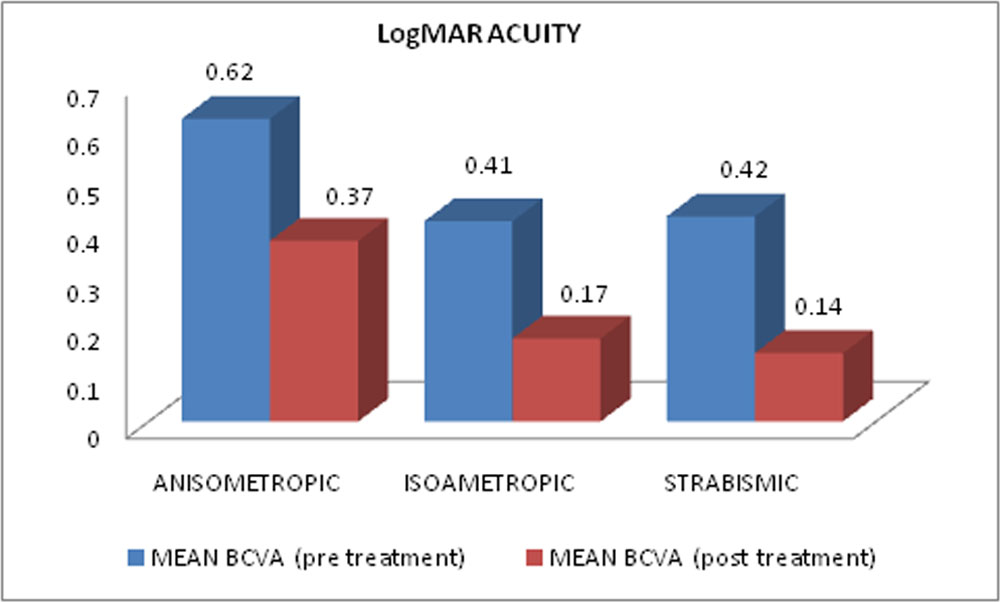
Figure 2:
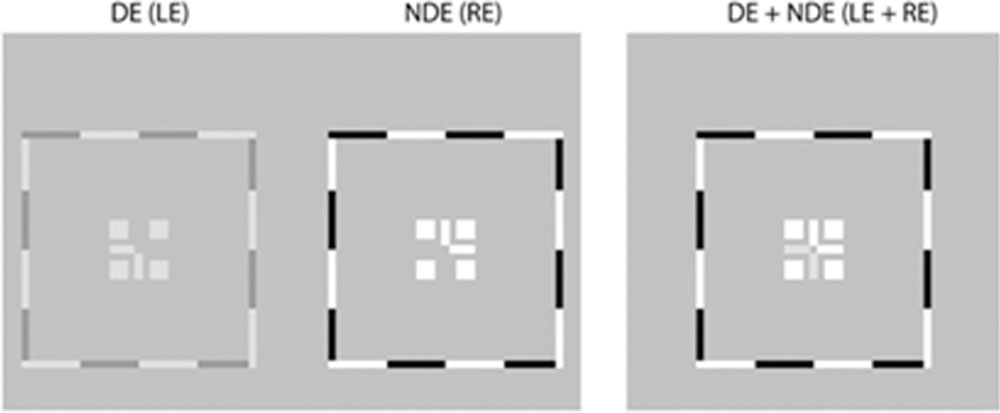
FIGURE 2 Dichoptic stimuli as presented to the patient with amblyopia. The stimuli are adjusted so that the dominant eye (DE), in this case the left eye (LE), has less contrast and is therefore more difficult to discriminate than the non-dominant eye (NDE). When the images are superimposed, the subject perceives a single percept with summation of elements presented to each eye separately. Over time, the contrast can be adjusted as the non-dominant eye improves with training (reproduced from Ding and Levi, figure 1A) .28 RE, right eye.
Leave a Comment