

Dr.RISHIKA JAIN,Dr.Mihir Trilok Kothari
Abstract –
Measuring the amplitude of stereopsis with novel bichromatic gradable stereopsis test.
Synopsis
Aim: To present a Novel bichromatic gradable bar test to measure contour stereopsis at distance that can be adapted to any screen .
Methods: Distance stereoacuity of normal (N) and intermittent exotropia (IX)subject was measured in a masked manner using CP690 projector chart and new chart. The streoacuity on new chart could be measured for minimum (Smin) and maximum(Smax) horizontal separation that could induce stereopsis. Paired t test used to find difference in distance stereopsis between N and IX subjects.
Results: 7 N subjects aged 26.9 years± 7.8 SD and 8 IXT patients aged 13.5 yrs± 11 were included. Mean stereopsis on CP690 chart was 1.42” in N and 3.25” in IXT (p=0.2). Smin and Smax was 2.2” and 8.7” in N and 1.5” and 4” in IX. Amplitude of stereopsis was (Smax- Smin) significantly less p=0.02 in patients with IXT.
Conclusion: New bichromatic gradable distance stereopsis test could be utilised for the sensory assessment of distance control in intermittent exotropia patients.
INTRODUCTION
Aim : To present a novel bichromatic gradable bar test to measure contour stereopsis at distance that can be adapted to any screen
Material : This test was designed on a computer screen taking in consideration from CP690 nidek projector chart .The amplitude of stereopsis was measured taking into consideration of horizontal disparity .The length of the red green bars were developed in 1:5 ratio with CP690 chart. The saturation of red green color was adjusted accordingly so red coloured bar should be appreciated only with red goggles and same for green coloured bar also.The distance between the two bars were planned according to CP690 chart.(Figure 1a) A central circle as fixation target was used and rest square,triangle,plus and star symbols used to denote the respective popping out bars. The stereopsis was recorded as 1’, 2’,4’, 10 arc seconds(Figure 1b). The random dot background was chosen.
For measurement of amplitude of stereopsis horizontal disparity between the red green bar was sequentially increased by one click compiled in a powerpoint presentation .The measured stereopsis was extrapolated by measuring distance in between two bars at CP690 and respective stereopsis value .To rule out false positive red blue plates were inserted randomly in the presentation.
Method : This is a prospective trial conducted in standalone tertiary teaching paediatric eye care practice in mumbai . The study was performed in the years 2017 and 2018 .
This study was performed on normal (N)and intermittent exotropia (IXT) patients aged more than 6 years . The patients with suppression in one eye previously operated for squint surgery , any history of ocular trauma ,cortically visual impaired or syndromic cases were excluded.
The test was conducted on 7 N subjects aged 26.9 years +/- 7.8 standard deviation and 8 IXT patients aged 13.5 years + /-11standard deviation at distance of 3 metres with full refractive correction on CP690 chart and our chart in a blinded manner by a senior paediatricoptometrist and an ophthalmologist . Both the tests were explained to the patient and performed in dark room with polarised and red green goggles for CP690 and our chart respectively. After recording the stereopsis on first plate , the powerpoint presentation was run manually giving atleast two minutes per plate to interpret . The child was instructed to inform when the bar starts popping out and then on sequential slides to appreciate the increasing stereopsis with increasing horizontal disparity of the bars till no more stereopsis was seen. At the break point the slides were scrolled in reverse manner to appreciate recovery .In this manner start, break and recovery were documented for each patient reporting the stereopsis max (Smax) and stereopsis min (Smin). The false positive for each patient was noted to assess the reliability of the patient.
Results : Mean stereopsis on CP690 chart was 1.42”in N and 3.25”in IXT (p=0.2). Smin and Smax was 2.2”and 8.7”in N and 1.5”and 4”in IX. Amplitude of stereopsis was (Smax- Smin) significantly less p=0.02 in patients with IXT. For example, one of the normal patient had Smin of 1.41’ and max of 8.93’ and an IXT patient wit 45 PD of meausrment on cover test had Smin 1.6’ and Smax 4’
Discussion :
Stereopsis results due to binocular disparity .Disparity-selective neurons fire more action potentials when a stimulus is presented to the two eye,even though same stimulus is presented.
Local stereopsis occurs due to differing values of the depth quality associated with single and quite small individual features.Synthesis of a whole depth pattern from a particular set of disparities of its constituent elements is called global stereopsis.(1)
Designing of a stereopsis chart needs meticulous work .The target size was chosen to be 1:5 ratio with CP690 nidek projector chart in view of the difference in screen size of our computer and the chart.Targets for measuring stereo acuity should be:
1.few in number,
2.well articulated,
3.sharply delineated
- good focused binocularly,
- of high contrast
- minimum, medium photopic luminance,
exposed for at least a good fraction of a second with binocular asynchrony of no more than a few tens of milliseconds.(2).We took in consideration these points while designing and performing the test,designing the test with two red and green vertical bars and time given upon each slide was 500 sec. Ideal time given should be 200 – 400 msec but not more than 1000 msec. The following formula for calculation of stereo disparity is used.
△y = a/Z2 * △z
Disparity is defined in an observer’s object space and, as is evident from the equation, depends in 2each instance on a, the observer’s interocular distance ( 65 mm), on z, the target distance, and on △z, the distance difference. It is an angle, and when a, z and △z are in the same units, say cm, it is in radians.Knowing the 10 arc seconds of stereo acuity on CP690 nidek projector chart ,△z was calculated for 1 arc second through the formula mentioned above.
We calculated the stereo acuity induced per click by extrapolating results from CP690 chart.
Random dot background was chosen for our test.The major virtue of random dot patterns is that their design can totally obscure monocular cues (2) . This chosen background also reduced the glare from the screen thus giving better contrast and appreciation of stereopsis.
There are several ways that binocular disparities might be described. One is simply to describe the difference in the retinal positions of various features (such as lines or bars). A second uses Fourier analysis to break down the image into a set of sine waves, and then records the phase differences between the eyes for each of these components. Binocular neurons use interocular phase differences — phase disparities — or interocular position differences — position disparities — to encode disparity.(3)
There are disparity-selective neurons in V1. They may also play some role in the generation of convergence eye movements — the involuntary movements of the eyes in opposite directions to align them on a binocular target.
In a study done by wright et al, results suggest that convergence makes a significant contribution in stereo acuity for large movements of eye. This could also be a confounding factor in our test when horizontal disparity increases due to movement of vertical bars giving falsely high stereo acuity measurements.(4)
In our chart we used red green coloured vertical bars.The vertical bars are stereoscopically perceived easily.De angelic et al gave alternate theory of stereopsis . They theorised that the striate cortex possesses a specialized mechanism for processing vertical contours, which carry the horizontal-disparity information needed for stereopsis.(5)
Color is considered to be an important feature of 3-D imaging but the contribution of color in stereoscopic vision is controversial, and there are three positions: 1. depth perception is independent of color, 2. the color stereoscopic mechanism being much weaker than the luminance mechanism, and 3. color vision is capable of supporting stereopsis at isoluminance. (6)
In neurology, it has become clear that there is extensive cross-communication between the parvocellular and the magnocellular system.Ts’o’ and Peirce also suggested that the neurons in the cortical area V2 are tuned for both color and binocular disparity.(6)
In a study done by chen et al,they showed that the perceived depth is not the same for different hue for a given size of disparity ,maximum being for yellow color. They concluded that chromatic features can contribute to depth perception and the stereoscopic depth perception can vary with the chromaticity.
The available strereotest are costly .This designed chart is cheap and easy to use. the sample size used for testing was small and needs further big studies for better outcome assessment. Stereo acuity is used for guiding in planning for surgical intervention in intermittent exotropia patients and giving therapeutic measures to improve stereopsis in patients of amblyopia lacking it.
The major limitation of our test is the induced convergence due to increased horizontal disparity thus giving falsely high stereo acuity recordings .It needs good cooperation and understanding of patient.It poses a learning curve and repeated testing might improve stereopsis. Very young children couldn’t be tested .
Conclusion : New bichromatic gradable distance stereopsis test could be utilised for the sensory assessment of distance control in intermittent exotropia patients.The stereopsis test available in market are very costly,our test is a free of cost . Stereopsis should be a pursue of every strabismologist. It aids in following of intermittent exotropia progression further guiding for surgery .
References
- Westheimer G, McKee SP. Stereogram design for testing local stereopsis. Invest Ophthalmol Vis Sci. 1980 Jul;19(7):802-9. PubMed PMID: 7390727.
- Westheimer G. Clinical evaluation of stereopsis. Vision Res. 2013 Sep 20;90:38-42. doi: 10.1016/j.visres.2012.10.005. Epub 2012 Oct 22. PubMed PMID: 23092634.
- Bruce cumming,Stereopsis : How the brain sees depth,current biology,volume 7 ,issue 10,october 1997 ,P R645-R647
- W D Wright 1951 Proc. Phys. Soc. B 64 289,The Role of Convergence in Stereoscopic vision, 12 October 19505
- DeAngelis GC, Ohzawa I, Freeman RD. Neuronal mechanisms underlying stereopsis:how do simple cells in the visual cortex encode binocular disparity?1995;24(1):3-31. PubMed PMID: 7617416.
- Zaiqing chen ,Junsheng shi,yonghangtai, lijun yun , Steeoscopic depth perception varies with hues , optical engineering ,51 (9),097401 (2012)
LEGENDS
Figure 1
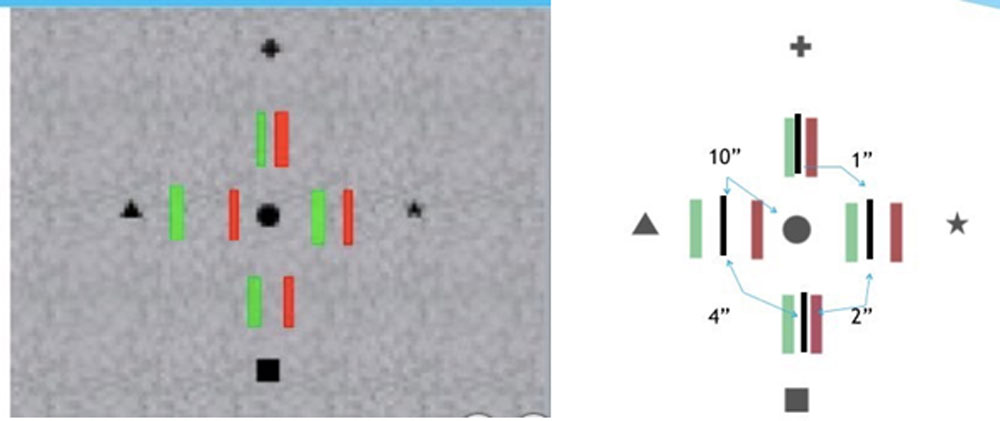
Figure 1 a.The new designed stereopsis chart withvertical red green bars on a random dot background .The central circle is used as fixation target and plus,triangle,square and star used to denote the respective bars. b.The figure illustrating the measurement of stereo acuity as extrapolated from CP690 chart.
Leave a Comment