

Dr.Vineet Vaishnav,Dr.Abhay Vasavada,Dr.Samaresh Srivastava
Purpose:
To study the intraoperative performance and postoperativeoutcomes of implantation of a cionni modified capsule tension ring and single-piece acrysof intraocular lens in the capsular bag eyes with subluxated lenses.
Material and methods:
The study population comprised 30 eyes with subluxated lenses that underwent lens extraction, capsular bag fixation with Cionni CTR, and in-the-bag IOL implantation. All eyes completed minimum 7 years follow-up. Main outcome measures were longterm postoperative best-corrected visual acuity (BCVA), IOL centration, and complications.Mean age:29.4±16.6 yrs.Mean extent of subluxation 6.1±1.0 clock hours.
Results:
Marfan’s Syndrome was the most common identifiable cause of subluxation in 65%.Anterior vitrectomy performed in 2 eyes.22eyes had a Single-element Cionni ring and 8 eyes Double element ring for bag fixation.Mean follow-up:90.1 ± 4.9 months.Meanpreop BCVA:0.66±0.22 logMAR.Mean postop BCVA at final follow-up:0.33 ± 0.21 logMAR(P<.001).BCVA improved in 25 eyes(85%).IOL decentration noted in 4 eyes(13.3%),requiring repositioning in 3 eyes.9 eyes(30%) required Nd:YAGcapsulotomy for PCO.
Conclusion:
In-the bag implantation of cionni modified ctr and single piece acrysofiol was possible in 95%eyes,visual improvement was seen in 94% eyes,ioldecenteration noted in 10%eyes,posterior capsular opacification in 35%eyes.
INTRODUCTION
Now a days we know that lot of patients report to us with loss of zonularsupport,zonular dehiscence and even with intraocular lens and bag subluxation.There is a need for the study to get a conclusion about how to fixate these capsular bags that can stay for longer period.Variousmethords have been tried to give artificial support to these bags and get stability for IOL+BAG Complex but there is not enough literature to support the longterm stability of these iol +bag complex.Here we have a data of minimum 7 years followup of Cionni+IOL in the bag fixation with 9-0 Prolene and Gortex suture.
METHODS
Study design:Prospective Observational Case series.30 eyes of 28 patients were include.
Settings:Raghudeep eye hospital(Tertiary eye care centre),Ahmedabad,Gujarat,India.
Study started in March 2003,and is still going study.We have collected full data of patients mainly recruited from march 2003 to march 2018.
Followup period included 1day,1 month,3 months,6 months,1 year and There after.On every followup we gathered the data of BCVA,extent of iol+cionni stability in the bag,extent of zonular weakness and subluxation of iol,intraocularpressure,cornealthickness,posterior segment examination were also included of all the 30 patients.
PARTICIPENTS
It is a cohort study.
We have include 30 eyes of 28 patients mainly.Minimum age of the patient was 3.8 years and maximum was 50 years.The mean age taken into consideration was 29.4 years.
The study period ranges from 5 to 15.5 years.Mean years of followup is 7 years.We have taken minimum of 7 years followup period.
The participents included in the study had been evaluated for other pathological conditions in the body.
We have found that maximum number of patients included in the study had Marfan’s Syndrome(14%),followed by idiopathic subluxation(12%),Trauma(8%),Homocystienurea(2%).So from the study we can find that marfan’s syndrome is the commonest cause of subluxation of lens and zonular weakness in the young patients.
There was no specific age criteria for inclusion of patients in hestudy.Patient of any age with lens subluxation was included in the study.
VARIABLES:Pre-op-Age,sex,extent of subluxation,BCVA Intra-op-Type of suture used,single or double eyelet cionniused,Type of IOL put,intra-op complications
Post-op-Cionni with IOL fixation,suturedegradation,stability of iolbagcomplex,Post op complications,ND-YagCapsulotomy rate postoperatively for PCO
DATA SOURCE-
For each variable the data was collected subjectively by measuring the vision manually of each patient going for surgery.Video recording was done for all the patients included in the study group pre-operatively.Extent of subluxation was taken by using caliper pre-operatively and intra-operatively.All the patients were checked for any phacodonesis.Record of any intra-operative complicatios was taken into account.PostoperativelyPhotoslit of every patients were taken and cionni element were recorded(with single or double eyelet),any postoperative complication was taken into account.ND-Yag Laser capsulotomy was done by using mainly 2.2mj power for posterior capsular opacification and record of that was done in case papers.Every patient detail is recorded in his/her case paper.
STUDY SIZE-
As mentioned earlier Patients included were 30 in number.28 Eyes were taken into account.All the patients came for regular followup at 1day,1 week,1 month,3 months,6 months,1 year and thereafter.
STATISTICAL ANALYSIS-
All the patients’ data were collected on every visit and excel sheet was made from that and were measured statistically using paired t-test.Pvaue,mean were calculated from the data.f
RESULTS
INTRAOPERATIVE PERFORMANCE:Cionni successfully implanted in 100%
PCR: 1 eye(2.8%); PCCC done, Double eyelet Cionni,3 piece IOL in sulcus
Rhexis split: 1 eye(2.8%)
Decentered IOL at end of surgery: 2 eyes(5.5%)
Residual PC plaque: 1 eye(3.3%)
Anterior vitrectomy: 3eyes(10.0%)
POSTOPERATIVE OUTCOMES:Best corrected visual acuity
IOL centration
Postoperative complications
Post operative follow up:1 day, 1 week, 1 months, 3 months, 6 months and thereafter
BCVAPreoperatively 86.1% had BCVA< 6/12; At final follow up 66.7% had BCVA≥ 6/12
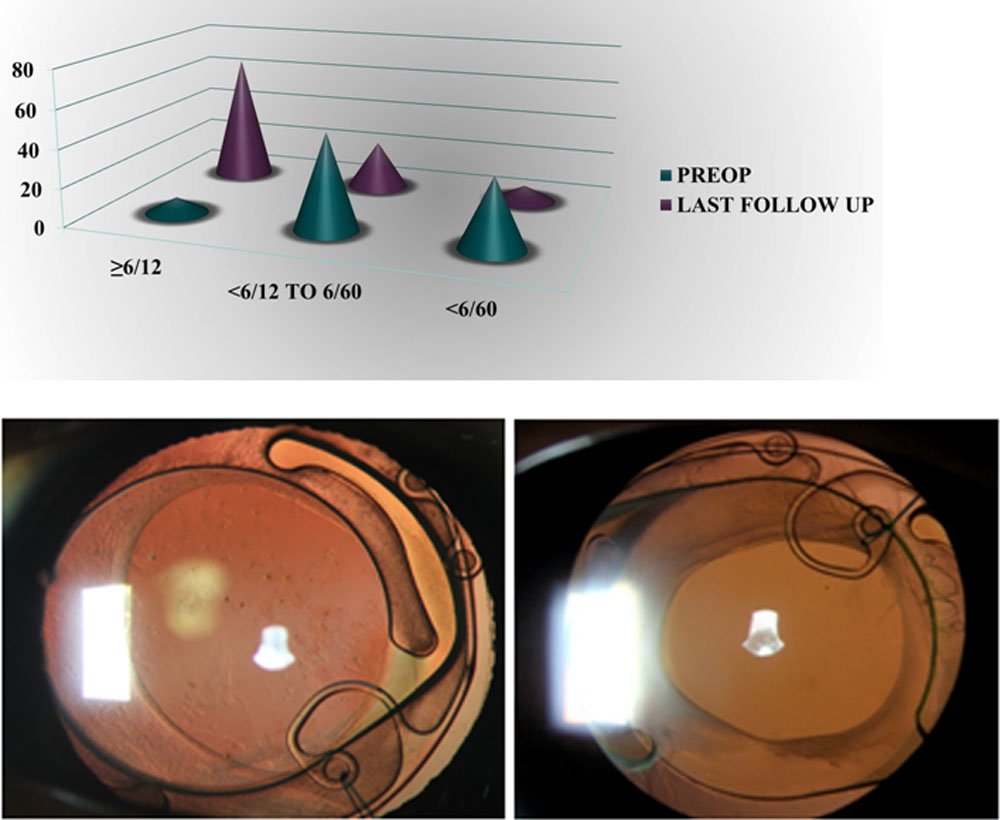
IOL CENTERED IN 22 EYES.(77.8%)
IOL DECENTRATION:
8 eyes(24.2%)
Mean time at which decentration noted: 5.3 years(4 years to 8 years)
Significant decentration requiring resurgery: 4 eyes (13.1%)
Mean time at resurgery: 8.5 years
(5 years to 15 years post surgery)
RESURGERY- PATIENT CHARACTERISTICS:
50 Years – Idiopathic anterior subluxation
44 years- Traumatic 3 clock hour subluxation.
31 years-Idiopathic 9 clock hours subluxation
40 years- Idiopathic 5 clock hours subluxation.
IOL DECENTRATION-TYPE OF RESURGERY:1 eye: refixation of IOL+ Bag with 9-0 prolene
1 eye: SFIOL
2 eyes: refixation with cionni and Ahmed segment with goretex suture
POSTERIOR CAPSULAR OPACIFICATION:
PCO : 21 eyes(70.0%)
Mean time at which PCO was noted: 1.4 year (1 month to 5 years)
Significant PCO requiring Nd: YAG capsulotomy: 16 eyes(48.0%)
Mean time at which Nd: YAG capsulotomy was done: 2years 3 months (4 months to 5.6 years)
DISCUSSION
In the bag IOL implantation was successful in 97.2%.
At final follow up visit, 66.7% had a BCVA of ≥ 6/12 compared to 8.3% preoperatively.
PCO most common complication & was seen in 70.0%.
13.1% needed resurgery for decentered IOL.
Cionni RJ, Osher RH, Marques DM, et al.
Modified capsular tension ring for patients with congenital loss of zonular support
J Cataract Refract Surg 2003; 29: 1668-73.
90 eyes of 57 patients, mean age 35.6 years
Mean Follow-Up 14.6 months ( 2 – 32 )
– BCVA 20/40 or better in 88.9% eyes
6.7% eyes developed late symptomatic PC IOL decentration
Bahar I, Kaisermann I, Rootman D, et al.
Cionniendocapsular ring implantation in Marfan’s syndrome
Br J Ophthalmol 2007; 91: 1477-1480
Retrospective series
15 eyes (12 patients) with Marfan’s syndrome (19-56 yrs)
– Follow-Up 3 – 27 months
– BCVA 20/40 or better in all eyes
18.7% eyes developed PCO
Abhay R Vasavada, Mamidipudi R Praveen, et al
Cionni ring and in the bag intraocular lens implantation for subluxated lenses: a prospective case series
American Journal Of Ophthal. Jun 2012, issue 6, Pages1144-1153
Prospective case series
41 eyes
– Follow-Up: 45.8±2.9 months
– Mean BCVA at final follow up 0.33±0.21 logMAR
34.2% eyes developed PCO; 7.3% had decentration; 2.4% developed CME; 2.4% RD
Leave a Comment