

Dr.Mayur Rokdey,Dr.Mahesh Pathak,Dr.Kalpana Narendran
Introduction
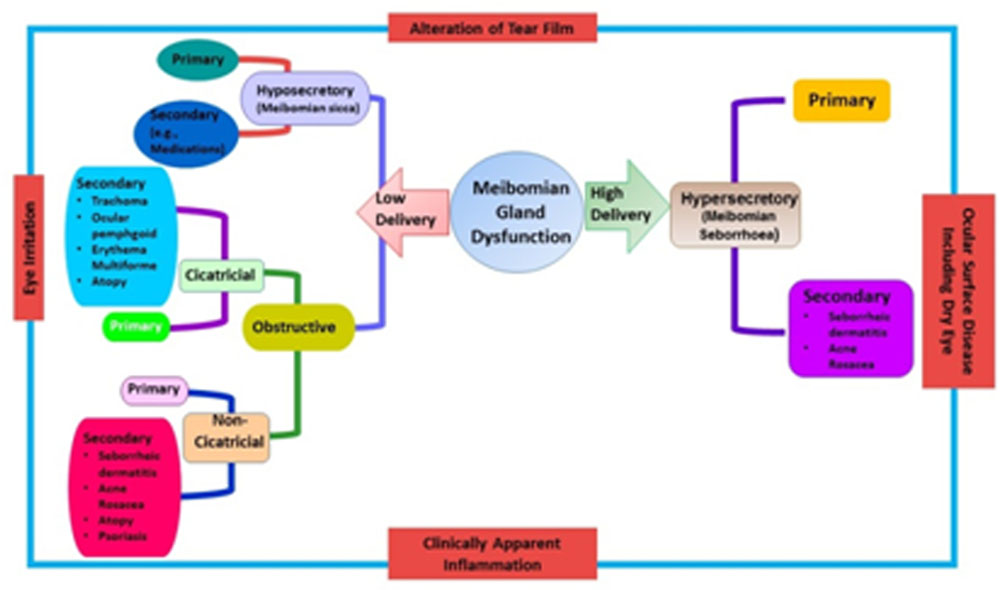
Korb and Henriquez coined the term Meibomian Gland Dysfunction (MGD) in a study addressing contact lens intolerance and the obstruction of the Meibomian gland orifices by desquamated epithelial cells. [1] The International Workshop on MGD defined the disease as “a chronic, diffuse abnormality of the meibomian glands, commonly characterized by terminal duct obstruction and/or qualitative/ quantitative changes in the glandular secretion. It may result in alteration of the tear film, symptoms of eye irritation, clinically apparent inflammation, and ocular surface disease”.[2] The new classification system proposed by the 2011 International Workshop on MGD is shown in Figure 1.[3]
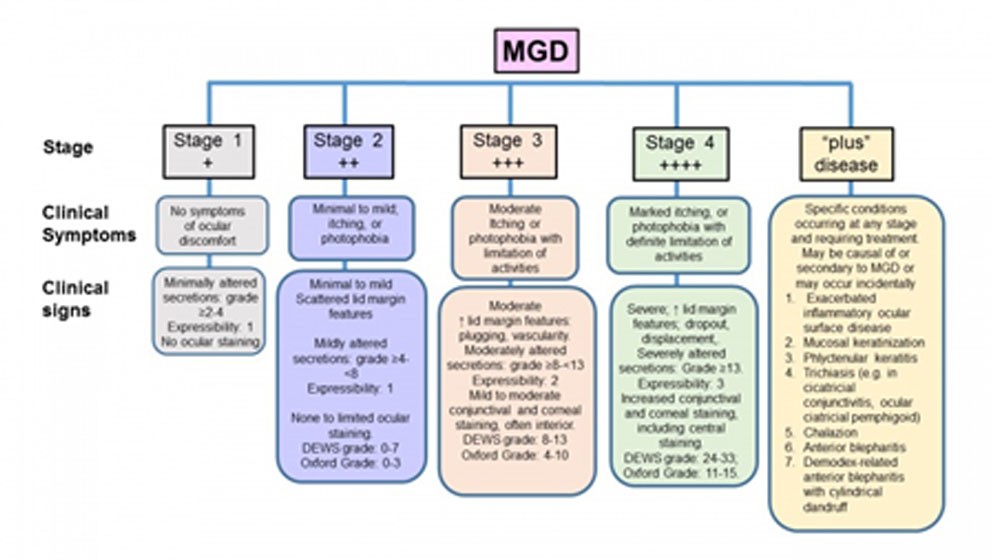
The staging of MGD and their clinical descriptions as per the international workshop on meibomian gland dysfunction is shown in the figure 2.[4]
Aim
A prospective study was done to evaluate the efficacy of topical chloroquine drops in the treatment of meibomian gland dysfunction (MGD).
Sample size
30 patients were studied with varying grades of MGD.
Study area
The study was conducted ‘on actuals’ basis in the out patient department of Aravind Eye Hospital, Tirupur.
Study design
Ours was a prospective study design. Patients were asked to follow up with us at 10th and 21st days.
Methodology
Slit lamp examination to grade MGD; schirmer test & tear film breakup time to rule out dry eye disease. Patients were given a questionnaire to indicate levels of severity of pain and discomfort. Topical Chloroquine drops(0.03%) [twice daily] with topical lubricating eyedrops (4 times daily) were given in accordance with topical chloroquine regimen for dry eyes.[5] Follow ups were done on day 10 and day 21.
Results
16 patients showed improvement by 1 grade at day 10 and 12 patients showed change by 2 grades at day 21(p value<0.05). 24 patients showed improvement by 1 grade by day 21(p value<0.005). 28 patients experienced significant improvement in symptoms at the end of the study.(p value<0.001)
Conclusion
Topical Chloroquine drops may play a significant role in the acute treatment and control of MGD.
References
- Korb DR, Henriquez AS. Meibomian gland dysfunction and contact lens intolerance. J Am Optom Assoc 1980;51:243-51.
- Nelson JD, Shimazaki J, Benitez-del-Castillo JM, et al. The international workshop on meibomian gland dysfunction: report of the definition and classification subcommittee. Invest Ophthalmol Vis Sci 2011;52:1930-7
- Nelson JD, Shimazaki J, Benitez-del-Castillo JM, et al. The international workshop on meibomian gland dysfunction: report of the definition and classification subcommittee. Invest Ophthalmol Vis Sci 2011;52:1930-7
- Geerling et al (2011). The International Subcommittee on Meibomian Gland Dysfunction: Report of the subcommittee on Management and Treatment of Meibomian Gland Dysfunction. IOVS, 52: 2050-2064.
- Bhavsar A et al. Evaluation of the effects of chloroquine phosphate eye drops in patients with dry eye syndrome. International Journal of Biomedical And Advance Research.
Leave a Comment