

Dr.Desai Sanjiv
Introduction
In recent years there has been a shift from using gunpowder to expansive mortar to crack stones in stone quarries. The greatest disadvantage of using gunpowder is that It breaks the boulder in uneven jagged pieces which are not of uniform size. So a lot of the rock is lost because it’s unfit for use in construction. Moreover it maims and kills workers in the quarry because of its explosive nature. Therefore expansive mortar which is made of calcium oxide is the favored material these days.
The mortar which comes in a powdered form is mixed in water to make slurry. The slurry is poured in pre-drilled holes in the stone block. In a few hours the slurry expands and breaks the huge stone blocks noiselessly with clean cut cleavages. However a disadvantage is that the slurry is highly alkaline [PH 13] and its expansion creates an exothermic reaction with the formation of steam which sometimes shoots out from the peg holes – a phenomenon called blow out shoot.These shootouts rise up to 10 feet in the air and can injure workers and bystanders by producing alkaline burns of the face and eyes. This study reports on 16 eyes that had alkalie burns from the use of expansive mortar in stone quarries. This is the first such report on a new form of ocular hazard that is now plaguing the stone industry.
Material & Method
This is a retrospective study of 15 stone quarrymen [16 eyes] who presented to our eye hospital in a one year period with alkaline burns of the eyes after handling expansive mortar in the stone quarries around Jodhpur. All 15 cases were male as the stone industry is an exclusively male domain [pervere]. They were treated with standard treatment for alkaline burn which included debridement because most times the slaked lime formed from the mixture of water with calcium oxide was driven into the cornea, conjunctiva and fornices. Steroid eye drops and cycloplegichomatropine formed the mainstay of medical therapy. The cases were followed up and the clinical course recorded. They ere referred to higher centers if they required limbal stem cell transplants or other intervention not available with us.
Results
After treatment
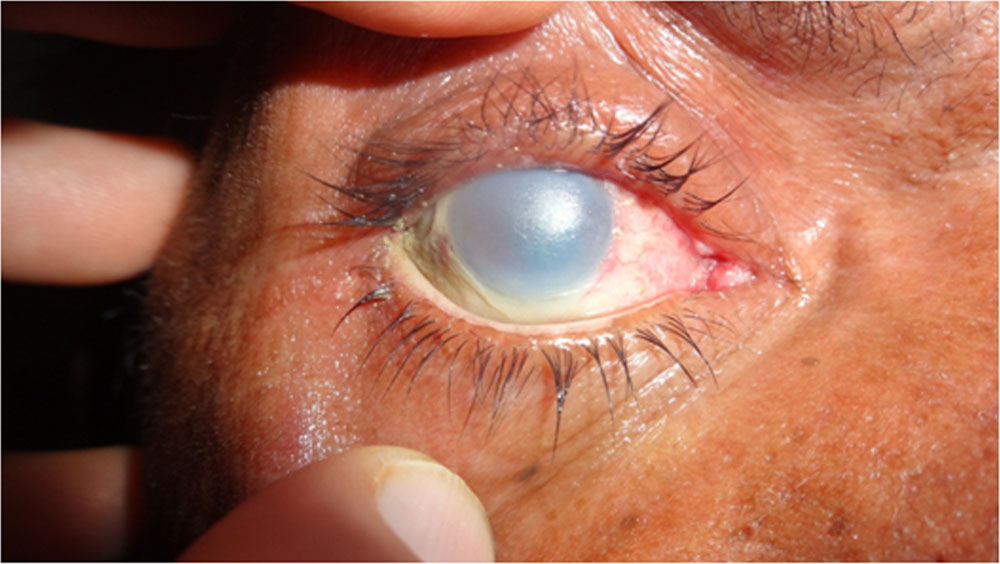
A total of 15 cases [22 eyes] reported to us with alkaline burns due to injury with chemical spurts from blow out shoots of the expansive mortar.The all-male patient cohort ranged in age from 19 to 48 years.Their presenting vision ranged from No Perception of light to 6/9 in the affected eye. Most eyes [72.8 %] had severe burns that led to stem cell deficiency and irreversible corneal opacification [Figure 1].
The visual recovery was less than 6/60 in 18 % eyes and a similar number of patients were left with either no perception of light or vision that was counting finger close to face at the end of treatment [Table 1]. One eye underwent a keratoprosthesis with 1 meter vision recovery and one went phthisical even with treatment.
Discussion
Expansive mortar is the preferred stone cracking material now because its environmentally friendly as its noiseless, there are no vibrations and no toxic gases and flying debris are produced. In comparison to gunpowder, it’s also very cost effective. It’s also ideal for demolishing buildings where flying debris may damage surrounding buildings.
The greatest disadvantage of using this material is the occurrence of blow out shoots. A blown-out shot is that the EM filled into a hole spurts out from the hole. Quicklime, which is the main ingredient of expansive mortar, releases heat energy by the formation of the hydrate, calcium hydroxide [slaked lime], by the following equation : CaO (s) + H2O (l) = Ca(OH)2 (aq) (ΔHr = −63.7 kJ/mol of CaO
This is a spontaneous and vigorous reaction. A lot of heat is produced in the reaction, which may even cause the water to boil. If the reaction goes too quickly the temperature can reach higher than the boiling point of water before all the water has chemically combined with the EM. This can result in a steam driven explosion which blows the EM from the holes producing a blow out shoot.
None of the patients was wearing personal protection eyeglasses [PPE] at the time of injury. In fact there was no awareness in the workers or the quarry owners about the importance of PPE in stone quarries.
Conclusion
A new and emerging ocular hazard in the form of Expansive Mortar has been identified and its clinical course and visual outcomes presented in this communication. The ocular burns produced by EM are very severe and require prompt treatment in order to save eyes. The importance of using personal protection eyeglasses [PPE]cannot be overemphasized.
Table 1.
| Name | Age | VA | Final VA | |
| 1 | Pusa Ram | 42 | PL/PR in BE | 2mCF, 6/36 3POD |
| 2 | Bhoma Ram
|
48 | PL+ LE , IOP +
Tr.Hyphema + keratoconjunctivitis + iris tear |
6/12 |
| 3 | Chutra Ram
|
35 | B/L Alk Burn [R>L]
RE : 3/60 LE : 5/60 |
6/60
6/12 |
| 4 | Subhash | 17 | RE CFCF | 5/60 |
| 5 | Harka Ram | 20 | RE : 6/9 | 6/6 |
| 6 | Ali Khan | 42 | RE : Pl+
LE : 8/18 |
RE : CFCF
LE : 6/9+ |
| 7,8 | Munna Ram,
Magga Ram, |
26
28 |
BE : 6/6
BE:6/9 |
6/6
6/6 |
| 9 | Mugga Ram, | 35 | RE : PL+
LE : CFCF |
RE: PL+
LE : 2/60 |
| 10 | Sanjay | 26 | RE:6/6
LE: 1mCF |
RE:6/6
LE:3/60 |
| 11 | Prabhu Singh,
|
55 | RE : 6/18
LE 6/12 |
|
| 12 | Kisana Ram,
|
28 | RE : No PL
LE : 6/12 |
No PL
|
| 13 | Karna Ram, | 48 | RE : 1.5 mcf
LE: 4 mcf |
Lost to F/U |
| 14 | Mukesh | 19 | RE : 5/60 | 6/12 |
| 15 | Jagdish
|
31 | PL+
|
RE : Phthaisis No PL
LE : 1/60 |
Figure 1.Ground glass appearance of cornea after an expansive mortar blow out shoot.
Note peri-limbalischemia
 .
.
Leave a Comment