

Dr. SUBASHINI S, Dr. Dayakar Yadalla, Dr. RUKSANA AYUB K
Abstract
Aim:
To evaluate the compliance rate of diabetic retinopathy screening camps by analyzing the hospital attending diabetic retinopathy patients among referred diabetics for further interventions. To analyze the hindering factors for follow up of the patients and how to improve their follow up for further interventions.
Methods:
It is a retrospective study conducted on 3 years from Jan 2015 to Dec 2017 in a tertiary eye care hospital. All data of DR camps have been collected and analyzed. Our diabetic retinopathy camps were conducted in a module of registering all patients, preliminary examination by a doctor, checking intraocular pressure, blood sugar, indirect ophthalmoscopy examination after dilating the patient. Analyzing the diabetic retinopathy status, patients were advised review at camp site itself or referred to base hospital for further intervention.
Results:
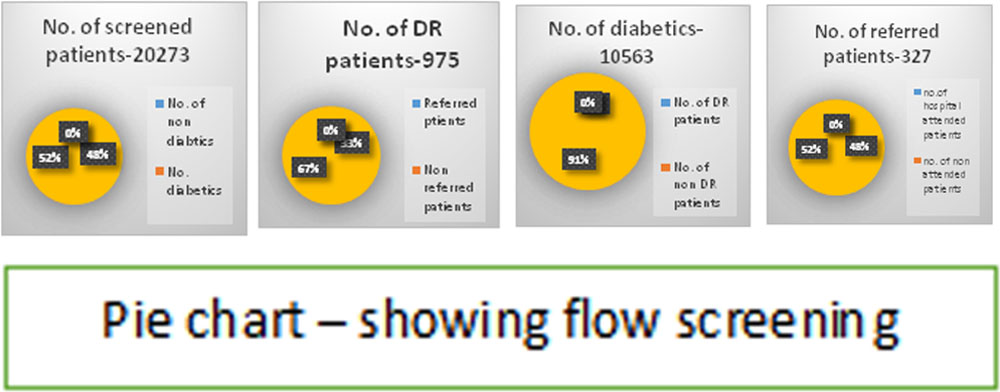
Totally 20273 patients have been screened including diabetics and nondiabetics. Among them 10563 (48%) were diabetics. Out of them 875(9%) had diabetic retinopathy and 327(33%) patients were referred for further treatment to the base hospital. But only 48% patients visited to the base hospital for treatment.
Conclusion: Eventhough diabetic retinopathy camps has reduced maximum number of diabetic patient’s burden to visit the hospital for checkup, its quality should be maximized by increasing the compliance of patients.Major challenge for an eye care programme is to ensure compliance in follow-up. If we able to overcome it, effectiveness of screening will be fruitful.
Introduction
According to the World Health Organization (WHO), India may become a main country of diabetes in the next two decades; the number of cases of adultonset Diabetes will grow to nearly 80 million in 2030 from 18 million in 1995.1 Diabetes-related blindness was the 17th most important cause of blindness about
20 years ago in India; today, however, it is in sixth place. Almost all persons with diabetes will experience some degree of diabetic retinopathy over time, with the prevalence
increasing with diabetes duration2.
Diabetic Retinopathy Study3 and the Early Treatment Diabetic Retinopathy Study4 showed that effective treatments for diabetic retinopathy can reduce severe vision loss by up to 94%. These two landmark clinical trials confirmed the benefits of regular eye examinations to insure early detection and treatment of diabetic retinopathy.
Current diabetes vision care guidelines, published by the American Academy of Ophthalmology5 and the American Diabetes Association6, aim to detect retinopathy in its most treatable, often asymptomatic earlier stages. For persons with type 1 diabetes, these guidelines recommendat least annual dilated eye examinations 5 years afterdiagnosis. Individuals with type 2 diabetes are recommendedto have a dilated eye examination concurrent withdiagnosis, and at least annually thereafter.
The main parameter is not only screening, treatment for the patient after screening. We referred the patients who need further intervention like laser, FFA, etc. if the patient got correct treatment, and our camps will be successful. Even though we have filtered referral the patients depends on severity, the compliance is not as good as we think. So we have to analyse the compliance rate and hindrance for follow-up.
Methods
It is a retrospective study, data were collected from the period of 2012-2017 and analysed. It showed, number of the diabetics including new and old, number of diabetic retinopathy patients, grading of the patients, referred patients for further intervention and number of follow up patients thus all were collected. We analysed that how many patients were referred for hospital and how many of them attended hospital for further treatment.
Our diabetic retinopathy camps have been conducted alone or in primary health centre including general population also. Thus we have diagnosed new diabetics as well as young diabetics. After registering the patient, vison will be checked by using Snellen chart. After that preliminary examination will be done by a doctor to check the anterior segment pathologies. After that intraocular pressure will be checked by using perkins tonometer, blood pressure will be checked and random blood sugar will be checked by strip method. Finally patient’s eyes will be dilated by putting 0.5% tropicamide. At last indirect ophthalmoscopy examination will be done a retina doctor.
Diagnosis and grading of the diabetic retinopathy will be done ETDRS guidelines. If the patient has severe diabetic retinopathy, CSME, proliferative diabetic retinopathy, patient will be referred to base hospital for further management. Counsellor Counsel the patient for treatment at base hospital and referral will be given to the patient to address his pathology and denoting referral place. If the patient not attended the base hospital within week, a reminder phone call will be given to the patient as well as asking the reason not follow up.Thus compliance and hindering factors for follow up were analyzed.
Results
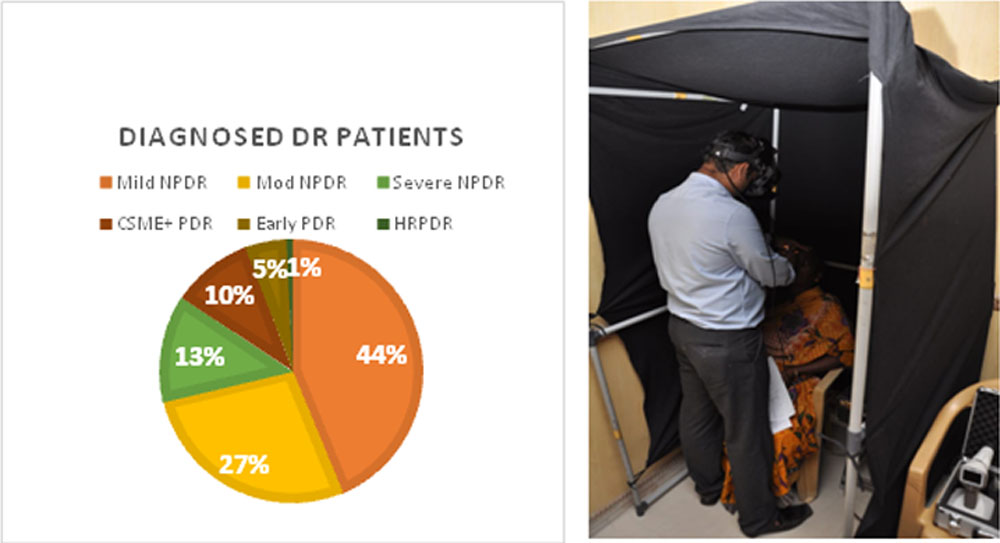
Totally 20273 patients from normal population have been screened. Among them 10563(52%) were detected as having diabetics. No. of known diabetics-10224; new diabetics-254; Among them total diabetics only 975 (9%) patients had retinopathy. Mild NPDR- 418(44%); Moderate NPDR-264(27%); severe NPDR-130(13%);early PDR-48(5%) ; HRPDR-6(1%); 372 (33%) patients were referred for further interventions to base hospital out of the total diabetic retinopathy patients. All other parameters year wise has been given in table one.
| 2015 | 2016 | 2017 | |
| No. of patient screened | 7175 | 6983 | 6115 |
| Known diabetics | 3335 | 3287 | 3602 |
| New diabetics | 125 | 129 | 85 |
| Total DR screened | 376 | 258 | 341 |
| No. of referred patients | 89 | 111 | 127 |
| No. of follow up patients | 49 | 45 | 62 |
| Compliance rate | 55% | 41% | 44% |
Discussion
This study (2015-2017) shows that the compliance rate of diabetic retinopathy screening camps is 47.7%(hospital attending diabetic retinopathy patients among referred diabetics in camps)A similar trend is observed also in a study by Swati Agarwal et al.15 in which the response rate is 51%. This low rate of compliance in follow-ups of diabetic retinopathy screening has implicationsfor quality of life of patients with diabetes, long term costs of caring for them and social costs due to lost productivity. Interventions to increase compliance rates are needed and should cater the patient needs.
Prevention is the main component in a health care system. On talking about the prevention of DR related vision pathologies,We suggest that factors associated with adherence to vision care guidelines may be grouped into four distinct categories: 1)effective screening methodologies 2)Integrated referral chain system; 3) participant demographics & values; and 4) diabetes education program
1) Effective screening methodologies:
A total of 169 camps being conducted in northern Tamilnadu and total no. of people being screened amounts to 20,273 over a span of 3 years. No.of diabetics identified is 10563 which is 52.1%. A recent study on prevalence of diabetes in tamilnadu (The chennai urban and rural epidemiology study) states only 30.1% prevalence16.Hence our camps are effective in addressing maximum diabetic patients and reducing their burden in visiting hospital for check-up. Table 1 shows the relative figures for each in every year.
2) Integrated referral chain system:
In our study, patients were referred with referral slips to nearby base hospital. Patients who fail to attend were being strictly reminded by our counsellor and being educated about its importance. Yet, the compliance rate is poor. On the contrary, in a study by Rani Raman Sharma et al.14 a high response rate of 94.3% of those who referred to attend base hospital was observed.
Upon analysing, the factors responsible for such high compliance rate are associated with,
a)Free transportation to base hospital, b)Free food arrangements, c) rapport with NGO’s viz., Lions club, Self-help groups, Locally influential peoples, and mainly, d) involvement of primary care physicians/GPs/ Diabeticians/ allied hospital workers and health care professionals.
It suggests that contact with a Primary Care Physicians/ general practitioners/ Diabeticians/ multipurpose workers and village health nurses may indeed be the most important factor associated with increased compliance. They are the first point of access for patients with DM. An increase in interaction with local physician rise the opportunities to educate the patient, and complete care under one-roof. A similar results also seen in a study by Brechner et al. and Mukamel Bersnick et al.10
Patients who have already spent several hours in the diabetic clinic may not want to spend more time waiting for an eye examination. Eye examination would be much more convenient if patients who wanted to attend the eye clinic that day had their eyes dilated in the diabetic clinic, avoiding the additional wait in the eye clinic 11. Hence an integrated network in target areas involving local physicians & clinics, Health care professionals, NGOs provides excellent yield.
3) Patient demographics & values:
In our study, Patient who did not come for follow up were given remainder calls and asked about hindrance factors for not showing up; which are,: a) economic and logistic factors, b) unawareness of specific eye complications, c) poor motivation, d) fear, e) choice over quacks and native medicine, and f)priorities over other things.
People residing in difficult areas/hills find it difficult in transportation. In the study by Rani Raman Sharma et al14 we have seen, Arrangements of free logistics and food resulted in a high response rate. Also, a outreach DR screening camp in most difficulty areas/hills can be panned to increase the screening rate in hilly/outreach population.
Traditionally, retina specialists and general ophthalmologists have provided screening for diabetic retinopathy; however, alternative approaches, including the use of other health care providers and retinal cameras, have recently emerged12. Studies have shown that the sensitivity and specificity of retinopathy screening by optometrists, internists, diabetologists and nurses are extremely variable and generally lower than the rates achieved by general ophthalmologists and retina specialists.One alternative with sensitivity and specificity parallel to the rates with traditional screening is screening with a retinal camera.8
A photographic system has advantages over the specialist-based model. First, technicians can perform camera screening. Second, a camera can be flown to an isolated community. Third, images can be archived to permit comparison over time 9
From the perspective of the healthcare system the camera program was preferable to the specialist-based program in terms of cost-effectiveness.7 also in developing countries where no. of retinal specialist /no.of patient at risk of DR, ratio is low such techniques can be used for mass screening12
4) Diabetic education:
Indeed the most important intervention needed in changing the response rate is proper and continuing education to people at risk. By eliminating unnecessary fear, and providing required motivation we can achieve improvement. Support from government organizations, involving NGOs in spreading awareness results higher response rates
Conclusion
The prevalence of diabetic retinopathy in general population is expected to increase substantially by 2020, driven by an increasing prevalence of diabetes mellitus over time with the ageing population of India.In the present study , data shows us, the prevalence of referable Diabetic Retinopathy(mild and moderate NPDR) is much lesser – (29%) than Non-referable diabetic retinopathy(Severe NPDR, CSME+PDR, Early PDR, HR PDR)- (71%). Eventhough
all diabetics need an annual or semi-annual eye check-up, DR screening camps assess all diabetics (new and old) in their respective living places and reassure non – referable DR patients with strict follow-up and refer patients with severe DR to base hospital only for intervention. This reduces the people’s necessity to go for frequent eye check-up at hospitals; especially people living in remote town. They can avail an early and easy access to tertiary care at their door steps. In another way, it also motivates diabetics and patients with non-referable DR
,who just need fixed follow-ups rather than a intervention, and that concerned specialist opinion too availing in their nearby places; so they are self-motivated to present for follow-up in further DR screening camps.
With this, we can conclude, diabetic retinopathy screening camps are effective in a way that, they efficaciously able to screen and identify prevalent Diabetic retinopathy among population and improving compliance of Non-referable DR.
But this data also states us, compliance of referable diabetic retinopathy patients caught up at camps,needs to be improved;which in turn stresses us to make a perfect diabetic screening programme with its quality maximized by improving compliance of referred DR patients. In this regard, targeted mass screening at outreach/hilly/most difficult areas
with help alternative screening technology like retinal camera for cost effectiveness, integral chain of referral system, and more awareness programme on Diabetes and diabetic retinopathy with help of Govt. Organisation, NGOs, volunteers, and self-help groups , shall be considered. Major challenge for an eye care programme is to ensure compliance in follow-up. If we are able to overcome it, effectiveness of the screening programme will be fruitful.
References
- Wild S, Roglic G, Green A, Sicree R, King H. Global prevalence of diabetes: estimates for the year 2000 and projections for 2030. Diabetes care. 2004; 27(5):1047-53.
- Klein R, Klein BEK. Vision disorders in diabetes. In: National Diabetes Data Group. Diabetes in America, 2nd ed. Bethesda, MD: National Institutes of Health, National Institute of Diabetes and Digestive and Kidney Diseases, 1995; chap. 14, NIH Publication No. 95-1468.
- Diabetic Retinopathy Study Research Group. Photocoagulation treatment of proliferative diabetic retinopathy: clinical application of Diabetic Retinopathy Study (DRS) findings, DRS Report Number 8. Ophthalmology. 1981; 88(7):583-600.
- Early Treatment Diabetic Retinopathy Study Research Group. Photocoagulation for diabetic macular edema. Arch ophthalmol. 1985; 103:1796-806.
- American Academy of Ophthalmology. Diabetic Retinopathy Preferred Practice Pattern. San Francisco: American Academy of Ophthalmology, 1998.
- Diabetic Retinopathy. American Diabetes Association. Diabetes Care 2000; 23(Suppl):S73– 6.
- Maberley D, Walker H, Koushik A, Cruess A. Screening for diabetic retinopathy in James Bay, Ontario: a cost-effectiveness analysis. Canadian Medical Association Journal. 2003; 168(2):160-4.
- Hammond CJ, Shackleton J, Flanagan DW, Herrtage J, Wade J. Comparison between an ophthalmic optician and an ophthalmologist in screening for diabetic retinopathy. Eye. 1996; 10(1):107-12.
- Klein R, Klein BE, Neider MW, Hubbard LD, Meuer SM, Brothers RJ. Diabetic retinopathy as detected using ophthalmoscopy, a nonmyciriatic camera and a standard fundus camera. Ophthalmology. 1985; 92(4):485-91.
- Mukamel BD, Bresnick HG, Wang Q, Dickey FC. Barriers to compliance with screening guidelines for diabetic retinopathy. Ophthalmic epidemiology. 1999; 6(1):61-72.
- Schoenfeld ER, Greene JM, Wu SY, Leske MC. Patterns of adherence to diabetes vision care guidelines: baseline findings from the Diabetic Retinopathy Awareness Program. Ophthalmology. 2001; 108(3):563-71.
- Singer DE, Schachat A, Nathan DM, Patz A, Kahn R, Alello LM, Smith R, Mazzaferri EL, Kreisberg RA, White LJ. Screening guidelines for diabetic retinopathy. Annals of Internal Medicine. 1992; 116(8):683-5.
- Mumba M, Hall A, Lewallen S. Compliance with eye screening examinations among diabetic patients at a Tanzanian referral hospital. Ophthalmic epidemiology. 2007; 14(5):306-10.
- Rani PK, Raman R, Sharma V, Mahuli SV, Tarigopala A, Sudhir RR, Kumaramanickavel G, Sharma T. Analysis of a comprehensive diabetic retinopathy screening model for rural and urban diabetics in developing countries. British Journal of Ophthalmology. 2007; 91(11):1425-9.
- Agarwal S, Mahajan S, Rani PK, Raman R, Paul PG, Kumaramanickavel G, Sharma T. How high is the non-response rate of patients referred for eye examination from diabetic screening camps?. Ophthalmic Epidemiology. 2005; 12(6):393-4.
- Raman R, Rani PK, Rachepalle SR, Gnanamoorthy P, Uthra S, Kumaramanickavel G, Sharma T. Prevalence of diabetic retinopathy in India: Sankara Nethralaya diabetic retinopathy epidemiology and molecular genetics study report 2. Ophthalmology. 2009; 116(2):311-8.
Leave a Comment