

Dr. SHYLESH DABKE, Dr. LITTA GEORGE, Dr. Devendra Maheshwari, Dr. HIMANI JAMOD
Abstract
Purpose
To study the effectiveness of Mid level ophthalmic personnel (MLOP) at Vision Centres (VC) in opportunistic screening for glaucoma in rural India.
Methods
Retrospective chart review was done of all glaucoma referrals from MLOP at 13VC associated to our tertiary hospital during year 2016. All patients had undergone comprehensive eye examination by MLOPs. Patients with any of the following: intraocular pressure > 21mmHg, shallow anterior chamber (Van Hericke ≤ 2), suspicious optic disc were referred to the base hospital. Data was analysed with respect to the diagnosis and response rate at the hospital.
Results
Out of 342 referrals, 257 cases were evaluated with rest cases excluded either due to these being a diagnosed cases needing routine follow up or having a positive family history with normal ophthalmic evaluation at VC. Shallow anterior chamber was most common cause for referral(48%). 49 cases were discharged accounting to a false positive rate of 19%.Primary angle closure suspect was the most common diagnosis arrived at. Response rate for three parameter for referral i.e. shallow anterior chamber, raised IOP and suspicious optic disc were 81%, 24% and 70% respectively.
Conclusions
Importance of screening in glaucoma cannot be undermined. Population based screening are not cost-effective. VC caters in rural areas and by conducting glaucoma screening a large section of the rural population at risk of glaucoma can be reached. In the presence of limited economic resources VC can be used for opportunistic glaucoma screening and help reduce the burden of disease.
Key Words: Mid level ophthalmic personnel, Vision centre , Screening
Introduction
Glaucoma is the leading cause of irreversible blindness worldwide[1] and, once diagnosedrequires lifelong monitoring. The disease is more prevalent with advancing age and with our increasingly aging population[2]the number of glaucoma cases is only set to increase.[3]Deteriorating vision or the presence of other symptoms are the most common reasons why people seek an eye examination,[4]which may work against early diagnosis of glaucoma which is commonly unnoticeable to the individual. Early detection and timelytreatment are important in order to delay diseaseprogression and prevent visual impairment.[5]However, it is estimated that half of prevalent glaucoma cases are undetected.[6]Primary eye care for rural population catered by Mid level ophthalmic personnel (MLOP) at Vision centre (VC) may act as an important source of referrals for suspected cases of glaucoma. This common condition is insidious and diagnosis in the asymptomatic stage is vital if the patient has to benefit from early treatment.[7]To the best of our knowledge, this is the first study evaluating the effectiveness of MLOP’s at VC in opportunistic glaucoma screening for rural population which would otherwise be difficult to access and help reduce the burden of disease.
Method
In this study a retrospective case review was done on all the referrals received at our tertiary eye care centre from MLOP’s at 13 associated VC’s. At our hospital we have an in house referral triage service which runs as a synchronous virtual clinicin which patient and clinician interacts in real time via a webcam. Before this MLOP perform ophthalmic evaluation of the patient which also includes anterior chamber depth assessment using Van Hericke grading, Intraocular pressure (IOP) measurement using goldmann applanation tonometery and dilated indirect fundoscopy to look for suspicious optic disc. Apatients with any of the following: intraocular pressure > 21mmHg, shallow anterior chamber (Van Hericke ≤ 2) and suspicious optic disc are discussed about with the general ophthalmologist in virtual clinic. Patients who are deemed to be in need for further evaluation are referred to the base hospital with a referral letter mentioning all the findings of MLOP. These referred cases are then evaluated by glaucoma consultant at the base hospital.
Purpose of this study is to describe quality of these referrals from MLOP retrospectively and to look for degree of agreement between the examination by MLOP and glaucoma consultant ophthalmologist.
Statistical analysiswas performed using Microsoft excel 2010(Redmond, WA, USA).
Results
For a duration of one year (2016) our tertiary eye care centre received a total of 342 glaucoma referrals from mid level ophthalmic personnel associated thirteen vision centres. Of these 12 referrals were excluded from the study in view of insufficient documentation in the referral letter or some of these cases had a normal ophthalmic evaluation and were referred in view of positive family history. 73(22%) of these referrals were diagnosed cases of glaucoma which were referred for evaluation as per there scheduled follow up. Only the reminder of the 257(78%) referrals were further evaluated in this study to know the effectiveness of MLOP with respect to their glaucoma referrals.
Of the parameters for referrals shallow anterior chamber was the most common cause for referral followed by suspicious optic disc and increased IOP. (Figure1)
49 of the 257 referrals evaluated were discharged accounting to a false positive rate of 19%.
Primary angle closure suspect was the most common diagnosis noted with proportion of other diagnosed cases as shown in figure 2.
166(65%) cases required intervention in the form of either initiation of antiglaucoma medication or laser peripheral iridotomy or surgical intervention whereas 42(16%) cases required follow up with regular monitoring.
Table 1 depicts outcomes of patients who were evaluated.
Shallow anterior chamber
A total of 124 referrals were due to shallow anterior chamber of which on evaluation at base hospital, 101(81%) were found to have occludable angles on goniioscopy.
Suspicious Optic Disc
Of the 87 cases referred with suspicious optic disc, 61(70%) cases were found to glaucomatous optic disc changes on evaluation at base hospital.
Raised Intraocular Pressure
Of the46 cases referred with raised intraocular pressure, on evaluation at base hospital only 11(24%) were found to have raised intraocular pressure above 21mmHg.
Discussion
Screening for glaucoma is made much more difficult as there is no single ‘simple, safe, precise and validated screening test’ available as defined by the 1998 UK National Screening Committee. Using this definition, most screening programmes fall short of the standards required.[8] Moreover, opinions vary as to what the current gold standard is for the diagnosis of glaucoma. One of the most widely accepted methods to detect and assess glaucoma is to perform a comprehensive eye examination for all patients who attend the clinic irrespective of the complaints they present with.[9]
The Royal College of Ophthalmologists have acknowledged the difficulties of applying gold standard screening principles for the detection of glaucoma and asserted that ‘any formal screening programme will not identify every subtle glaucoma at a stage at which a glaucoma specialist might identify the disorder’.[10]Despite this, efforts must be made to adhere as closely as possible to these principles, and we believe the CGRS fulfils these recommendations. In this study which is first of its kind evaluating the effectiveness of MLOP’s in opportunistic screening for glaucoma we have addressed two issues as mentioned above pertaining to glaucoma screening and diagnosis, that is to assess for glaucoma during comprehensive eye examination which is done by MLOP at VC and the other one being referral to glaucoma specialist to identify subtle glaucoma at early stage which is done at our base hospital.
Virtual clinics like ours are not new to glaucoma screening or monitoring.[11,12] ‘false positives’ are defined as those cases that were referred andwere not defined as suffering from glaucoma or glaucoma suspect. In our study we had a false positive rate of 19%, which is lower than that reported by other studies (20–65%).[13–19]
Trikha et al,[20] whereby community-based optometrists collect clinical information, but the decision of ‘normal’ or ‘suspect’ is made by a consultant ophthalmologist is one study similar to ours. as state earliest this study is first of its kind hence the only studies done in European nations are the only one available for cross referencing.
Optometrists are a highly skilled group of professionals whose ophthalmic examination skills could be utilized to provide shared glaucoma care and release capacity in the tertiary setting for more complex glaucoma management.
Glaucoma prevalence is set to rise due to an ageing population. There is consensus among experts that early diagnosis is of high importance, both for patient quality of life and to alleviate pressure on secondary care services. With more research, targeted population screening may offer a cost effective and feasible alternative to opportunistic case-finding. This study represents one possible configuration for a glaucoma case-finding service.
Referrences
- Tham YC, Li X, Wong TY, Quigly HA, Aung T, Cheng CY. Global prevalence of glaucoma and projections of glaucoma burden through 2040: a systematic review and metaanalysis. Ophthalmology 2014; 121: 2081–2090.
- Department of Work and Pensions. Focus on Older People. Office of National Statistics, 2005. Available from: https:// www.statistics.gov.uk/cci/nugget.asp?id = 1352 (accessed 14 January 2015).
- Tuck MW, Crick RP. The projected increase in glaucoma due to an ageing population. Ophthalmic Physiol Opt 2003; 23(2): 175–179.
- Leamon S, Hayden C, Lee H, et al. Improving access to optometry services for people at risk of preventable sight loss: a qualitative study in five UK locations. J Public Health 2014;36:667–673
- Maier PC, Funk J, Schwarzer G, et al. Treatment of ocular hypertension and open angle glaucoma: metaanalysis of randomised controlled trials. Br Med J 2005;331(7509):134.
- Quigley HA, Broman AT. The number of people with glaucoma worldwide in 2010 and 2020. Br J Ophthalmol 2006;90:262–267.
- Collaborative Normal Tension Glaucoma Study Group. Comparison of glaucomatous progression between untreated patients with normal tension glaucoma and patients with therapeutically reduced intraocular pressures. Am J Ophthalmol 1998; 126: 487–497.
- Hernandez A, Rabindranath K, Fraser C, Vale L, Blanco AA, Burr JM. Screening for open angle glaucoma: a systematic review of cost-effectiveness studies. J Glaucoma 2008; 17: 159–168.
- Thomas R, Parikh R, Paul P, Muliyil J. Population based screening versus case detection. Ind J Ophthalmol 2002; 50: 233–237.
- National Eye Care Service Steering Group 2004. https://www.vision2020uk.org.uk/core_files/220404eyecare%20report.doc.
- Wright HR, Diamond JP. Service innovation in glaucoma management: using a web-based electronic patient record to facilitate virtual specialist supervision of a shared care glaucoma programme. Br J Ophthalmol 2015; 99(3): 313–317
- Kotecha A, Baldwin A, Brookes J, Kotecha A. Experiences with developing and implementing a virtual clinic for glaucoma care in an NHS setting. Clin Ophthalmol 2015; 9: 1915–1923.
- Harrison RJ, Wild JM, Hobley AJ. Referral patterns to an ophthalmic outpatient-clinic by general-practitioners and ophthalmic opticians and the role of these professionals in screening for ocular disease. Br Med J 1988; 297: 1162–1167.
- Clearkin L, Harcourt B. Referral pattern of true and suspected glaucoma to an adult ophthalmic outpatient clinic. Trans Ophthalmol Soc UK 1983; 103: 284–287.
- Theodossiades J, Murdoch L. Positive predictive value of optometrist-initiated referrals for glaucoma. Ophthalmichysiol Opt 1999; 19: 62–67.
- Vernon SA. The changing pattern of glaucoma referrals by optometrists. Eye 1998; 12: 854 857.
- Bell RWD, OBrien C. The diagnostic outcome of new glaucoma referrals. Ophthalmic Physiol Opt 1997; 17: 3–6.
- Bell RWD, OBrien C. Accuracy of referral to a glaucoma clinic. Ophthalmic Physiol Opt 1997; 17: 7–11.
- Tuck MW, Crick RP. Efficiency of referral for suspected glaucoma. Br Med J 1991; 302: 998–1000.)
- Trikha S et al. The Portsmouth-based glaucoma refinement scheme: a role for virtual clinics in the future? Eye (Lond) 2012; 26(10): 1288–1294
Table 1 – Final Outcome of all the referred cases
| Outcome | n(%) |
| Intervention | 166 (65%) |
| Monitoring | 42 (16%) |
| Discharged | 49 (19%) |
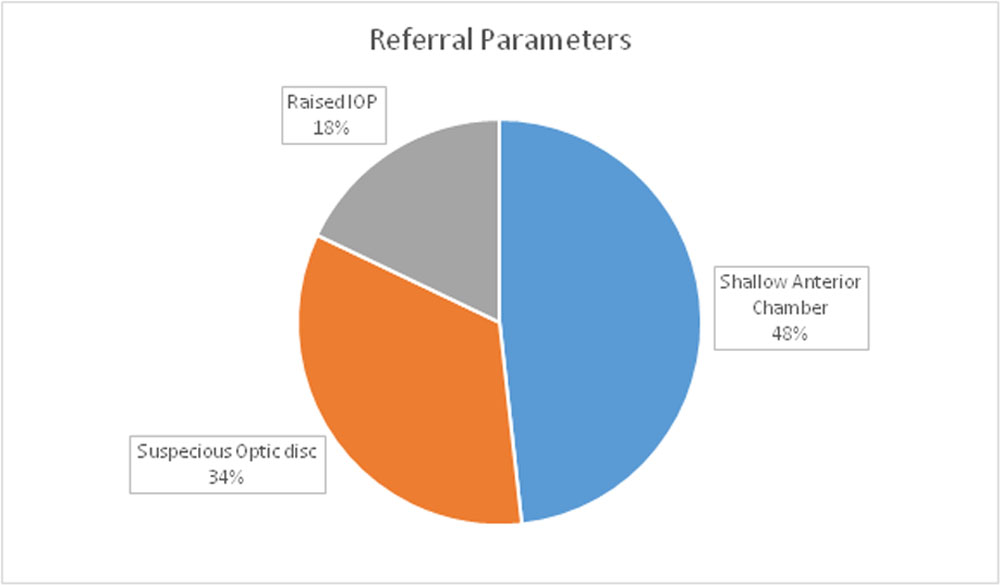
Figure 2 – Diagnosis arrived at
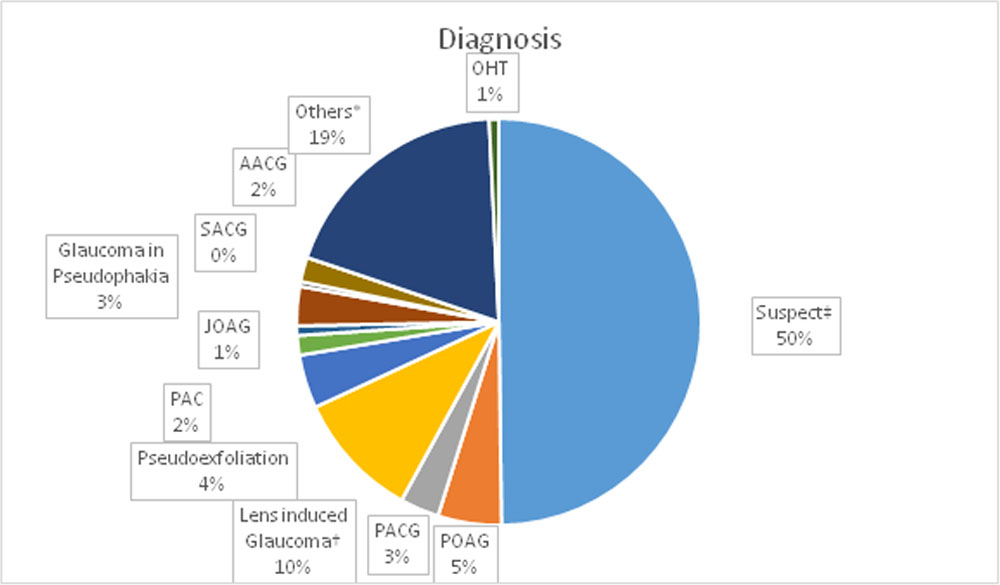
*- Presbyopia, Refractive errors, Age related lenticular changes etc.
†-Phacolytic glaucoma, Phacomorphic glaucoma.
‡- Primary open angle suspect, Primary angle closure suspect.
-Pseucoexfoliation syndrome, Pseudoexfoliation glaucoma.
OHT-ocular hypertension, AACG-acute angle closure glaucoma, SACG-secondary angle closure glaucoma, JOAG-juvenile open angle glaucoma, PAC-primary angle closure, PACG-primary angle closure glaucoma, POAG-primary angle closure glaucoma.
Leave a Comment