

Dr.John Davis Akkara,Dr.Anju Kuriakose,Dr.Devika Bhattacharya,Dr.Davis J Akkara
Abstract
India is a large and diverse country where people travel to study and work. Doctors and patients have to travel across language barriers to get the training and the treatment that they need. The authors noted the unmet need of simple language translator apps for few contextual translations that ophthalmologists and optometrists need to know in multiple languages. The authors used their basic mobile software programming skills to make a few Indian regional language translator apps to help ophthalmic personnel to transcend the language barrier painlessly. This improves the doctor-patient rapport and prevents misunderstanding of patient symptoms and history, and of doctors advice and treatment.
Key Words
Languages, patients, tamil, telugu, malayalam, bangla, translator
Body of the Manuscript
Introduction
India is a rich and diverse, multilingual country with 23 official languages and 122 major languages. Doctors have to speak and interact with patients and often study and work in different parts of the country where the language is not one that they know. Many young doctors struggle with language during their residency and are able to devote less time to learning medicine, diagnosis and treatment.Often, they miss clues from patient’s Case History simply because they could not understand the nuances of the language. Offline resources available now include dictionaries and “Learn this language in 30 days” books. But, the most useful and effective were small notebooks with common questions, phrases and answers written by new doctors learning the language from colleagues and nurses in the Outpatient Department
Methods
The authors used Phonegap App making framework to make simple Smartphone Apps1 to help ophthalmologists communicate with patients in their native language to take Clinical History, do Eye Examination and Counsel for treatment. Questions, Answers, Phrases and common words were translated into the regional language and then transliterated into English to allow the user to speak them.These were arranged into various pages based on context such as :
- History Taking
- Slitlamp Examination
- Treatment Counselling
- During Anesthetic Block
- During Surgery
- Postop Instructions
Questions and Expected answers were arranged such that natural flow of language was not interrupted. Started with one language first – Tamil. Previously made handbooks were found and more relevant phrases added. This data was made into an App by the author using Phonegap and uploaded in Google Play Store as “Eye Know Tamil”. Ophthalmologists were encouraged to use the App by searching for “Eye Know Tamil” or “Eye Know Bangla” in Play Store or directly downloading from a link
https://play.google.com/store/apps/details?id=com.fundazone.eyeknowtamil
https://play.google.com/store/apps/details?id=com.fundazone.eyeknowbangla
Feedback was received on corrections, design, rearranging, adding pages, and for adding more translations. Changes were incorporated and App updated accordingly. Based on feedback and requests, other language Apps were also made and are being updated, namely – Eye Know Bangla, Eye Know Telugu, Eye Know Malayalam, Eye Know Hindi and so on.
Results
Apps evaluated were tested for their usability, time saved and help in patient interaction. The Apps were found to be useful for doctors very new to the target language. Pronunciation of the transliterated words were sometimes confusing. It was easier for doctors who had been explained the pronunciation of words a few times. Arrangement of words in pages based on context was more convenient than a single page search option. Doctors who knew Malayalam found it easier to read the Tamil and vice versa, compared to those who knew Telugu or Hindi. After a few weeks of use, doctors were able to manage without the app except for occasional recall.
Discussion
Language difficulty2 is a problem experienced by several medical personnel studying and working out of their native region especially in India.
Not Knowing the Language3 is one problem that makes effective diagnosis and treatment difficult. It does not affect other professions like engineers and other jobs where people interaction is less. This is 4more common in a country like India, where so many languages co-exist. Native Language of the place is one criteria that affects medical students5 when they select a college for their education and a hospital for their practice. It restricts their full potential because it is difficult to learn a new language and a new subject while communicating effectively in a new place.
Questionnaires6 are often translated in to other languages7 and then validated8 to make sure that the message is conveyed correctly. Vision testing charts2 need to be translated to regional languages for best evaluations.
Small, Simple Apps are useful for helping short Doctor-Patient interactions6 in regional languages. These help doctors and medical personnel new to the regional language converse effectively9 smoothening the learning curve. There is a need for language learning in addition to medical training for good doctor-patient relationship.
References
- Innovative smartphone apps for ophthalmologists Akkara JD, Kuriakose A – Kerala J Ophthalmol [Internet]. [cited 2018 Oct 15]. Available from: https://www.kjophthal.com/article.asp?issn=0976-6677;year=2018;volume=30;issue=2;spage=138;epage=144;aulast=Akkara
- Sengupta S. Vision assessment in regional Indian languages. Indian J Ophthalmol. 2018;66(5):617–8.
- Nesher R, Ever-Hadani P, Epstein E, Stern Y, Assia E. Overcoming the language barrier in visual field testing. J Glaucoma. 2001 Jun;10(3):203–5.
- Sailoganathan A, Osuobeni EP, Siderov J. A standardized logarithm of the minimum angle of resolution visual acuity chart in Hindi. Indian J Ophthalmol. 2018;66(5):634–40.
- Shimizu GKM, Wedy GF, Schaefer LV, Ramos PM, Miot HA. Translation into Portuguese language (Brazil), transcultural adaptation and validation of the quality of life questionnaire in female pattern hair loss (WAA-QoL-BP). An Bras Dermatol. 2018 Oct;93(5):701–6.
- Adnan TH, Mohamed Apandi M, Kamaruddin H, Salowi MA, Law KB, Haniff J, et al. Catquest-9SF questionnaire: validation of Malay and Chinese-language versions using Rasch analysis. Health Qual Life Outcomes. 2018 Jan 5;16(1):5.
- Srinivasan K, Krishnan G, Wilkins A, Allen P. Reliability and validity of a Kannada rate of reading test. Indian J Ophthalmol. 2018;66(5):630–3.
- Negiloni K, Mazumdar D, Neog A, Das B, Medhi J, Choudhury M, et al. Construction and validation of logMAR visual acuity charts in seven Indian languages. Indian J Ophthalmol. 2018;66(5):641–6.
- Gillen P, Sharifuddin SF, O’Sullivan M, Gordon A, Doherty EM. How good are doctors at introducing themselves? #hellomynameis. Postgrad Med J. 2018 Apr;94(1110):204–6.
Figure 1 :Page from Tamil Language Translator App for Ophthalmologists – Eye Knoe Tamil
Figure 2 :Front page of “Eye Know Bangla” App
Figure 3 :Page for Slitlamp Instructions to patient
Figure 4 :Bangla/Bengali Language page for Patient Introduction
Figure 5 :Book available for Learning Tamil
Figure 6 :Free Apps by the authors available in Google Play store
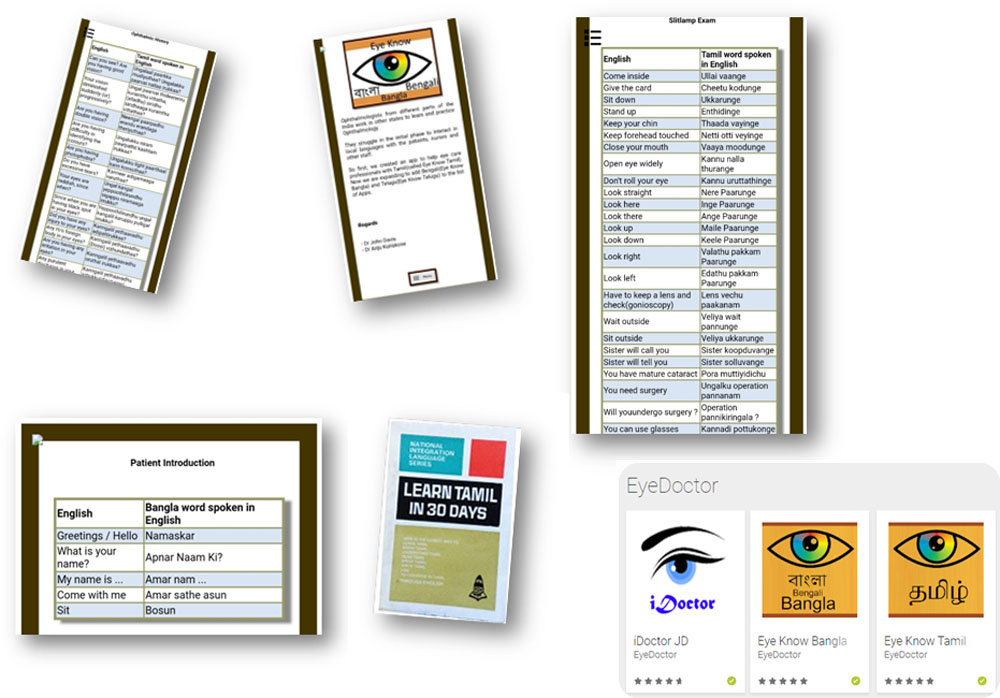
Figure 1 :Page from Tamil Language Translator App for Ophthalmologists – Eye Knoe Tamil
Leave a Comment