

Dr.Kaushik Murali,Dr.Kamala Subramanian,Dr.Shruthi Tara
Purpose:
Evaluate a new champion driven model for quality assurance in eye hospitals.
Methods:
Unique Person-Process Quality Assurance Model with trained Quality Champion implemented across network of eye hospitals.NABH accredited & ISO certified hospital considered benchmark.Effectiveness measured on NABH self-assessment toolkit, time motion analysis of Code Blue Events, infection control adherence & new initiatives during Quality month.
Results:
While benchmark hospital scored 97.60% on NABH compliance, others scored 93.4%, 90.06% & 96%.Code Blue response improved in the units from 115 seconds to 60 seconds.All completed 100% of tasks for World Quality Month.No correlation between role ( IT Manager, Ophthalmologist, Laboratory Technician) of Quality Champion & outcome.
Conclusion:
Quality Assurance in eye hospitals can be ensured with a model that combined protocol implementation with a Quality Champion ensuring monitoring,capacity development & advocacy to accreditation standards
Introduction:
Quality assurance has been an integral part of manufacturing industry with concepts such as Lean, 5S and kaizen being entrenched as part of their routine functioning.
Today we have moved to an experience economy[1] and the same is felt even in health care.Quality management systems in healthcare aim to improve health outcomes, patient experiences and efficiency of service delivery as well as job satisfaction of al staff involved across the world.[2]
As our organisation grew, we realised that the awareness amongst staff was poor about quality and was limited largely to outcome measurements. This resulted in issues related to certain departments going unaddressed. There was a time lag in mock drills and knowledge of specific infection control measured and documentation was inadequate.
However it is important to acknowledge that the term “quality” defies a single accepted definition and its interpretation would vary based on the perspective of the clinician, patient, family or health system administrator. The most quoted definition remains that Donabedian[3]where it is described as the degree of agreement between the care that is actually provided and previously stated criteria or demands.
As an organisation there was a strategic direction to adhere the National Accreditation Board of Hospitals standards as laid by the Quality Council of India to enable benchmarking with other hospitals. A quality officer was recruited to champion this effort at our centre in Bengaluru. As we looked to scale rather than recruit a quality officer at each centre, we followed a counter-intuitive path of nominating one of the line staff as the Quality Champion rather than making it process bound.
The paper looks to explain the SanQALP model and also evaluate its effectiveness
Materials & Methods:
SanQALP(Sankara Assurance Learning Programme) Model: SanQALP (Figure 1) at its core an employee who believed in the purpose of the organisation being recognised amongst the world leaders in providing best quality of eye care. The Quality Champion was identified through interactions with the author and the quality officer recruited. The model had as pillars The balance score card, the benchmarking through accreditation and institution of quality improvement. (figure 1)
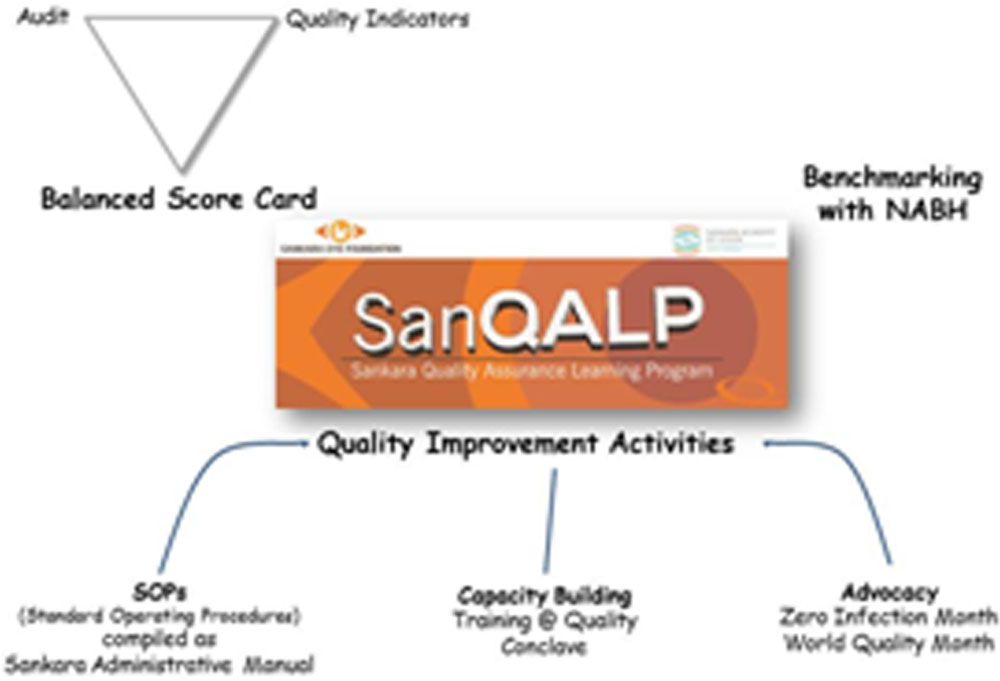
Figure 1– SanQALP model
The balanced scorecard [4] is a tool that translates an organization’s mission and strategy into a comprehensive set of performance measures that provide the framework for a strategic measurement and management system. The scorecard measures organizational performance across four balanced perspectives: financial, customers, internal business processes and learning and growth.Balance Score Card has been in use in the organisation since 2009 and provided a visual tool for benchmarking the various indicators.
The champion was empowered with information on various standard operating procedure through a consolidated document (Sankara Administrative Manual) and invited to participate in a biannual quality conclave with experts to empower them on various aspects of implementation.
Rather than enforce quality the model looked at advocacy and empowerment with every success being celebrated (infection control month a cake being cut etc) and various calendarised events having specific and visible events – safety week , hand hygiene week etc.
The NABH self-audit tool was used as a guide to benchmark the implementation of Quality across hospitals. Units at Bengaluru, Shimoga, Ludhiana and Coimbatore were asked to conduct an audit. Specific aspects of infection control (hand hygiene and biomedical waste segregations compliance) , contingency readiness (code blue response time) and quality improvement culture ( clinical audit compliance) . These were repeatedafter a period of 12 months after implementation of this model. For the purpose of analysis Bengaluru was taken as the benchmark unit.
Results :
Only one centre Bengaluru had a qualified hospital administrator as the Quality Officer , the other centres had Quality Champions identified from the existing pool and they were ranging from Ophthalmologist, Laboratory Technicians to the Information Technology Manager play the role of Quality Champion.(Table 1).
Table 1: Quality Champion – Qualification.
| Unit | Qualification of Quality Champion |
| Benagluru | Masters in Hospital Admininstration |
| Coimbatore | Diploma Medical Lab Technology |
| Shimoga | DipNB Ophthalmology |
| Ludhiana | Masters in Computer Application |
The overall compliance analysis across all parameters on implementation of SanQALP showed improvement (Table 2).
Table 2: Overall average compliance analysis for all units.
| Parameters | Before SanQALP | After SanQALP | p value |
| Clinical audit compliance | 86.08% | 90.88% | 0.086 |
| Hand hygiene compliance | 86% | 95% | <0.0001 |
| BMWS compliance | 92% | 98% | 0.001 |
| Patient Satisfaction Score | 94.63% | 97.15% | 0.011 |
| Code Blue Response Time (in sec) | 115 | 60 |
Significant improvement was noted in infection control and response to contingency with the Code Blue Response reducing by 48%.
Coimbatore showed statistically significant improvement in Clinical Audit and Hand Hygiene compliance. Ludhiana showed significant improvement in Bio Medical Waste Segregation. Shimoga showed an improvement that was significant in patient satisfaction.
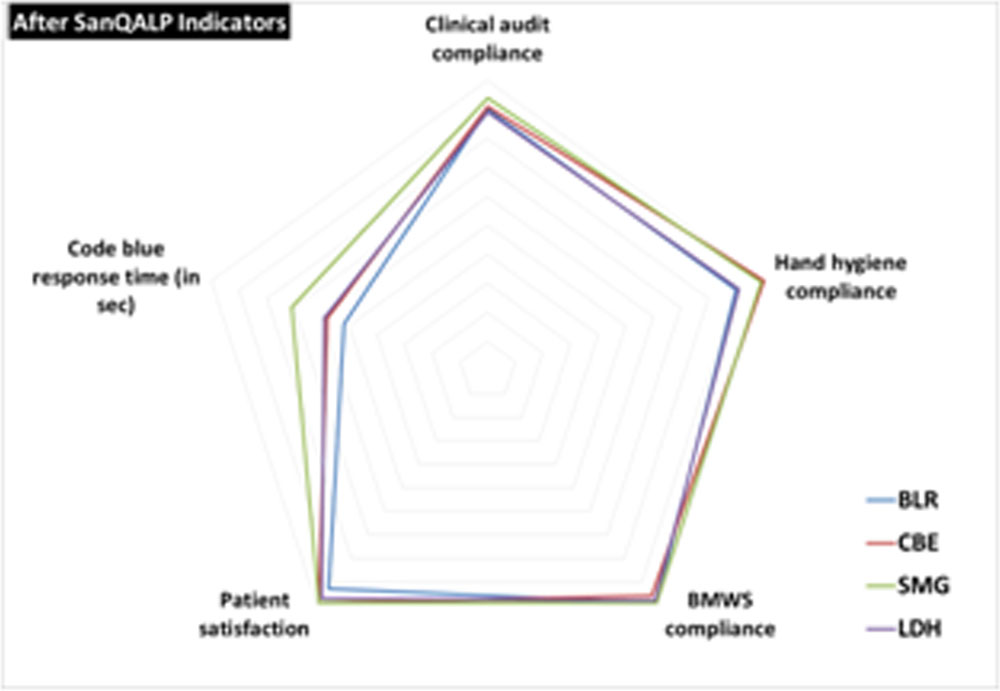
All units on analysis showed at Post Implementation , scores that were not statistically significant from the benchmarked unit (Bengaluru).(Figure 2)
Discussion
Healthcare delivery is a continuum and the opportunity for Quality Control is thus limited to consumables, equipment and medicines purchased. Organisations are faced with rapid advancements in health care process and systems and also increased awareness amongst patients and their family. There is also a desire to have a differentiation from peers.
It is imperative for eye hospitals to implement models of quality assurance as it has been demonstrated that high quality health care systems lead to better health outcomes and improved patient safety. Importance of employee involvement in accreditation and in promoting a culture that supports quality improvement and that allows employees to feel that they have a sense of belonging to the organization.[5]
Through implementing this model we were able to recognise untapped expertise amongst exiting team members. They were further able to learn and accomplish improvements with support and training. Also there is a limitation to which the leadership can push quality implementation. Involvement of the Quality champion recruited from amongst the staff allowed better buy in from the line staff who actually are critical for Quality Improvement to happen.
Accreditation was probably a rallying point and enabled better implementation of the Quality Assurance Programme. This has again been evidenced across the world where there has been a positive correlation between accreditation and quality programmes.[6]
Often by instituting a separate quality department , the ownership of implementation is with them, here as the line staff were involved in the implementation we saw the entire staff rally around them to ensure implementation. For any quality assurance or accreditation programmes to succeed the involvement and commitment of the staff is critical.[7]
While accreditation is a great start as a preliminary goal for hospitals, we have demonstrated that quality assurance in eye hospitals can be ensured with a model that combined protocol implementation with a “Quality Champion”, ensuring monitoring, capacity development & advocacy to accreditation standards.
References
- Joseph Pine II and James H. Gilmore .Welcome to the Experience Economy. Harvard Business ReviewJuly–August 1998
- https://www.woncaeurope.org/content/ws-56-european-practice-assessment-epa-practice-assessment-and-quality-management-indicators
- Donabedian A. The quality of care. How can it be assessed? JAMA,1988;260(12):1743-1748
- Kaplan, R., Norton, D. (1996), The Balanced Scorecard: translating strategy into action, Harvard Business School Press, Boston, MA.
- Ghareeb, Alia, Hana Said, and Mohamad El Zoghbi. “Examining the Impact of Accreditation on a Primary Healthcare Organization in Qatar.” BMC Medical Education18 (2018): 216. PMC. Web. 13 Oct. 2018.
- Baker RG. Survey on continuous quality improvement in health care. Dep Health AdmUniv Tor. 1993
- Greenfield D, Braithwaite J. Developing the evidence base for accreditation of healthcare organisations: a call for transparency and innovation [internet]. BMJ Publishing Group Ltd; 2009
Leave a Comment