

Dr.Bishnupriya Khuntia,Dr.Sumita Mohapatra,Dr.Bishnu Prasad Rath,Dr.Purnima Nanda
INTRODUCTION:
Diabetes Mellitus represents a significant public health issue which has become increasingly prevalent due to changes and trends in diet,lifestyle and consequently the rate of obesity.It causes microvascular damage and vascular dysregulation of retina and optic disc leading to vision loss from Diabetic retinopathy.
In Diabetic retinopathy patients there is increasing evidence to suggest that they are at a greater risk for glaucoma as well. Though pathophysiology of glaucoma is not completely understood both Diabetes and Glaucoma appear to share some common risk factors and pathophysiologic similarities with studies reporting that presence of Diabetes and elevated fasting glucose levels are associated with increased IOP, a risk factor for Glaucoma.
AIM:
To study the role of opportunistic screening of glaucoma in patients attending diabetic retinopathy camp
MATERIALS AND METHODS:
Prospective study was done from July 2017-March 2018 during which total of 908 Diabetic patients mostly from geriatric age groups attended different camps for Diabetic Retinopathy screening. Digital Fundus photographs were taken and graded according to presence/absence or severity of DR
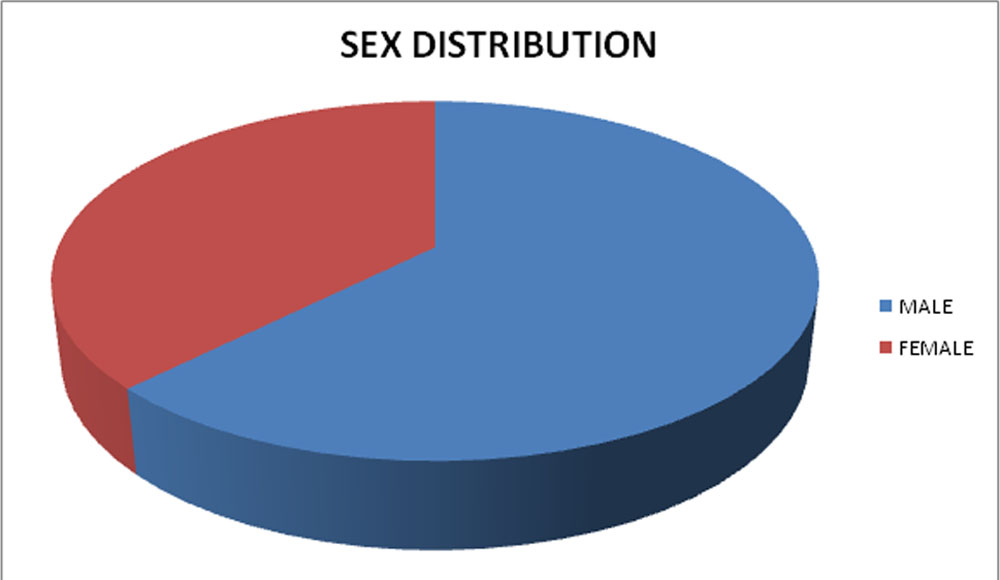
Of 908 patients,177(106 males,71 females)mostly from geriatric age group(50-85yrs) had increased C:D ratio(>0.6:1),IOP measured by NCT and referred to our Glaucoma clinic for further evaluation.86(62 males,24 females)had mild NPDR with glaucomatous OD changes,32(21males,11females)had moderate NPDR with glaucomatous discs and rest 59(36males,23females)had glaucomatous changes in discs but no DR changes. Detailed ophthalmic evaluation including Visual Acquity, IOP by applanation tonometry along with +90D evaluation in Slit lamp was done. Optic disc cupping(vertical C/D ratio) and RNFL average thickness measured with OCT(Heidelberg).Family H/O Glaucoma was also taken.
Presence of glaucoma was established based on presence of two of three parameters-IOP>21mm Hg, increased vertical CDR of>0.6:1, asymmetry between eyes >0.2,Visual field defects on perimetry supported by RNFL thinning on OCT.
STATISTICAL ANALYSIS
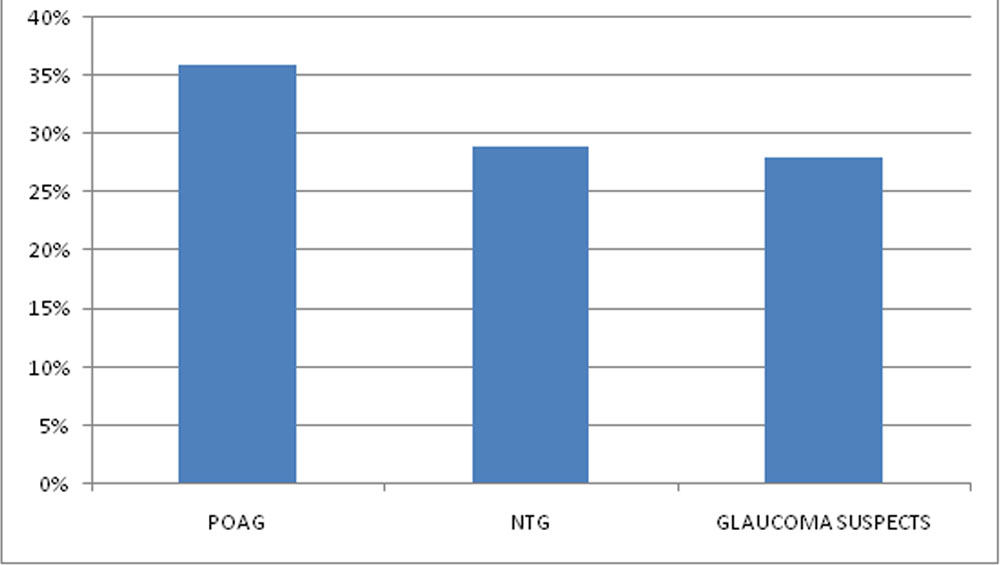
Types Of Glaucoma
RESULTS:
In the above study amongst 177 patients 64(36%) had increased IOP (>21mm Hg),Optic disc changes along with some form of visual field defects on perimetry classified as Primary Open Angle Glaucoma(POAG).52 (29%)patients had glaucomatous disc changes and visual field defects associated with consistently low to normal IOP(<21mm Hg) classified as Normal Tension Glaucoma(NTG).Remaining 51(28%) of which 33 had only increased IOP but no VF changes,18 had suspicious disc changes in the form of asymmetry of C:D ratio(diff>0.2),notching or narrowing of neuroretinal rim or a disc haemorrhage but normal IOP and VF changes. These 51 pts were classified as glaucoma suspects and advised for follow up .
DISCUSSION:
Common Pathophysiologic Mechanisms in Glaucoma And Diabetics
- Diabetes Mellitus is a/w glycation of lipids and abnormalities of lipid metabolism which may increase oxidative stress and promote cellular apoptosis. Similar mechanism of Retinal Ganglion Cell loss also occurs in glaucoma.
- Vascular Mechanisms-Implicated to explain increased risk of Glaucoma in DR patients regardless of IOP levels. Diabetes causes microvascular damage and vascular dysregulation of retina and optic disc thereby causing a reduction of blood flow and impairment of oxygen diffusion.This leads to relative hypoxia with subsequent damage to optic nerve head and RNFL
- Diabetes also impairs physiological glial and neuronal function leading to impairment of retrograde axonal transport,increasing the susceptibility of RGC’s to glaucomatous damage.
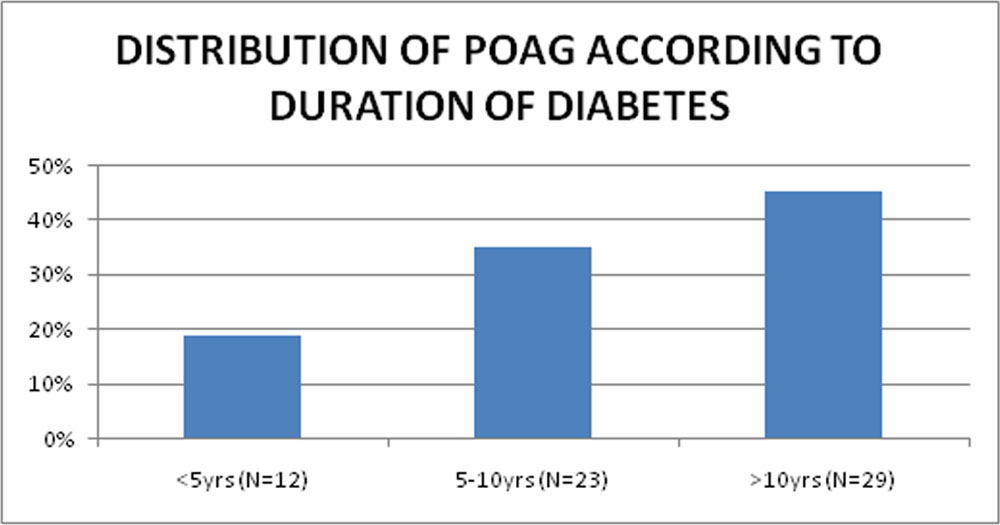
Duration of Diabetes>/10 years is also a risk factor in the development of Glaucoma.
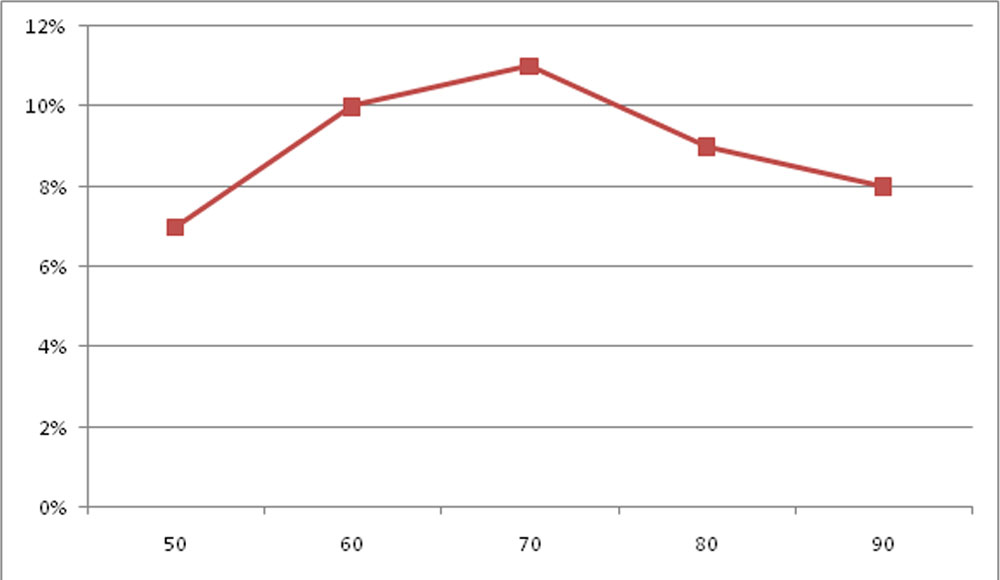
In y-axis- Incidence(%)of Glaucoma,x-axis-Age in years.
CONCLUSION:
On the basis of above findings we found that mild to moderate diabetic retinopathy patients with long standing diabetes (>/10years) were associated with significantly increased risk of POAG .As a consequence assessment and hence thorough evaluation of glaucoma during Diabetic Retinopathy screening camp for signs of optic disc damage should be considered as a strategy to improve case detection and decrease burden of disease in society.
REFERENCES:
Diabetes,Fasting Glucose and risk of Glaucoma(A metaanalyses)By Dizhao,Myung Hun Kim,David and Friedman,American Academy Of Ophthalmology.
- Presence and Risk Factors for Glaucoma in patients with Diabetes.Massachusets Eye Institute,Beetham Eye Institute,Joslin Diabetes Centre
- Should Diabetic patients be screened for Glaucoma?Ellis JD,Morris AD,MacEwen CJ(British Journal of Ophthalmology).
- DielemansI,de Jong PT,Stolk R et al.Primary Open angle Glaucoma,intraocular pressure and Diabetes Mellitus in the general elderly population.The Rotterdam Study.Ophthalmology(1996)
- Chopra V,Varma R,Francis BA et al.Type 2 Diabetes Mellitus and Risk of Open angle Glaucoma:The Los Angles Latino Eye Study.Ophthalmology.2008
Leave a Comment