

Dr. Navya Mannem, Dr. Santosh Mahapatra
Abstarct:
Introduction:
Uncorrected Refractive Error (uRE) is now a public health problem in India and other low- and middle-income countries, which may impact the learning abilities of children. Sightsavers International (SSI), in association with JPM Rotary Club of Cuttack Eye Hospital has introduced “Vidyajyoti” School Eye Health Program as a pilot project that screened children and initiated appropriate measures for preventing visual impairment in the district of Cuttack.
Material and methods:
Vidyajyoti is a five year project started in September 2014. In this project we screened students in government schools in Cuttack district. Our master trainers initially trained school teachers and School Management Committee (SMC) members regarding vision screening and eye health education and they were also provided with ‘school eye screening kit’. Teachers conducted preliminary screening of all the students and identified students who cannot read 6/12 line in snellen’s visual acuity chart in either eye, and also students with other eye problems. Cluster wise camps were conducted by JPM rotary eye hospital by teams, who visited schools and identified and corrected refractive error with snellen’s visual acuity chart under proper illumination at 6 meters. Students with other eye problems were identified and they were referred to JPM Rotary eye hospital for further evaluation. Spectacles were provided to students within 10 days of identification of refractive error.
Results:
In this program within 17 months we covered 91.6% of government schools and 82.5% students in the Cuttack district. Out of 2,95,196 students screened 26,092 students were identified with vision <6/12 with a prevalence rate of 8.8%. The prevalence of refractive error was highest in urban area which is 13.9%. Out of 26,092 students identified with refractive error spectacles were provided to 10,596 students with a percentage of 40.61%. In this eye health program 3014 teachers, 3,404 school management committee members were trained. Total number of students with other eye problems who were referred to referral centre was 294.
Discussion:
Vidyajyoti project has screened highest number of students over a longest time and found a prevalence of refractive error of 8.8% in the community. The uniqueness of this project is that it not only screened and identified refractive error but also to corrected the same by providing spectacles. This program had trained school teachers and SMC members and students regarding eye health education and nutrition. This project is an eye opener to the society and Government of Odisha started to implement similar program in remaining districts of Odisha state.
Conclusion:
Vidyajyoti has a better socio economic impact in the society as it adds more visual years to the children than the population where cataract screening and surgery is done. Sightsavers has decided to replicate the program at national level because of successful completion of this pilot project.
Key words:
School eye health, Refractive Error, Spectacle Correction, School Eye Screening Kit
Introduction
There is a strong link between children’s health, including their visual health and the quality of their learning and achievement at school which, in turn, affects children’s future quality of life and economic productivity. Since 80% of what a child learns is visual, in case, they have a problem she/he suffers not only from poor vision but also faces critical setbacks in development.1
Though prevalence of childhood blindness is comparatively low as compared to blindness in the aged, it assumes significance due to large number of disability years of every child remaining blind. Though no population based nationwide survey has been undertaken on the prevalence of childhood blindness in India, data is available from some pockets which is shown in Table-1. A number of conditions cause vision impairment in children. Among them are uncorrected refractive errors (uRE), trachoma, vitamin A deficiency disorders (VADD), cataracts, retinopathy of prematurity, etc.
| Table 1: Prevalence of childhood blindness among different states | |
| State | Prevalence of childhood blindness |
| Andhra pradesh1 | 0.61 |
| West Bengal | 0.51 |
| Delhi2 | 1 |
| India | 0.8 |
Refractive error (<6/12 in the better eye according to refractive error study in children)4 is the cause of visual impairment in 83% children in urban India,2 70% in rural India.3 Studies show the prevalence of refractive errors among school-aged children to be between 2.6% and 7.4%. Moreover, uncorrected RE is now a public health problem in India and other low- and middle-income countries, may impact the learning abilities of children.5, 6, 7 In 1995, the WHO launched Global School Health Initiative to improve health status of the students.8 The WHO recommends screening for vision problems and providing refractive services to children at school along with other health issues.9 School eye screening program was introduced under NPCB in 1994 in India.
Refractive errors may not be addressed for a variety of reasons, including lack of awareness by the individual or their family, children not realizing that they are not seeing clearly, limited availability, or affordability of refractive services including glasses and cultural stigma that discourage the use of glasses. Numerous studies worldwide have affirmed that the prevalence of uncorrected RE is influenced by strong socio-economicfactors.10
Therefore, the key role of school eye health programs is to identify children with eye problems as early as possible and provide quality treatment on time. School eye health programs also help increase awareness among children, teachers, and school staff as well as parents about the importance of eye health and need for preventive or regular eye examinations. School screening initiatives apart from the provision of spectacles must also aim to identify conditions such as squint, ptosis, and cataract and provide early management for such conditions also.
Sight savers international (SSI), the UK-based organization working for elimination of avoidable blindness among people has introduced Vidyajyoti School Eye Health Program in association with JPM Rotary Club of Cuttack Eye Hospital and Research Institute that screened children and initiated appropriate measures for preventing visual impairment. The initiative provided free eye health service to children among different schools in the Cuttack district. Besides providing eye care services to students, it trained teachers, local health staff and members of school management committees (SMC) on various aspects of screening and preventive aspects of eye health. The five-year program worked closely with Government programs like National Program for the Control of Blindness (NPCB), Rashtriya Bal Swaasthya Karyakaram (RBSK) and Sarva Shiksha Abhiyan (SSA) to create a robust school health system in the district with demonstrative impact on the State.
Material and Methods
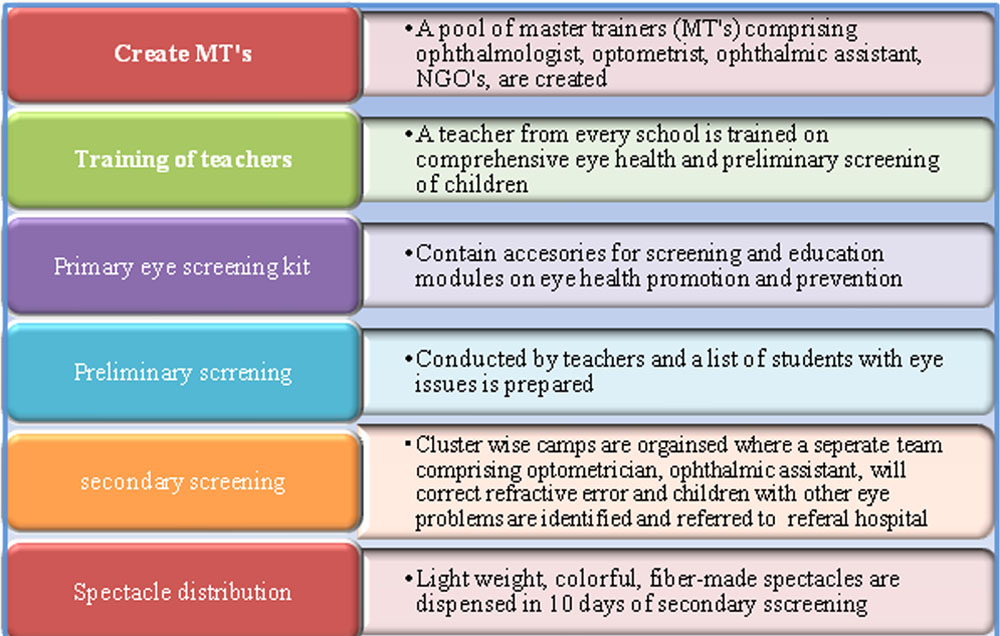
‘Vidyajyoti’ is a 5 year project started in September 2014 by ‘Sightsavers International’ in association with JPM rotary eye hospital. In this project we screened students in government schools of Cuttack district. Initially our master trainers comprising of Ophthalmologist, Optometrist, Ophthalmic assistant, and NGO’s trained one teacher from each school and SMC members regarding vision screening and eye health education. Teachers were also provided with ‘school eye screening kit’ which consists of a vision chart, occluder, torchlight and eye health education tools. This teacher conducted preliminary screening of all the students with snellen’s visual acuity chart at 6 meter distance in the school and identified students who cannot read 6/12 line in either eye, and students with other eye problems. Cluster wise camps were conducted by JPM rotary eye hospital by teams comprising of Optometrist, Ophthalmic assistants. They visited schools and they cross checked students who were identified earlier. Detailed history, previous ocular disorders, history of other medical and surgical treatment was collected. Visual acuity was tested with the help of a standard snellen’s visual acuity chart under proper illumination at 6 meters. Improvement of vision with pinhole was checked. Screening for any other eye problems was done. Refractive error was corrected and noted in the prescription pad. Cycloplegic refraction was done in required students. Students with other eye problems and who were not able to attain complete correction (6/6) were referred to JPM Rotary eye hospital for further evaluation. Light weight, high quality, colorful spectacles were provided to students within 10 days of prescription. Standard organizing procedure for implementation of program is shown in Table 2. Data which was available from September 2016 to January 2018 was collected and analyzed as shown in Table 3.
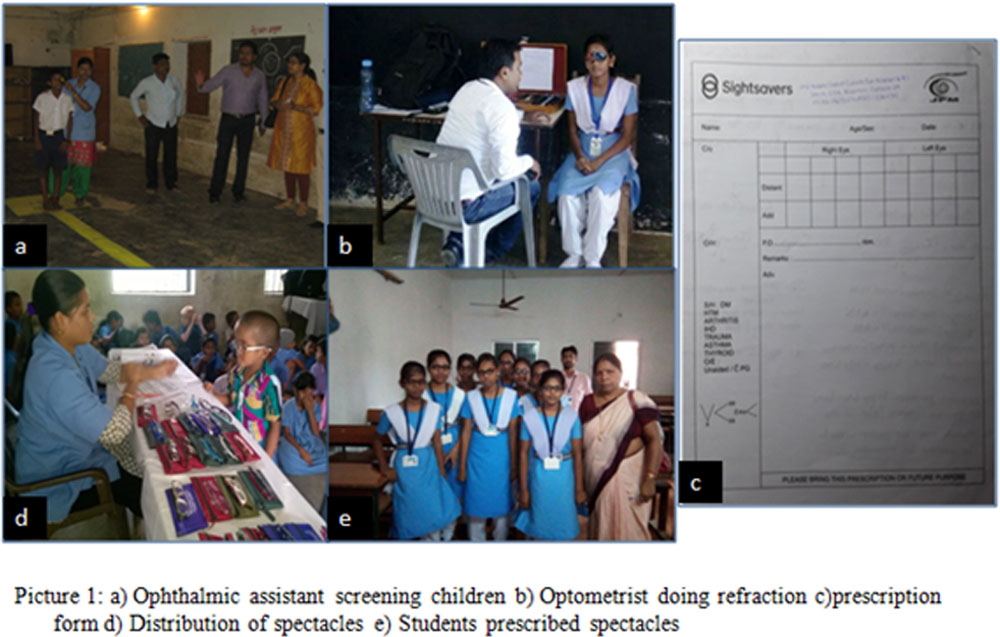
Table 2: Standard Organizing Procedure
Results
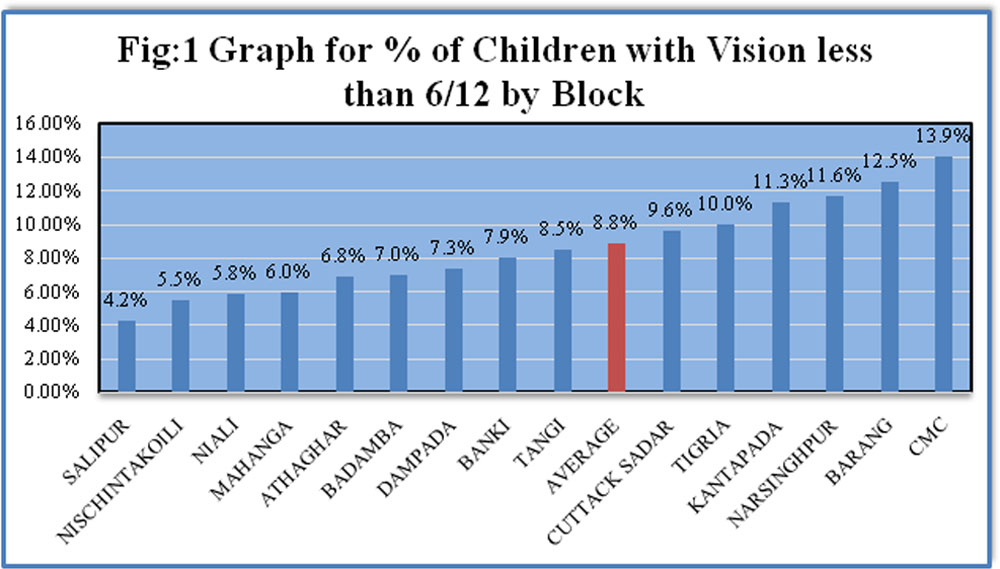
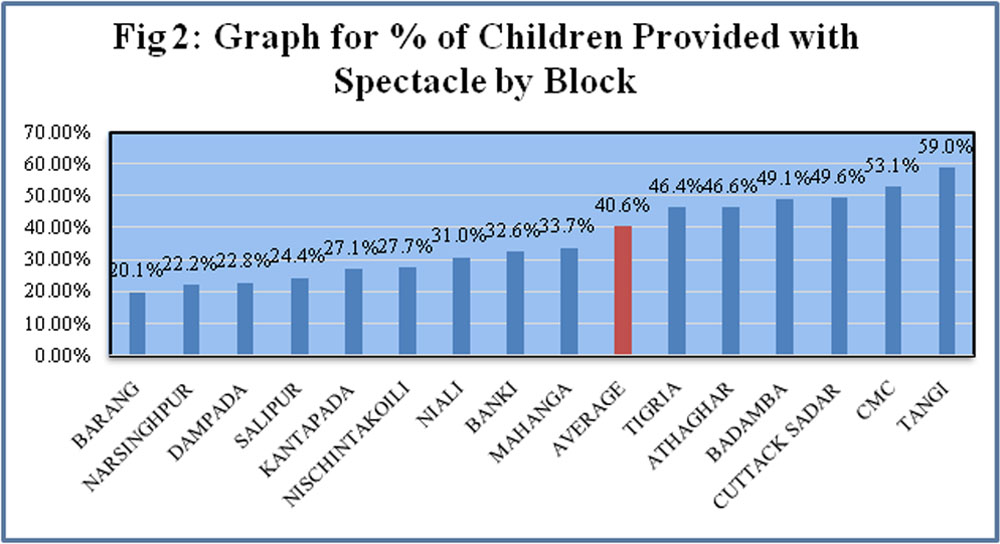
Vidyajyoti a pilot project on school eye health was launched in September 2014. It was a 5 year project covered government schools among 15 blocks in Cuttack district in the state of Odisha. Data was collected from September 2016 to January 2018. Out of 2,112 government schools in Cuttack district 1,936 schools (91.6%) were covered in this program. Total number of students in 5- 15 years age group was 3,57,507, out of which 2,95,196 (82.5%) students were covered in the program, with highest coverage in Niali block (96.8%) and least coverage in Narsinghpur block (64.8%). Total number of students identified with vision less than 6/12 were 26,092 (8.8%) in which highest percentage of students with refractive error was seen in Cuttack Municipal corporation (CMC) 13.9% and least percentage in Salipur block (4.2%). Out of 26,092 students with vision <6/12 spectacles were provided to 10,596 students with a percentage of 40.61%. Spectacle distributions were highest in Tangi block (59.0%) and least in Barang block (20%). Total number of teachers in Cuttack district was 7597, out of these 3014 teachers were trained in eye health program. Percentage of school teachers trained in school eye screening was 39.6%. Total numbers of School management committee (SMC) members trained were 3404. Total number of students with other eye problems who were referred to referral centre was 294.
| Table 3: Data collection and analysis | ||||||||
| SL. No. | Name of block | Students in the age
group of 6-15 yrs |
Number of Students Covered | % of Coverage | Number 0f Students not able to read 6/12 line | % Low Vision | Number of Children
provided ped spectacles |
% of
children provided with spectacles |
| 1 | ATHAGHAR | 22295 | 18978 | 85.12% | 1299 | 6.84% | 605 | 46.57% |
| 2 | BADAMBA | 23291 | 19809 | 85.05% | 1386 | 7.00% | 681 | 49.13% |
| 3 | BANKI | 31125 | 27034 | 86.86% | 2154 | 7.97% | 703 | 32.64% |
| 4 | BARANG | 12335 | 9986 | 80.96% | 1252 | 12.54% | 251 | 20.05% |
| 5 | CMC | 57241 | 49987 | 87.33% | 6987 | 13.98% | 3709 | 53.08% |
| 6 | CUTTACK SADAR | 21208 | 17987 | 84.81% | 1723 | 9.58% | 855 | 49.62% |
| 7 | DAMPADA | 16306 | 13209 | 81.01% | 964 | 7.30% | 220 | 22.82% |
| 8 | KANTAPADA | 11529 | 8346 | 72.39% | 940 | 11.26% | 255 | 27.13% |
| 9 | MAHANGA | 25785 | 18698 | 72.52% | 1117 | 5.97% | 377 | 33.75% |
| 10 | NARSINGHPUR | 31542 | 20467 | 64.89% | 2382 | 11.64% | 528 | 22.17% |
| 11 | NIALI | 19586 | 18977 | 96.89% | 1108 | 5.84% | 343 | 30.96% |
| 12 | NISCHINTAKOILI | 22756 | 19789 | 86.96% | 1081 | 5.46% | 299 | 27.66% |
| 13 | SALIPUR | 23276 | 19983 | 85.85% | 848 | 4.24% | 207 | 24.41% |
| 14 | TANGI | 27329 | 22437 | 82.10% | 1899 | 8.46% | 1121 | 59.03% |
| 15 | TIGRIA | 11903 | 9509 | 79.89% | 952 | 10.01% | 442 | 46.43% |
| TOTAL | 357507 | 295196 | 82.57% | 26092 | 8.84% | 10596 | 40.61% | |
Discussion
This pilot project on school eye health ‘Vidyajyoti’ was conducted for 4 years and the data was compiled in the last 17 months which has covered 1936 schools and 2,95,196 children. The prevalence of low vision among school children in the age group of 5-15 years was 8.8% and this was high in urban areas like CMC (13.9%). Krishnamurthy et al.11 also reported a similar prevalence of 6.5% in a study conducted at Mysore. Murthy et al.12 in a study done at Andhra Pradesh observed the prevalence of visual impairment of 6.7% in right eyes and 6.5% in left eyes. Vishnu Prasad et al found a prevalence rate of 6.37% in school children between 10- 14 years in a cross sectional study in Puduchery.13
The prevalence of refractive error among different studies are shown in table 4. Since our study covered all the government schools in district of Cuttack covering nearly 3,00,000 children our results can be taken as a real reflection of status of refractive error in the community in comparison to cluster like sampling in previous studies. Krishnamurthy et al.14 (2014) also found a significantly higher prevalence of uncorrected refractive error among urban school children when compared to students of rural schools. The results of above studies are consistent with that of present study. This might be due to frequent use of mobile phones or doing more close work than children in rural areas. The average percentage of students covered among different blocks was 82.5%.
The uniqueness of this project is that it not only screened and identified refractive error but also to corrected the same by providing spectacles. Spectacles were provided to 40.6% of students at free of cost. Besides screening for refractive error and providing spectacles this program had trained school teachers and SMC members regarding eye health education and nutrition. Not only teachers, school students are also educated regarding eye health and good nutrition which will help them to improve their quality of life. This project is a eye opener to the society, and Government of Odisha is inspired by the outcomes of the project and it started implementing similar project by name of Baljyoti in remaining districts of Odisha. Sightsavers has also expanded this program to cover 5 more districts in the state of Odisha and other states of the country. Dedicated team work by specially trained staff, good coordination between higher authorities and school staff was the key for success of this project which is definitely going to act as a milestone project for determining prevalence of low vision in this part of the country as well as provision of treatment in the same setting.
Table 4: Comparison of prevalence or refractive error among different studies
| Study | Sample size | Age group
(In years) |
Time period
(In months) |
Prevalence
of RE |
| Our study | 295196 | 5-15 | 17 | 8.8% |
| Padhy A S et al14 | 13043 | 5-15 | 12 | 4.0% |
| Dhanya.D et al15 | 958 | 7-15 | 12 | 8.14% |
| Vishnu Prasad et al13 | 1884 | 10-14 | 22 | 6.37% |
Conclusion
‘Vidyajyoti’ estimated the prevalence of low vision to be 8.8% and also provided nutritional education, training of teachers and SMC members for ongoing evaluation of visual health and nutrition as well as provided spectacle correction. Hence it has a better socio economic impact in the society as it adds more visual years to the children than the population where cataract screening and surgery is done. Sightsavers has decided to replicate the program at national level because of successful completion of this pilot project.
Bibliography
- Sathyan S Vision screening at schools: Strategies and challenges. Kerala J Ophthalmology [serial online] 2017 [cited 2018 Oct 11]; 29:121-30.
- Murthy GV, Gupta SK, Ellwein LB, Muñoz SR, Pokharel GP, Sanga L, et al. Refractive error in children in an urban population in New Delhi. Invest Ophthalmol Vis Sci 2002;43:623-31.
- Dandona R, Dandona L, Srinivas M, Sahare P, Narsaiah S, Muñoz SR, et al. Refractive error in children in a rural population in India. Invest Ophthalmol Vis Sci 2002;43:615-22.
- Pokharel GP, Negrel AD, Munoz SR Refractive Error Study in Children: results from Mechi Zone, Nepal., Ellwein LB.Am J Ophthalmol. 2000 Apr; 129(4):436-44.
- Resnikoff S, Pascolini D, Mariottia SP, Pokharel GP. Global magnitude of visual impairment caused by uncorrected refractive errors in 2004. Bull World Health Organ 2008;86:63-70.
- Naidoo KS. Design of a blindness prevention reporting and planning tool utilizing the results of a population-based study of visual impairment in a health district in KwaZulu-Natal [dissertation]. Australia: The University of New South Wales; 2009.
- Taylor HR. Refractive errors: Magnitude of the need. J Community Eye Health 2000;13:1-2.
- Bhalwar R. Textbook of Public Health and Community Medicine. 1st ed. Pune: Armed Forces Medical College; 2000.
- Elimination of Avoidable Visual Disability Due to Refractive Errors: Report of an Informal Planning Meeting, Geneva, 3-5 July, 2000. Geneva: WHO; 2000.
- Drover JR, Kean PG, Courage ML, Adams RJ. Prevalence of amblyopia and other vision disorders in young Newfoundland and Labrador children. Can J Ophthalmol 2008;43:89-94.
- Krishnamurthy H, Tanushree V, D’Silva AJ. Prevalence of refractive errors among school children of 5-15 years age group in Mysore District. Int J Sci Stud. 2014;2:150–4.
- Murthy VK, Prabhu R, Reddy AK, Sridhar MS. A Study on Prevalence of Refractive Errors among 5-16 Years Rural Children in Chandragiri, Chittoor District, Andhra Pradesh. Journal of Evolution of Medical and Dental Sciences. 2014;3:11411–8.
- Vishnuprasad R, Bazroy J, Madhanraj K, et al. Visual impairment among 10–14-year school children in Puducherry: A cross-sectional study. Journal of Family Medicine and Primary Care. 2017;6(1):58-62. doi:10.4103/2249-4863.214983.
- Padhye AS, Khandekar R, Dharmadhikari S, Dole K, Gogate P, Deshpande M. Prevalence of Uncorrected Refractive Error and Other Eye Problems Among Urban and Rural School Children. Middle East African Journal of Ophthalmology. 2009;16(2):69-74. doi:10.4103/0974-9233.53864.
- Dhanya D, Pandu S, Sujatha V, et al. A population based study of refractive errors in children among age group of 7-15 years. J. Evid. Based Med. Healthc. 2016; 3(20), 815-817. DOI: 10.18410/jebmh/2016/185.
Leave a Comment