

Dr. Ratish Chandra Paul, Dr. Priyansha Chatterjee, Dr. Shobhana Phukan, Dr. Madhusudan Mandal, Dr. KOUSIK SARKAR
INTRODUCTION:
There are many short term phaco training programs existing in India today to help practicing ophthalmologists adopt quality phaco surgical skill. However, relatively little is known about how this training translates into a post training success in phaco adoption in their own practice.
AIM:
This study was done as an initiative to set up a standardisedphaco surgical training model which would also analyse the post training outcomes of the trainees.
METHODS:
The study was conducted in a tertiary eye hospital. It is a retrospective study which included 391 surgeons from the period of June 2010 to December 2017. The surgeons were scheduled for 2-3 weeks phaco surgery training course. The training course included wet lab, hands on practice in the OR, surgical video discussion and didactic lectures. Dedicated trainers carried out the curriculum without any deviation. Minimum 20 Phaco cases were performed by each surgeon during the course. On completion of the training program the surgeons went back to their own hospitals where they received periodical support by Phaco Development Specialist along with competency assessment by ICO- OSCAR tool
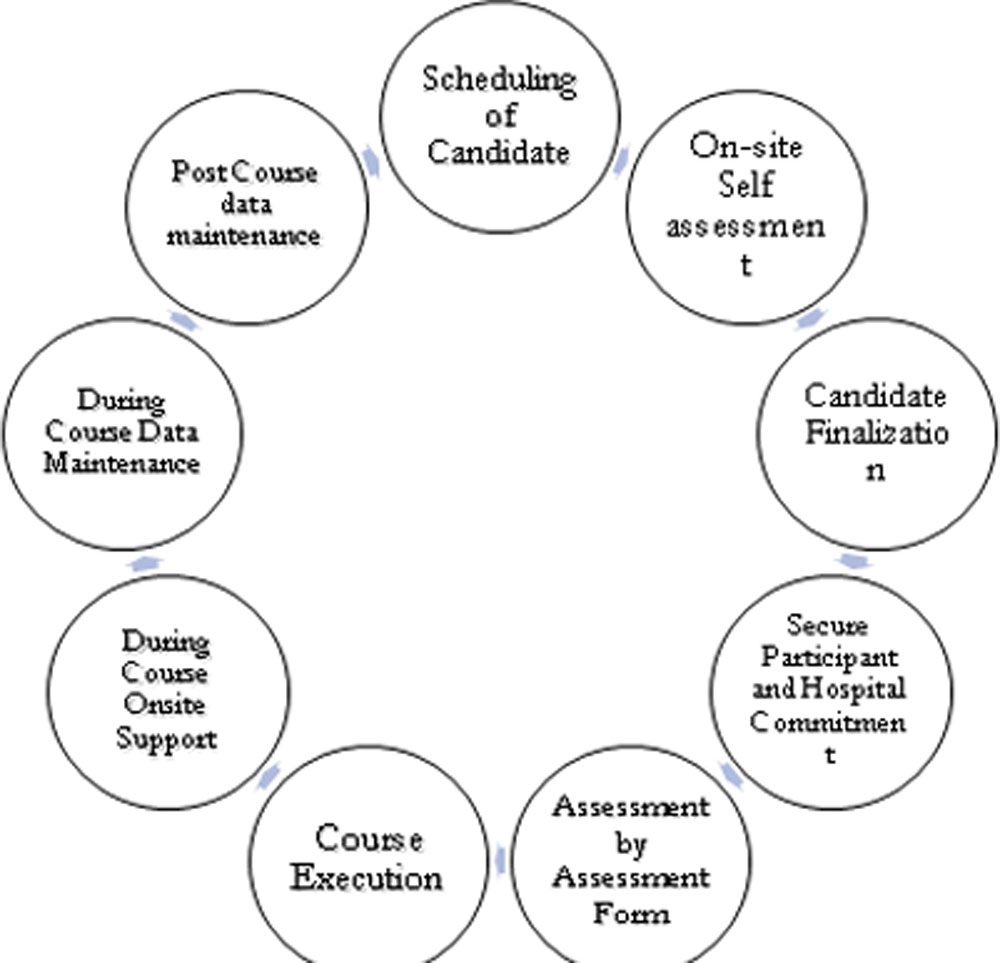
Fig 1 : Flowchart of study methodology
| Pre-Operation Planning & Discussion | Case Chart Review | Review all biometry, patient pre-operative examination, and surgical plan before the start of surgery |
| Mutually discussed Objective for Coaching | Discussion with faculty of the challenges faced during the last surgery and focus for next case along with previous case video |
| Intra-Operative Planning & Discussion | Faculty time for Coaching | Faculty was mostly available during surgery without losing coaching opportunity in most critical steps |
| Communication | Focused communication which supported their surgery at critical times throughout the case | |
| Guidance & Anticipation | Highly engaged and pro-active guidance | |
| In case of challenging situation | Anticipate the challenges and guide to prevent the same thereafter giving chance back to the trainee to proceed | |
| Standardisation of technique | No major deviation on standardisedtechniques as compared to set SOP |
| Post-Operation Planning & Discussion | Case video Review | Majority of the key focus areas of the videos covered by the faculty |
| Key Learnings & Development Plan | Detailed discussion about participant progress, and development plan | |
| Feedback | feedback is constructive : i.e.Mix criticism with praise, Highlight areas for improvement, Start with a positive, Sandwich the negative, End with a positive |
Table 1 : Training protocol
RESULTS:
During training course 391 surgeons performed a total of 8841 phaco surgeries. The complication rate during the training was 1.78% and after training dropped to 1.2%. 291 doctors (94.2%) actively adopted phaco in their practice (defined by surgeons doing phaco in >50% of total cataract cases). Total of 2,60,010 surgeries have been performed by these surgeons post training completion. Average surgical competency measured by ICO-OSCAR Score was 80%
CONCLUSION:
This unique training model of phaco surgery where training course is followed by periodical onsite support not only increased the successful adoption of phaco among the practicing cataract surgeons but also expanded their surgical competency.
KEY WORDS:
ICO-OSCAR, Phaco Development Specialist
Leave a Comment