

Dr. DHRUVEN SHAH, Dr. Suhas Haldipurkar, Dr. Vijay Shetty, Dr. Zarin Modiwala
Abstract
Aim:
To compare the reading speed with MNREAD charts in phakic,monofocal and multifocal IOL patients in 2 illuminations.
Methods:
This study included 85 patients of phakic(45) and pseudophakic(40) aged above 20yrs with ability to read English.Patients were asked to read MNREAD chart at 40cms in 2 illuminations binocularly. Time taken to read each line was measured using stopwatch. Reading acuity and reading speed were measured.
Results:
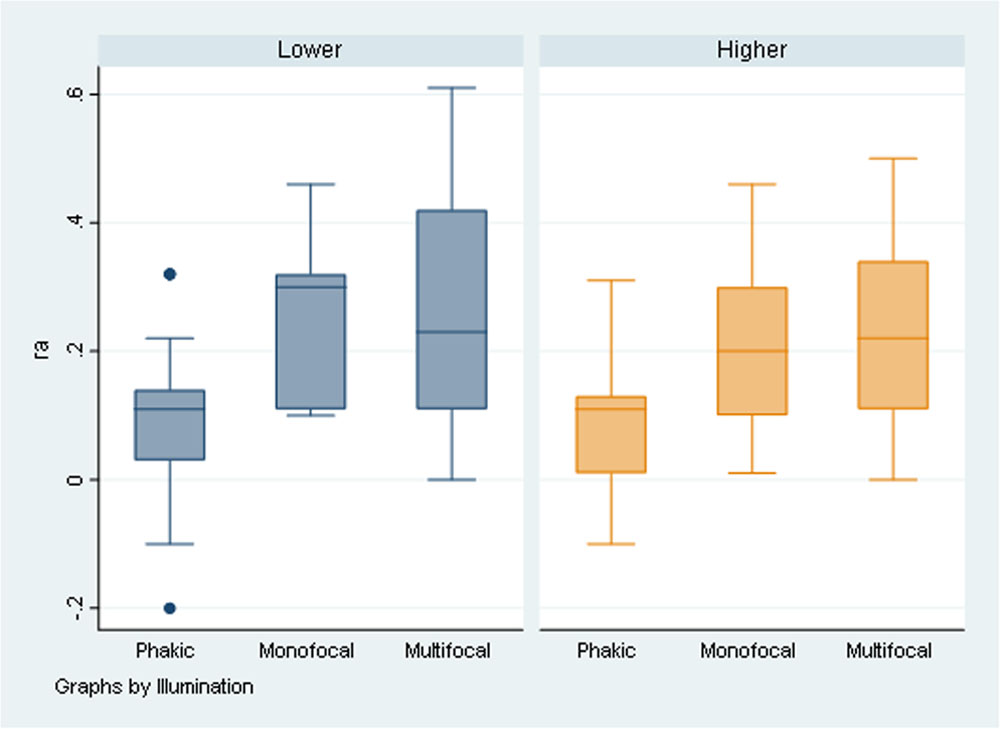
Median reading speed was similar between phakic(8.4,8.0),monofocal(7.8,7.9) and multifocal IOL(7.4,6.6) patients in both illuminations (p>0.05). Reading acuity was better in phakic(0.11,0.11) patients as compared to monofocal(0.30,0.20) and multifocal(0.23,0.22) patients (p=0.0001,0.0002) in both illuminations. Multifocal IOL patients performed better in higher illumination (p=0.033).In rest of the groups reading speed and acuity were similar in different illuminations.
Conclusion:
Illumination does not affect reading speed in phakic ,monofocal and multifocal patients. However phakics have a better reading acuity in both illumination,
Full Text:
Introduction :
Illumination is one of the essential factors to carry out our daily activities.
Productivity can get altered depending on the quality of light in the workplace.
Increased light will lead to increase in productivity reducing the number of mistakes
along with reduction in complaints such as eyestrain, headache, and nausea and neck
pain.
Illumination in Phakic:A study done by Tinker, M.A. et al1 had shown that reading speed tends to increase when there is increase in intensity of illumination.Thus a patient’s reading
speed will be more if the illumination is increased. However few studies state that
reading speed does not increase significantly as the
illumination increases2.
Illumination in Pseudophakic: A study done by Radner W et. Al compared reading performance of monofocaland pseudophakic patients with and without glasses in normal and dim light conditions. The study showed reading performance was considerably good even without glasses under normal illumination3.
Aim:
To compare the reading speed with MNREAD charts in phakic,monofocal and multifocal IOL patients in 2 illuminations
Methodology:
Study design : Prospective, single-center, comparative clinical study
Study site: Laxmi Eye Institute (LEI), a private tertiary eye carecenter, Navi Mumbai, India
Study duration : 6 months (August 2017 to January 2018).
Inclusion criteria :
- Age – 20 years and above
- Both eye– Best corrected visual acuity(near) should be N6
- Patients should be able to read English
- Both eye – Phakic or Both eye – Pseudophakic
Exclusion Criteria
- Ocular surgery other than cataract surgery
- Ocular pathology
- Deaf and dumb patients
- Ocular trauma
- One eyed patients
- Monocular Pseudophakic patients
Methods and materials:
Incandescent lamp was used with a rheostat to achieve two illuminations. Lux meter was used to measure the illumination. Room illumination was measured before
starting the procedure. Illumination of near lamp was measured each time in two
illuminations. Patients were made to read the chart till the last visible line without changing the reading distance (40 cms). Patients were asked to start reading the chart and the timer was
started. Time taken to read each line on the chart was measured using stopwatch.
Reading speed was measured in two illuminations, the sequence of which was
altered for each patient randomly. Reading speed was measured in words per minute. Reading acuity was measured in log MAR (log value of last visible line read by patient).
Statistical analysis :
Data was entered in MS-Excel and analyzed using Stata software. Median
values of reading speed and reading acuity were calculated for three groups i.e.
phakic,monofocaland multifocal. All the values were compared using Kruskal Wallis test.
Results :
There were 3 group of patients phakic(45),monofocal (13)and multifocal(27).
There were 44 females and 41 males included in this study.
Median reading speed in 1 and 2 illumination phakicgroup was8.422(6.121,9.314) and 8.016(6.821,9.303), in monofocal group was 7.806(6.937,9.250) and 7.913(7.294,8.713) and multifocal group was 7.441(4.633,9.630) and 6.634(5.250,8.960).
There was no significant difference found across all three groups in low (p=0.88) and high (p=0.38) illuminations.
However reading acuity was better in phakic patients as compared to monofocals and multifocals in low (p=0.0001) and high (0.0002) illuminations.
Discussions:
Reading ability is really important daily activities in a working population. Our results showed that reading speed was not affected with implantation of intraocular lens. It aslso showed that reading speed does not get affected much because of illumination. Median reading speed was almost similar in all three groups of patients in both illuminations.
Also reading speed did not significantly improve in higher illumination.
Reading acuity was much better in the phakic group than monofocal and multifocal groups in both illuminations. Also reading acuity did improve much in higher illumination in all three groups.
Conclusion :
Illumination does not affect reading speed in phakic ,monofocal and multifocal patients. However phakics have a better reading acuity in both illumination,
References :
- Tinker MA. The effect of illumination intensifies upon speed of perception and upon fatigue in reading . J Educ Psychol. 1939;30(8):561–71.
- Tinker MA. Illumination intensities for reading newspaper type . J Educ Psychol. 1943;34(4):247–50.
- Radner W, Radner S, Raunig V DG. Reading performance of monofocal pseudophakic patients with and without glasses under normal and dim light conditions . (2):167.
- Rong Liu, Bhavika N. Patel MK. Age – related changes in crowding and reading speed. 2015;31.
- Quaid P, Simpson T. Association between reading speed, cycloplegic refractive error, and oculomotor function in reading disabled children versus controls. Graefe’s Arch ClinExpOphthalmol. 2013;251(1):169–87.
- Chmykhova E V, Davydov DG, Lavrova TP. The Factors of the Reading Speed: an Experimental Study. 2014; Available from: https://ssrn.com/abstract=2599252
- Hida WT, Nakano CT, Yamane IS, Francisco A, Motta P, Tzeliks PF, et RevistaBrasileira de Oftalmologia Visual performance in pseudophakic patients with different intraocular lens. 2018;1–9.
- Ito M, Shimizu K. Reading ability with pseudophakicmonovision and with refractive multifocal intraocular lenses: Comparative study. J Cataract Refract Surg [Internet]. 2009;35(9):1501–4. Available from: https://dx.doi.org/10.1016/j.jcrs.2009.03.051
- Souza CE, Gerente VM, Chalita MR, Soriano ES, Freitas LL, Belfort RJ.Visual acuity, contrast sensitivity, reading speed, and wavefront analysis:pseudophakic eye with multifocal IOL (ReSTOR) versus fellow phakic eye in non-presbyopic patients. J Refract Surg. 2006;22(3):303–https://gellab.dl.umn.edu/mnread-acuity-charts
Legends for figures :
Figure 1 :Box plot for reading speed
Figure 2 : Box plot for reading acuity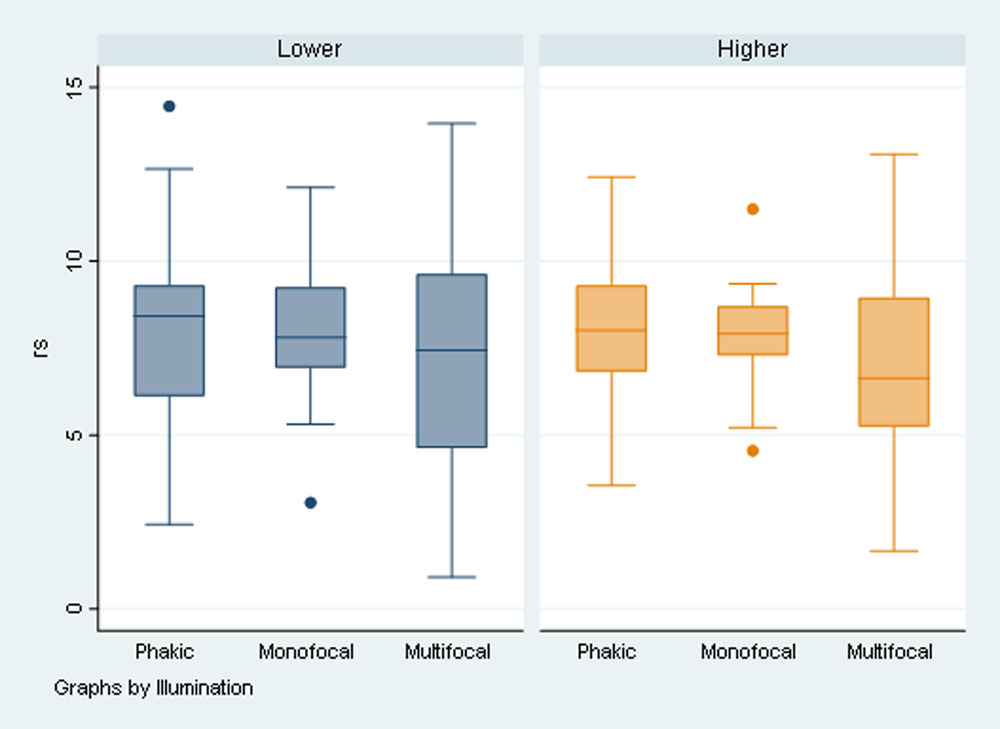
Figure 1
Leave a Comment