

 FP210 : Accidental viral markers positivity in the patients undergoing for cataract surgery
Dr. Deepak Mishra, Dr. smriti gaur,Dr. shivani shrivastava, Dr. TANMAY SRIVASTAV
ABSTRACT
AIM:To findtheprevalence of accidental viral markers positivity in the patients undergoing cataract surgery.
MATERIALS AND METHODS: It was a retrospective cross-sectional hospital based study. Total 700 cataract patients were studied and their data was collected from Hospital record system. All patients who had denied any infection from HBV, HCV & HIV nucleic acids were included in the study. All patients were made to sign informed consent for serological evaluation for HBV, HCV and HIV.Post test counselling was given to viral markers positive cases and referred to ART centre for registration, further investigations and treatment.
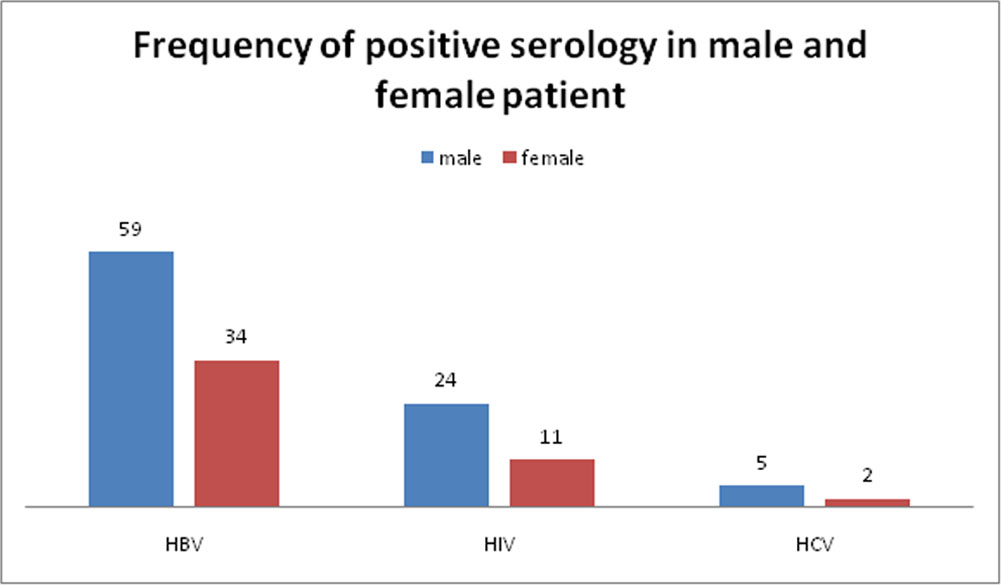
OBSERVATIONS AND RESULTS: During the study period, out of 700 patients, 417 were males and 283 were females. 93 patients were accidentally diagnosed HBV positive. In these 93 patients 59 were males and 34 were females. In case of HIV screening, 35 patients were found seropositive accidentally out of which 24 were males and rest females. AntiHCV antibody was positive in 7 males and one female patient accidentally.
CONCLUSION: We recommendthat screening for viral markers should be made compulsory and also a part of normalpre-operative protocol before ocular surgery.
KEYWORDS: Cataract, Viral markers, Accidentallydiagnosed.
Introduction: Cataract surgery is the most common operation performed across entire world. Last year greater than 5.9 million cataract extraction were done in our country[1].Peribulbar anaesthesia is frequent mode of administration of anaesthesia in our country[2,3].Peribulbar anaesthesia inhabits the perforation risk accidentally. Also, sharp instruments used during cataract extraction may also become a potent source of haematologic infections.
The most frequently reported blood-borne infection is hepatitits B,followed by hepatitis C &human immunodeficiency virus (HIV)[4,5]. The incidence of needle prick injury in ophthalmological practice is 0.06-0.08 per 1000 surgeries in our country[6]. WHO reports HIV infection in 36.8 million people worldwide[7]. The similar numbers for hepatitis B &C infection are 251 million and 70 million respectively[8]. Majority of seropositive people tend to be asymptomatic[5]. Every fluid in human body including aqueous is prone to viral infection[9,10].
The infected hepatitis and retropositive cases with eye disease can transmit their infection to ophthalmic practitioners[11]. The hospital staff carries risk of infection transmission during surgery as well as during handling sharp instruments[11]. In India,most of the patients who undergo ocular operations do not routinely undergo blood investigations for viral infections. Since, most of them are asymptomatic[12-14], the infection can also spread horizontally to surgeons, staff and other patients. Since onlyfew studies are reportedin our country which demonstrates essence of viral infection screening in ocular surgery patient, we carried this survey to ascertain the prevalence of viral markerpositivity in patients planned for elective cataract extraction.
Materials and Methods: This was a retrospective, cross-sectional hospital based study done in Department of Ophthalmology, IMS, BHU Varanasiin which all patients who underwent cataract surgery within a span of one year from July 2017 to December 2017 were included from Hospital Information System. Total 700 cataract patients were studied and their data was collected from Hospital record system. Approval was granted by the Institutional Ethical Committee and we strictly adhered to Declaration of Helsinki. Preoperatively detailed ocular examination was done in all selected cataract patients and accordingly laboratory investigations were ordered. All patients who had denied any infection from HBV, HCV & HIV nucleic acids were included in the study. All patients were made to sign informed consent for serological evaluation for HBV, HCV and HIV. Other laboratory investigations included hemogram (CBC) and blood sugarrandom (RBS). HBV and HCV were tested with ELISA test kit. HIV was labelled as positive only when both the tests were reported positive in accordance with NACO guidelines[15].
All positive cases who were newly diagnosed and came to know accidentally about their seropositivitywith our investigations were included in the study. Post test counselling was given to viral markers positive cases and referred to ART centre for registration and baseline investigations. In order to find the risk factor of infection, a questionnaire was given to all seropositive cases. The elicited risk factors included history of blood transfusion, unprotected sex with multiple partners, receiving injections from unqualified local practitioners, history of previous surgery, tooth extraction and having shaving done routinely from barber. The information recorded was kept confidential.
All cases with any of the above viral infection were considered as high risk for surgical supportive staff and surgeons. All high risk subjects underwent minor outpatient procedurelikewise lacrimal sac syringing at last using disposable syringing cannulas. Biometry was done with help of ultra thin paper made of transparent polythene as an interface and after disinfection of tip. Disinfection of tonometry was done after every case. OT procedures followed universal health precautions as advocated by WHO.Sharp instruments were handled with proper care to avoid cuts. Reusable items like scissors, blade handles etc. were kept separate and glutaraldehyde disinfectionwas done for appropriate time period.Thereafter proper cleaning and double autoclaving was done. Biomedical wastes were disposed according to accepted standards. The details were recorded on proforma and data was compiled and analyzed for age and sex mean values. Occupation of the subject was also emphasized upon. All patients who were selected for elective operation were included in the study.
RESULTS: During the study period, out of 700 patients 417 were males and 283 were females. 93 patients were accidentally diagnosed HBV positive. In these 93 patients 59 were males and 34 were females. In case of HIV screening, 35 patients were found seropositive accidentally out of which 24 were males and rest females. AntiHCV antibody was positive in 7 males and one female patient accidentally.
| VIRAL INFECTION | TOTAL SEROPOSITIVE PATIENTS | MALES | FEMALES |
| HBV | 93 (13.28%) | 59 (8.42%) | 34 (4.85%) |
| HIV | 35(5.00%) | 24 (3.42%) | 11 (1.57%) |
| HCV | 7 (1.00%) | 5 (0.71%) | 2 (0.28%) |
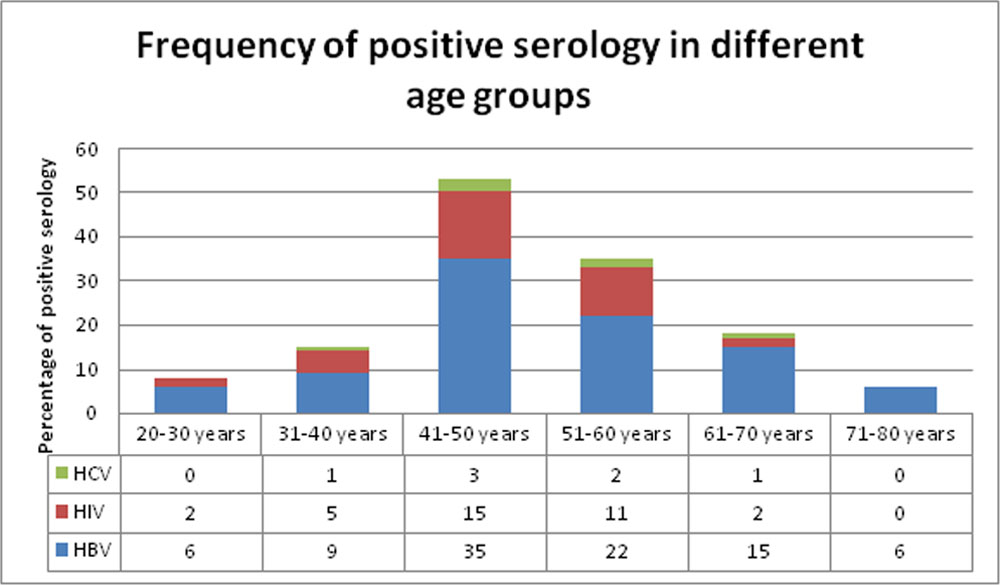
FREQUENCY OF POSITIVE VIRAL MARKER PATIENTS IN DIFFERENT AGE GROUPS
| Viral infection | AGE GROUP 20-30 yrs | 31-40 yrs | 41-50 yrs | 51-60 yrs | 61-70 yrs | 71-80 yrs |
| HBV | 6 | 9 | 35 | 22 | 15 | 6 |
| HIV | 2 | 5 | 15 | 11 | 2 | 0 |
| HCV | 0 | 1 | 3 | 2 | 1 | 0 |
DISCUSSION: India is having a lot of HIV, HBV and HCV infected patients[16-18]. The symptomless carriers with positive serology forms the major pool of infection and increased transmission is because of lack of routine screening prior to surgery[12,14,19]. Ophthalmologists are at risk of infection due to accidental needle prick and because they also come in contact with tears and aqueous humour of patients[11,20]. Temel et al.&Koksal et al. noted that 71% and 84% HBsAgpositive patients in serum also tested positive for HBsAg in ocular fluid samples by Polymerase chain reaction (PCR) respectively[21,22]. Ching-Yao Tsai detected HBV in aqueous humour of symptomfree Taiwanese Hepatitis B patient by PCR[20]. A study by Kobayakawa et al. reported HCV in aqueous[23]. Even HIV virus, has been reported in ocular fluids like tears, aqueous humour, cornea, conjunctiva and retinal vascular endothelium. Yang HanM et al. detected HIV 1 virus in tears of patients even in patients who had been taking HIV treatment for long time[24].
We found overall prevalence of triple H (Hepatitis B, Hepatitis C & HIV) viral infection 3% among cataract patients. Viral seropositivity studies in cataract patients from India and Pakistan ranged between 4% and 16%[22,23,25,26]. Average estimated prevalence of HBV DNA, HCV DNA and HIV in general Indian population is 3%-4%, 0.094%-15% and 0.3% respectively, although regional variations are seen[27,28].
The age group between 40-60 years is found to be affected in major number with these viral infections as compared to others. It may be due to the fact that most of our patients in this study belong to the same age group who are being planned for senile cataract surgery. Similarly Iftikhar et al. &Naeem et al. reported highest number of seropositive cases in 50-85 years and 55-64 years respectively[26,29]. We found males suffered more than females. This could be a reflection of more males coming for treatment in our centre. This can also reflect that males are more mobile socially and thus have greaterchances of getting infected[30,31]. Similarly Sayeedul Hasan et al. reported more number of males who were seropositive in comparison to female patients[32].
Most of these seropositive cases were not aware of the infection and its source.Through this study we also tried to highlight the possible origin of infection. The risk factor commonly associated with HCV epidemiology in India are blood transfusions and use of reusable glass syringes[27]. The blood transfusion was not a common risk factor as there is improvement in transfusion practices and awareness among blood donors.Seropositivity of HBV, HCV and HIV among blood donors was 1.7%, 1.0% and 0.3% respectively[33,34]. Other important risk factors were history of tooth extraction, shaving at saloon and history of taking injections from local practitioner. According to Verma et al., history of injection from local practitioner and history of dental extraction were two risk factors for HCV infection[35]. It is reported that 60-90% of total injections administered in India are unsafe[27]. Approximately 70% of health care contributor in rural India receives no formal training for practicing medicine[36]. Same way shaving at saloon is a possible potential origin of infection as awareness level among them is low and poor practice pattern[37-40].
The limitation of our study was that it was a single centre study. It included patients from local geographical area therefore seroprevalence and its pattern may not be representative. Large multicentre study would be needed to know distribution of type of seropositive cases in different regions. Also, only cataract patients were taken for the study. Patients undergoing other ocular surgeries like trabeculectomy, strabismus, extraocular sugeries should have also been included.
Conclusion: As we found in our study significant number of viral markers positive patients who were diagnosed accidentally when they underwent investigation for ophthalmic surgical procedure,we recommendthat screening for viral markers should be made compulsory and also a part of normalpre-operative protocol before ocular surgery. It is helpful not only in protecting the health care providers but also the other patients. This can also help in early diagnosis and treatment of patients.
Leave a Comment