

Dr.Pranoti Nagvekar,Dr.Suhas Haldipurkar,Dr.Vijay Shetty,Dr.Zain Khatib
Abstract:
Purpose:. To compare quality of life and dysphotopsia in 4 groups of patient
Setting: Laxmi Eye Institute, Panvel.
Design:Non-randomized prospective observational study.
Methods: : 139 patients undergoing uneventful cataract surgery with monovision with Acrysof IQ, Restor, Biotech and Physiol IOL were provided with VFQ 33 and dysphtopsia questionnaire on their 15 days follow up visit
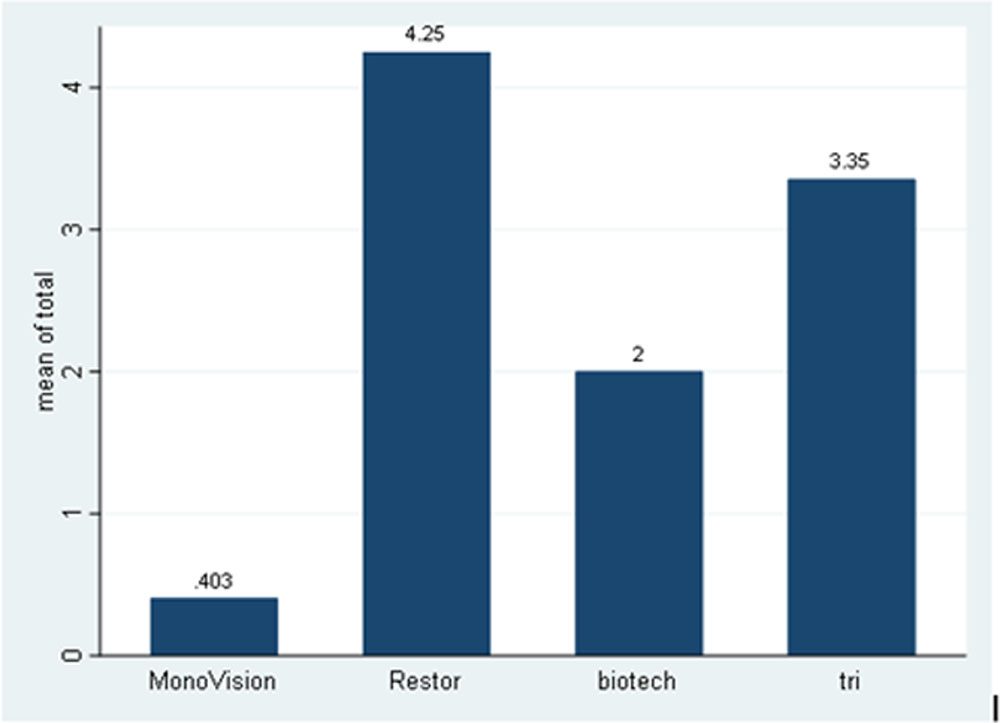
Results: Dysphotopsia questionnaire showed monovision with Acrysof IQ (mean score:0.4) to be better as compared to Restor(4.25), Biotech(2), Physiol(3.35) which was also stastically significant (p<0.05). Unwanted images were more seen with Restor(31%) compared to Physiol(3%), monovision with Acrysof IQ(2%) and Biotech(0%). Extremely satisfied patients were more with Biotech(43%) compared to Restor(22%), Physiol(13%) but 16% Restor patients were disappointed . Patients with monovision with Acrysof IQ were 100% satisfied. The Indian VFQ 33 Questionairre showed us that there was statistical difference amongst the four groups of IOL’s with respect to mean of visual functioning score (p< 0.0001), Monovision performed better amongst the 4 groups of IOL’s. There was no statistically significant difference amongst the four groups of IOL’s with respect to general functioning and psychosocial functioning, which are the other two subsets of the Indian VFQ 33 Questionairre.
Conclusions: These questionnaire surveys for quality of life and Dysphotopsia can be employed in postoperative examination to assess patient satisfaction. Monovision is a good choice for those patients who have realistic expectations and who are on a tight budget
Full Text:
Introduction:
Nowdays, cataract surgery alongwith IOL implantation has become more of a refractive procedure where the end result is measured not only by visual acuity but also by the quality of vision experienced by the patient. In recent years,patients have expressed a desire for a spectacle-free life, which in turn has brought about an advancement in the field of cataract surgery.1,2Advances in microsurgical techniques, development of new IOL technologies & sophisticated biometry methods have allowed most cataract patients to regain high-quality vision.Various approaches for intraocular lens implantation have been developed to correct the loss of accommodation and improve visual function post cataract surgery such as implantation of monofocal IOL with use of reading glasses, monovision technique by monofocal IOLs, accommodating IOLs, multifocal and trifocal IOL’s. Each of the above approaches has its own merits and drawbacks. 3,4,5One of the drawbacks is the phenomenon of Dysphotopsia, which is commonly reported in cases of an uneventful cataract surgery.6,7,8 The aim of this study was to determine the quality of life & phenomenon of dysphotopsia in 4 groups of patients undergoing implantation with Acrysof IQ (Monovision), Restor (Multifocal), Biotech(Multifocal) and Physiol(Trifocal) IOL, by using a preexistent validated Dysphotopsia questionnaire and the validated Indian VFQ 33 Questionairre.
Aim of the study:
To determine the Quality of life and Visual satisfaction among the Acrysof IQ Monovision, Restor Multifocal, Biotech Multifocal and Physiol Trifocal patients.
Need for the study: There are very few studies showing comparision of patient satisfaction in terms of visual outcome and quality of life on the basis of validated questionnaires among those patient who undergo implantation with Acrysof IQ Monovision, Restor Multifocal, Biotech Multifocal and Physiol Trifocal patients.
Methodology:
Study design: Prospective observational study
Study site: Laxmi Eye Institute, Panvel
Sample size: 139 patients were recruited from Laxmi Eye Institute,Panvel during a time period of April 2017 to April 2018
Inclusion criteria: The recruitment inclusion criteria were patients requiring bilateral cataract surgery, not having any ocular pathology or previous surgery, with corneal astigmatism less than 1.00 D, aged between 40 and 70 years, deemed suitable by the treating surgeon and willing to be implanted with either of Acrysof IQ Monovision, Restore Multifocal, Physiol Trifocal and/or Biotech Multifocal.
Exclusion criteria:
Patients with any intraoperative and postoperative complications were excluded from the study
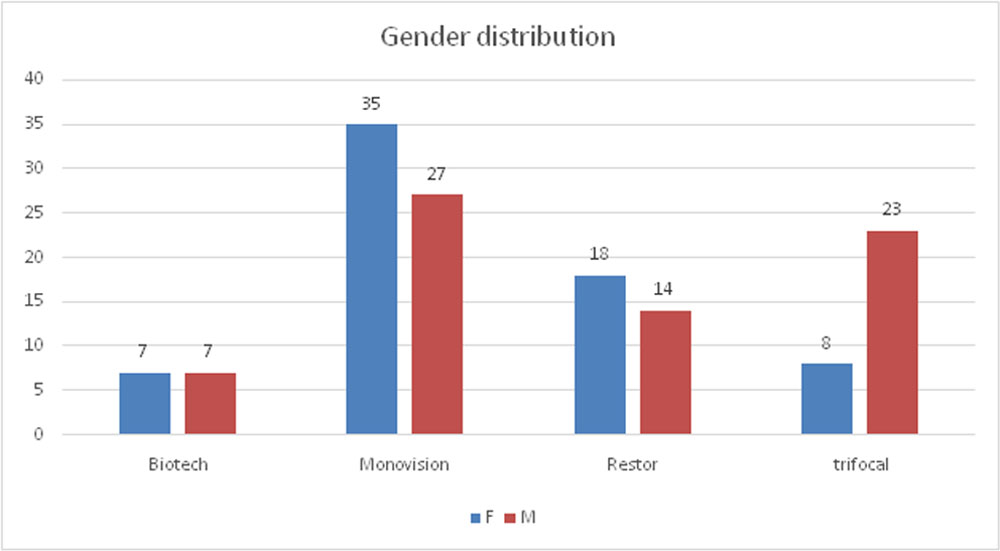
Study procedure: . The hospital research ethics committee approved the study, and informed consent was obtained from each patient. The consequences and details of the study were explained to each patient, and the research followed the tenets of the declaration of Helsinki. Out of the 139 patients there were 62 patients who were implanted with Acrysof Monovision,32 patients with Restor Multifocal,31 patients with Trifocal and remaining 14 patients with Biotech Multifocal IOL’s. All patients underwent an uneventful cataract surgery and all the surgeries were performed by a single surgeon. Second eye surgery was performed within a week of the first eye surgery. . The study was designed to evaluate the quality of life and phenomenon of dysphotopsia from the perspective of subjective multiple question questionnaire. Patients were also provided with the Indian VFQ 33 Questionairre. The Indian vision function questionnaire 33 item questionnaire (IND-VFQ33) directly captures patients’ experiences of their vision problems upon their daily lives. Questionnaire items are classified into one of three scales [general functioning (Q1-Q21), psychosocial impact (Q22-Q26), and visual symptoms (Q27-Q33)]. Higher score indicating poor quality of life Patients enrolled in the study were surveyed at the two week postoperative examination. A single investigator performed all the questionnaires .
Primary outcome measure: It was regarding patient satisfaction, quality of life and frequency of Dysphotopsia.
Secondary outcome measures: Results of uncorrected/corrected visual acuity (measured using the Snellen distance and near Visual Acuity chart).
Statistical Methods:
Data were entered in MS Excel 2007 and analyzed using STATA Version 12.
Means and standard deviations were calculated for continuous normally distributed variables & percentages for categorical variables .Median was also calculated for non-normal distribution
The means were compared using ANOVA among the three groups.
Results:
The demographic data of the study is summarized in Figure 1.
The gender distribution is shown in Figure 2
The Best Corrected distance visual acuity among the 4 different groups of IOL’S was that total of 64.74% patients had an uncorrected BCVA OF 6/6 AND 28.77% had an uncorrected BCVA OF 6/9 on 15 days followup
All patients had an uncorrected Near vision of N6 (100%).
Dysphotopsia questionnaire showed monovision with Acrysof IQ (mean score:0.4) to be better as compared to Restor( mean score 4.25), Biotech( mean score 2), Physiol( mean score 3.35) which was also statistically significant (p<0.05). These Primary outcome results are depicted in Figure 4
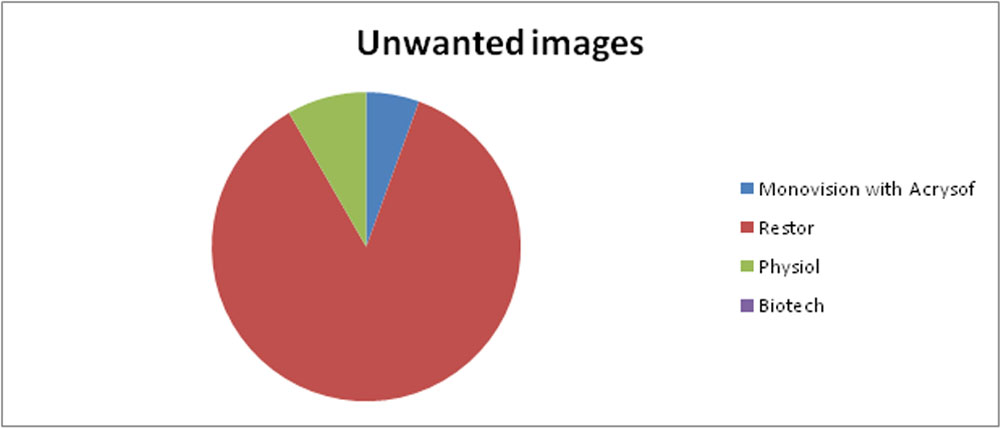
Unwanted images were more seen with Restor(31%) compared to Physiol(3%), monovision with Acrysof IQ(2%) and Biotech(0%). This is depicted in Figure 5
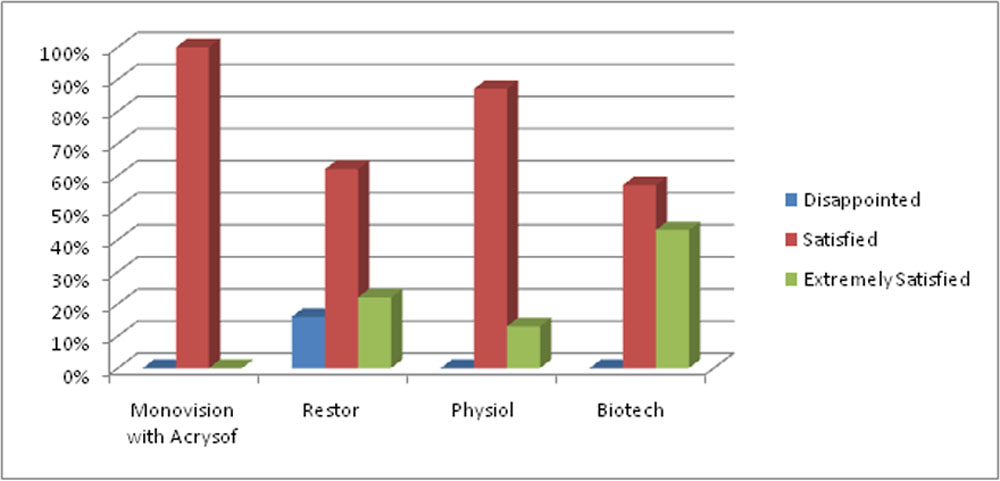
Extremely satisfied patients were more with Biotech(43%) compared to Restor(22%), Physiol(13%) but 16% Restor patients were disappointed . Patients with monovision with Acrysof IQ were 100% satisfied. This is depicted in Figure 6
For the Indian VFQ 33 Questionairre ,we obtained the following results.
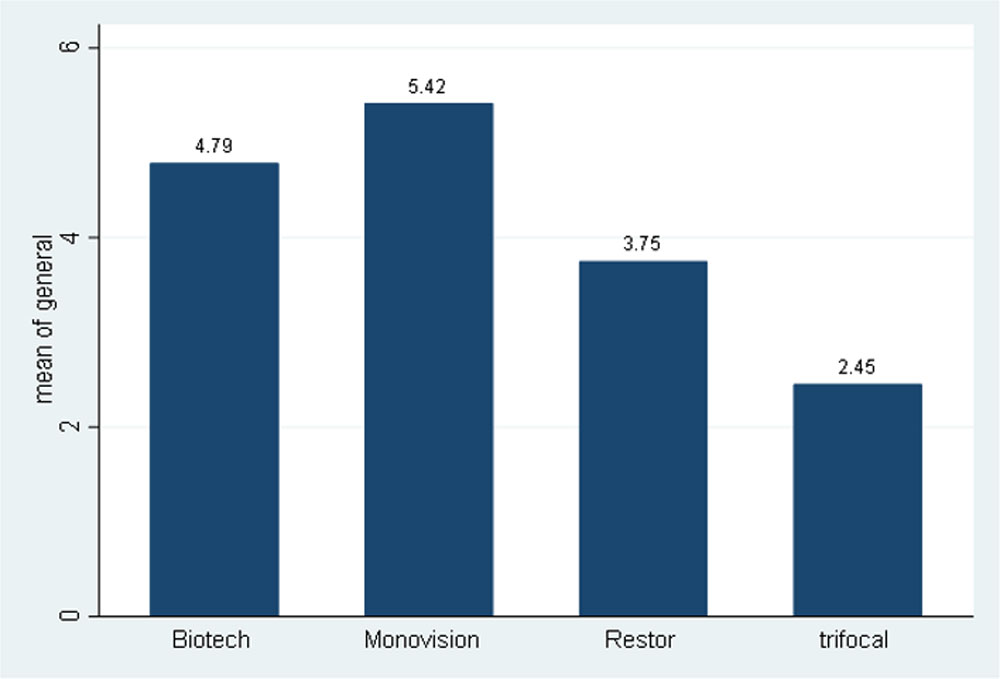
There was no statistical difference amongst the four groups of IOL’s with respect to mean of general functioning score in the VFQ 33 Questionairre (p= 0.0005) which is depicted in Figure 7
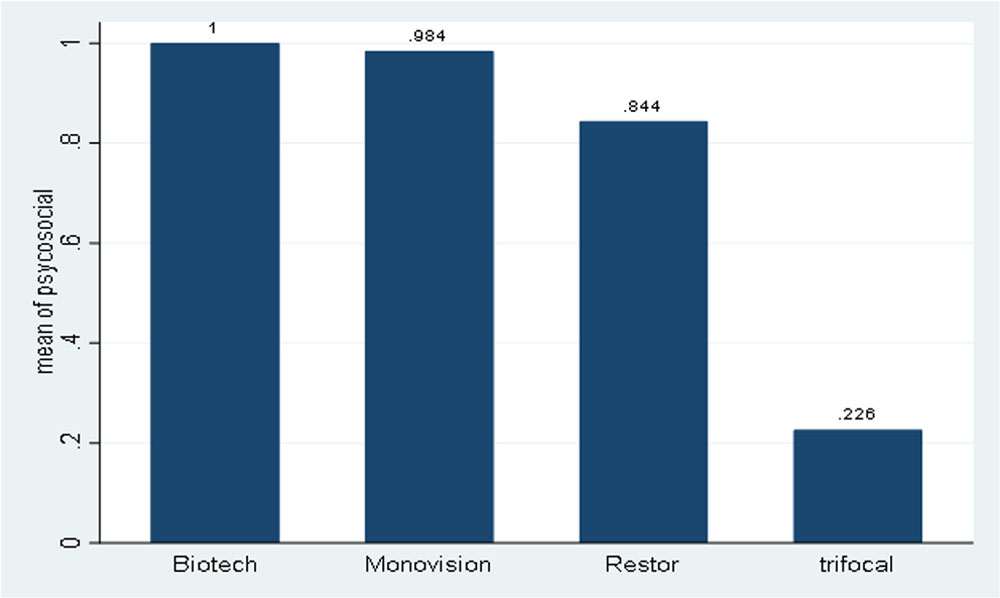
There was no statistical difference amongst the four groups of IOL’s with respect to mean of psychosocial functioning score in the VFQ 33 Questionairre (p= 0.0575),depicted in Figure 8
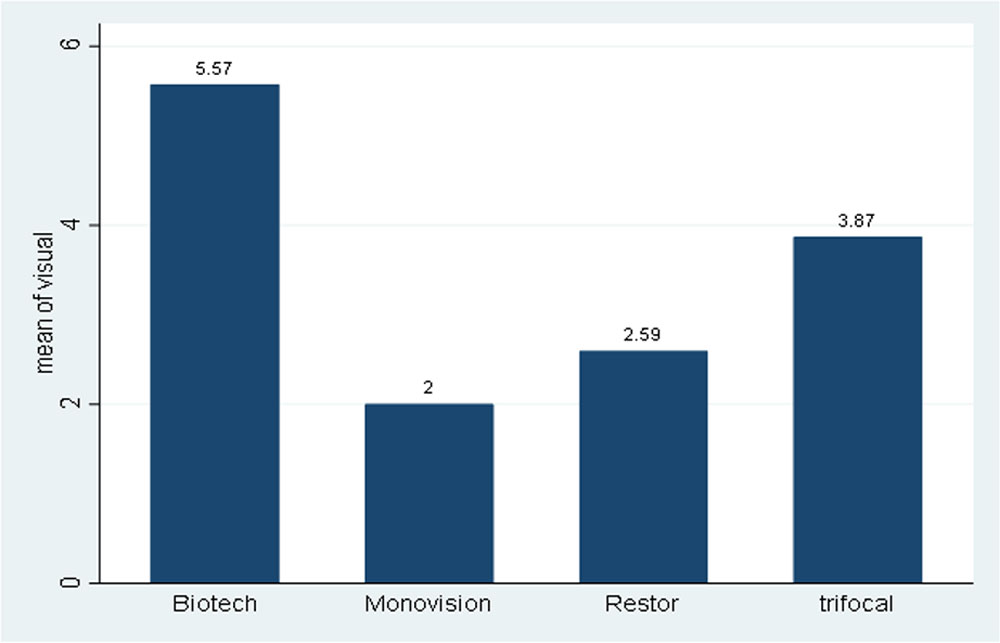
There was statistical difference amongst the four groups of IOL’s with respect to mean of visual functioning score in the VFQ 33 Questionairre (p< 0.0001), Monovision performed better amongst the 4 groups of IOL’s. This is depicted in Figure 9
Discussion:
All the above stated methods of IOL implantation appear to be viable approaches for the postoperative loss of accommodation following cataract extraction. All the study groups presented excellent outcomes in distance vision and visual function at various distances.Although there are no definite objective tests to diagnose the phenomenon of dysphotopsia, evaluation of the visual acuity alone is not sufficient in the assessment of postoperative visual function and quality of life. Taking into account the frequency of dysphotopsias that were detected in the examined patients, we can conclude that preexistent questionnaires demonstrate good reliability and provide an efficient way to identify dysphotopsias. According to the results of our study, this survey should be part of the routine postoperative follow-up, because focusing not only on surgical results, but on postoperative contentment too, cataract surgeries could bring a higher satisfaction and treatment options could bring about more specific results.
Conclusion: Our results confirm our clinical impression that when patient’s expectations are realistic, monovision is the treatment of choice, especially for patients with tight budgets.
References:
1.Mini-monovision versus multifocal intraocular lens implantation GeorgiosLabiris, MD, PhD, AthanassiosGiarmoukakis, MD, Maria Patsiamanidi, MD, Zois Papadopoulos, MD, Vassilios P. Kozobolis, MD, PhD. J Cataract refract surg 2014
2.Optical analysis, reading performance ,and quality-of-life evaluation after implantation of a diffractive multifocal intraocular lens: Jorge L. Ali_o, MD, PhD, Ana B. Plaza-Puche, MSc, David P. Pi~nero, PhD, Francisco Amparo, MD, Ram_onJim_enez, MSc, Jose L. Rodríguez-Prats, MD, Jaime Javaloy, MD, Vanessa Pongo, MD.J Cataract refract surg 2011
3.Visual function and patient satisfaction: Comparison between bilateral diffractive multifocal intraocular lenses and monovisionpseudophakiaFuxiang Zhang, MD, Alan Sugar, MD, Gordon Jacobsen, MS, Melissa Collins, COA
4.Optical analysis, reading performance ,and quality-of-life evaluation after implantation of a diffractive multifocal intraocular lens: Jorge L. Ali_o, MD, PhD, Ana B. Plaza-Puche, MSc, David P. Pi~nero, PhD, Francisco Amparo, MD, Ram_onJim_enez, MSc, Jose L. Rodríguez-Prats, MD, Jaime Javaloy, MD, Vanessa Pongo, MD.J Cataract refract surg 2011
5.Outcomes of a new diffractive trifocal intraocular lens Peter Mojzis, MD, PhD, FEBO, Pablo Pe~na-García, MSc, IvanaLiehneova, MD, Peter Ziak, MD, PhD, Jorge L. Ali_o, MD, PhD, FEBO.J cataract refract surg 2014
6.Visual outcomes and subjective experience after bilateral implantation of a new diffractive trifocal intraocular lens Amy L. Sheppard, PhD, Sunil Shah, MBBS, Uday Bhatt, MD, GurpreetBhogal, BSc, James S. Wolffsohn, PhD.J cataract refract surg 2013
7.Visual function of pseudophakicmonovisionversusmultifocalmonovision. Shimizu K. San Francisco: 2009. Apr 6 Paper presented at the: ASCRS Symposium on Cataract, IOL, and Refractive Surgery 2009
8.Development and validation of quality of life questionnaire in pseudophakic patients Wilson Takashi Hida et al Rev. Bras Ophtalmol. 2013; 72 (6): 388-95
Legends for figures:
Figure 1: The demographic data of the study
Figure 2: Bar Diagram of the gender distribution
Figure 3: Bar Diagram of the Best Corrected distance visual acuity among the 4 different groups of IOL’s
Figure 4: Bar Diagram of Primary outcome of the mean score for the Dysphotopsia Questionairre among 4 different IOL’s
Figure 5: Pie chart showing Percentage depiction of unwanted images seen in the different groups
Figure 6: Bar Diagram showing Percentage depiction of patient satisfaction among the four different groups
Figure 7: Bar Diagram which shows distribution of mean of general functioning score in the VFQ 33 Questionairre among the 4 different groups of IOL’s
Figure 8: : Bar Diagram which shows distribution of mean of Psychosocial functioning score in the VFQ 33 Questionairre among the 4 different groups of IOL’s
Figure 9: : Bar Diagram which shows distribution of mean of Visual functioning score in the VFQ 33 Questionairre among the 4 different groups of IOL’s
p<0.05
P=0.0005
P= 0.0575
P< 0.0001
Leave a Comment