

 FP720 : NO MORE ARGENTINIAN FLAGS WITH ZEPTO PRECISION PULSE
Dr.Amit Kumar Mahajan
Introduction
Improvement in surgical technique along with introduction of premium intra ocular lenses(IOLs) made cataract surgery as a part of Refractive Surgery. Making continuous curvilinear capsulorhexis (CCC) is the most crucial step in phacoemulsification surgery and remains a key to overall success of cataract surgery. With the advent of premium IOLs like toric and multifocal it became a must to have a perfectly sized and circular CCC. For smooth phacoemulsification surgery, for proper centration of IOLs and to reduce the chances of developing posterior capsular opacification intactness, size, shape & centration of CCC is very crucial. With conventional manual capsulotomy techniques either with cystitome or forceps there is always risk of CCC runoff or radial tears which extends quickly to periphery specially in white mature intumescent cataracts. Once this Splitting of anterior capsule occurs, the remainder of the surgery becomes extremely difficult and can lead to many complications like posterior capsule rupture, vitreous loss, nucleus drop , endothelial damage due to prolonged surgical time & decentered IOL.
So to overcome these difficulties Mynosys Cellular Devices Inc. (Fremont, California,USA) developed a new technique to reproducibly automate a perfectly sized and circular capsulotomy called Precision Pulse Capsulotomy (PPC) , under trade name ZEPTO and commercially launched in February 2017 in India for the first time in world.
Aim/Purpose
To study the effectiveness and safety of precision pulse capsulotomy(ZEPTO) in hyper mature white intumescent cataracts.
Settings
It was a prospective study conducted at Om Netralaya and Dental Clinic, Chalisgaon during June 2017 to March 2018.
Patients and Methods
It was a prospective case study of patients having white, intumescent,mature cataract who underwent phacoemulsification surgery with IOL implantation using Zepto PPC technique at Om Netralaya. Written informed consent is taken from all the patients in English as well as Marathi and standard protocol was followed.
Inclusion criteria
- Patients with no other ocular pathology than cataract
- Patients having white intumescent mature cataract who are prone for capsulotomy tears
Exclusion criteria
- Patients with preexisting ocular pathologies like glaucoma, weak zonules, traumatic cataract, complicated cataract
- Poorly dilating pupils less than 5mm
Procedure
All the surgeries were performed by single surgeon in same operation theatre at Om Netralaya, chalisgaon. All patients underwent phacoemulsification surgery under topical anesthesia with Alcon Centurion machine. Two side ports were made with 23G angled MVR disposable knife 180 degree apart from each other and 2.2mm main incision is taken temporally with disposable keratome. Trypan blue (Rhex ID) dye was used in all cases for proper visualization of anterior capsule. OVD used was 2% HPMC ( Aurovisc ) in all cases.
The Zepto handpiece (sterile, single use, disposable) consists of a circular nitinol ring covered by thin, soft, transparent silicone suction cup (SC) just like inverted frying pan. There is retractable metal push rod (PR) attached at tip of handpiece to elongate circular tip into small tubular structure. Handpiece was attached to power console and primed first using balanced salt solution(BSS) manually to remove all the air inside tubing. After filling anterior chamber (AC) with 2% HPMC , retractable metal push rod was pushed hard till click sound is heard to elongate the ring and suction cup into a narrower profile and inserted through 2.2mm incision into AC.
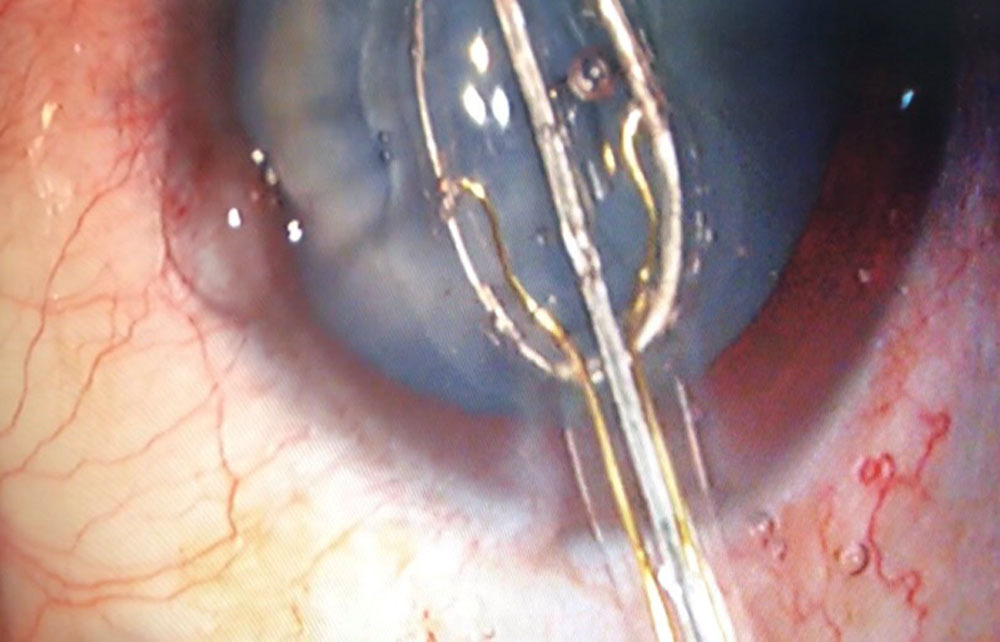
Now once in AC the PR is retracted immediately and kept at wound level for stability. As nitinol is super elastic shape memory alloy , after retracting PR ,the compressed tip resumes its original circular shape within seconds. The tip was then positioned at desired place on anterior capsular surface and a small amount of suction was applied through external console. This is very crucial to oppose the anterior capsule against the bottom edge of the nitinol ring. A rapid series of electrical pulses totaling 4ms in duration is used to create a capsulotomy. Once done then suction was released and tip was gently pushed out of AC.
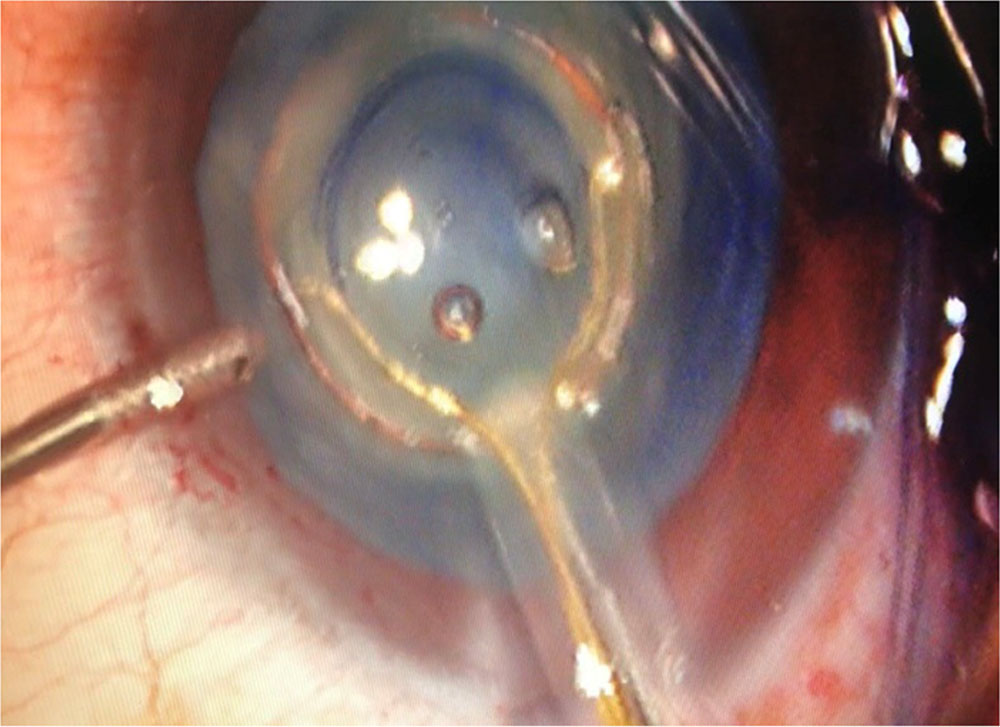
Once the capsulotomy was done,the nitinol ring broke into pieces and hence cannot be used again. The free cut portion of capsule was removed using forceps and capsulotomy was inspected for completeness before proceeding further. Phacoemulsification was completed and cortical wash was done by bi manual Irrigation and Aspiration canula. Foldable hydrophobic IOL was implanted in all cases.
Patient were examined on day 2,day 7 and at the end of one month after surgery. Main criteria studied was completeness of capsulotomy without any tags or extension. Other parameters studied were incision size before and after Zepto, endothelial cell count, zonular weakness due to Zepto, IOL stability and centration, anterior capsular opacification or contraction.
Results
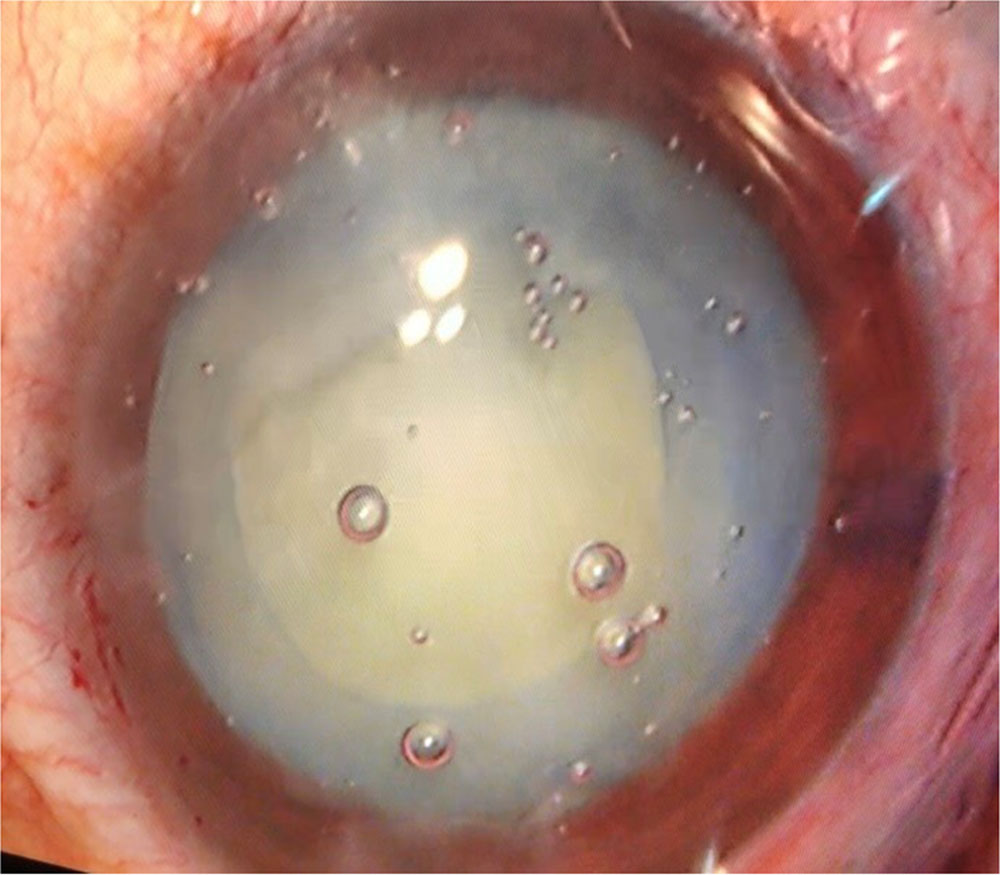
We have studied 15 eyes of 15 patients having white, intumescent, mature cataract prone for capsulotomy tear. There were 6 male and 9 female with age group ranging from 39-68 years. All eyes were well dilated with size of pupil more than 5mm. Average phaco energy used was CDE 15.06(+_3.50). Average preoperative endothelial cell count was 2305.77(+_340.39)whilepostoperative cell count was 2140(+_228.29) at the end of one month .Best corrected visual acuity was 6/9 in all cases at the end of one month with no one having developed cystoid macular edema which was confirmed on OCT also. No zonular weakness noticed in any case intra operatively. 14 cases had completely centered and circular capsulotomy without any complications. In one case capsulotomy was not complete at one place. Reason being energy was applied in little hurry before suction was complete and so at that point capsular contact with nitinol ring was lacking. In that case capsulotomy was easily completed using forceps.
In all the 15 cases, not a single case landed in Argentinian flag or rhexis run off.
Discussion
Over the past 50 years there have been more improvement in cataract surgery than in past 3000 years. Extracapsular cataract surgery created requirement of capsulotomy and phacoemulsification modified it to curvilinear continuous capsulorhexis(CCC). A lot of research work is still going on to automate this crucial steps. Few options available today are
- Femtosecond laser
- ZeptoPPC
- Aperture ctc
- Capsulaser
- miLoop
- Femtosecond Laser-femtosecond laser assisted cataract surgery (FLACS) is highly reproducible, uniformly more circular and has more precise diameter. However much higher capital is needed for it with huge recurring or procedural cost and workflow challenges with increased procedural time make it difficult in common scenarios.
- Aperture ctc- it should be available for human use in couple of years.
- Capsulaser- it uses new formulation of trypan blue to stain anterior capsule and laser device is attached to operating microscope to make capsular opening from 4.5mm to 6.5mm.
- miLoop- is actually endocapsular nitinol ring that acts like snare and bisects the nucleus from equator to equator and chops the cataract into small pieces. Though much cheaper than FLACS, it has significant disposable cost.
The name Zepto was chosen because in metric scale Zepto is one million time smaller than Femto. Both the small size of instrument and the several millisecond speed of capsulotomy creation inspired this name. The PPC technology mechanically and simultaneously cut all 360 degree of the apposed capsule without cauterizing it. So ocular tissue safety is achieved by extremely small and brief amount of energy applied and that too at the microscopic edges of nitinol ring. Secondly this nitinol ring is completely covered by silicone suction cup which again in turn covered by OVD.
As per the study carried out in human cadeveric eyes, the capsulotomy edge strength of PPC is much higher than manual CCC or FLACS and is likely due to its unique morphology.
PPC can be used in challenging cases like small pupil, calcified anterior capsule as it has very fast learning curve. As actual capsulotomy creation is automated, surgeon has to learn only insertion and removal of device from AC with centration and placement of the nitinol ring on anterior capsule surface.
Conclusion
The Zepto PPC technology creates a precise, well centered, circular capsulotomy used as apart of normal surgical sequence. The technique holds promise for complicated eyes also. Few more improvements in system like elimination of third party operator, a more accurate suction system, automation of manual release system and potential incorporation into phacoemulsification system might help in making capsulorhexis a complication free step of cataract surgery.
References
- Chang DF, Mamalis N, Werner L PRECISION PULSE CAPSULOTOMY-preclinical safety and performance Am J Opththal 2015
- Carifi G, Miller MH,Deshmukh RR-COMPLICATIONS AND OUTCOME OF CATARACT SURGERY COMPLICATED BY ANTERIOR CAPSULE TEAR J Cataract and Ref Surg 2014
- Assia EI, Legler UF, Apple DJ-THE CAPSULAR BAG AFTER LONG AND SHORT TERM FIXATION OF INTRA OCULAR LENSES -Ophthalmology 1995
- Chang DF-A ZEPTO PRECISION PULSE CAPSULOTOMY-A new automated disposable capsulotomy technology. IJO 2017
- Liu JW, Haw WW- OPTIMISING OUTCOME OF MULTIFOCAL INTRA OCULAR LENSES -curropinophthal 2014
Leave a Comment