

Dr.PRACHI SANKHE,Dr.Vijay Shetty,Dr.Suhas Haldipurkar,Dr.Harsha Dahake
Abstract:
Aim : To assess the accuracy of Holladay1, Hoffer Q, SRK/T, Haigis , Barrett universal II, Hill-RBF in prediction of the post operative refractive outcome.
Setting: Laxmi Eye Institute, Panvel.
Design: Retrospective Study observational study
Methods: This study included 450 eyes of 393 patients who underwent uneventful cataract surgery with IOL implantation of acrysof IQ®SN60WF or tecnis®ZCB00 IOL from January 2016 to january 2018 .Post operative refractive error at final follow up and the power of the IOL implanted were used to calculate the ideal IOL power .IOL power prediction with 6 modern formulae were compared with the ideal IOL power to calculate the accuracy of IOL power calculation. This retrospective study included 450 eyes of 393 patients who underwent uneventful cataract surgery with IOL implantation of acrysof IQ®SN60WF or tecnis®ZCB00 IOL from January 2016 to january 2018 .Post operative refractive error at final follow up and the power of the IOL implanted were used to calculate the ideal IOL power .IOL power prediction with 6 modern formulae were compared with the ideal IOL power to calculate the accuracy of IOL power calculation.
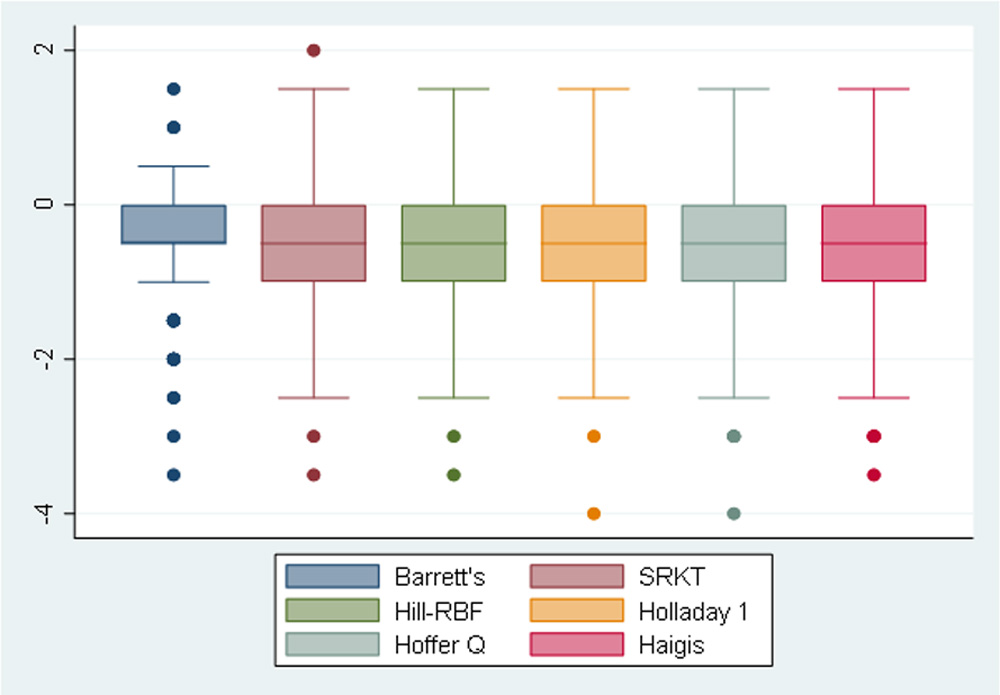
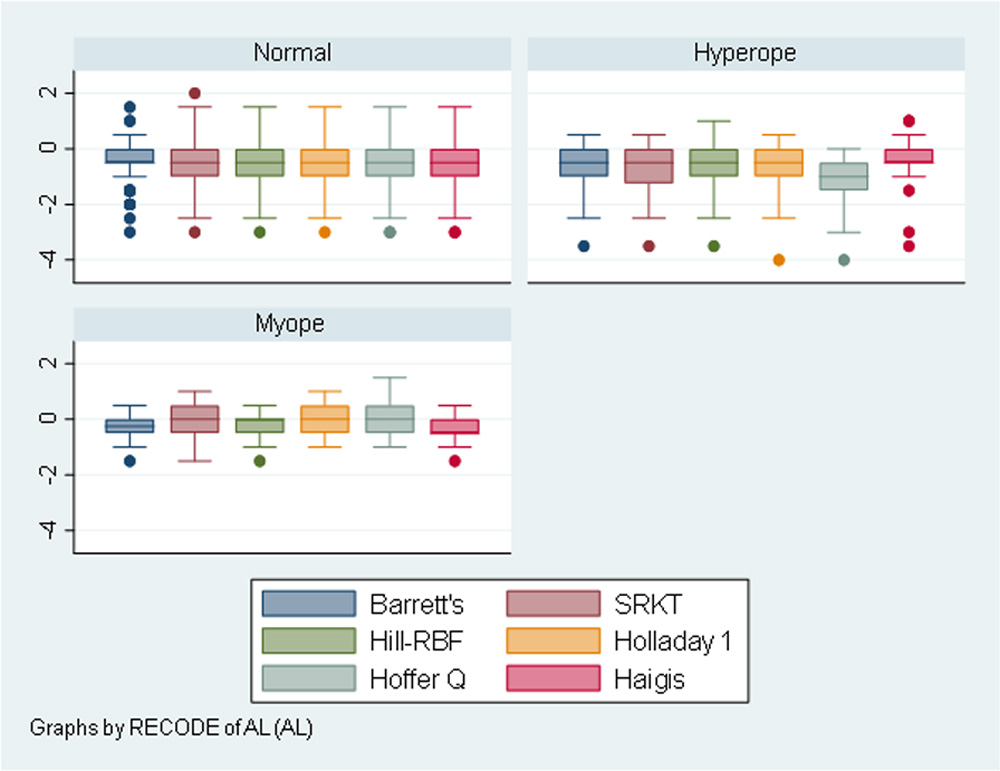
Results: The median error in IOL power calculation was -0.5 in all 6 formulae. Prediction error within -0.5 to +0.5 D for Barrett universal II(83.25%)was the best followed by SRK-T(71.91%), Holladay1(69.33%), Hill RBF(67.01%), HofferQ(66.24%), Haigis(65.46%). In normal eyes (22-25mm),barrett performed better than the other formulae(p=<.001). In hyperopes (AL-<22mm) and myopes(AL->25mm),barrett performed marginally better than other formulae (p=> 0.5).
Conclusion: Barrett formula gives predictable outcome over the entire axial length.
Full Text:
Introduction:
Cataract surgery is the most commonly performed surgery in Ophthalmology. Patient’s expectation for best refractive outcome after cataract surgery has spurred ongoing developments in Intraocular Lens power calculation formulae1. Though increased precision of preoperative evaluation and improved surgical technique have contributed to better postoperative refractive results2 , biometry plays the most important role. Thus calculating accurate IOL power serves the purpose maximum. Three essential parameters needed for accurate IOL power calculation are keratometry , axial length and effective lens position. Measurement of axial length and Keratometry is done using optical biometry (Lenstar LS 900). Effective lens position (post op ACD) can be predicted using 3 factors which are Pre operative measurements( K, AL, ACD, LT, WTW etc.) , Surgeon factors (Individual surgeon technique and surgery) and IOL characteristics(diameter, thickness, angulation etc). Effective lens position is calculated by using IOL formulae. There are 6 generations of formulae, of which the most commonly used are Hoffer Q, Haigis, Holladay1, SRK/T, Barrett universal II and Hill RBF.
Aim of the study:
To assess the accuracy of Holladay1, Hoffer Q, SRK/T, Haigis , Barrett universal II, Hill-RBF in prediction of the post operative refractive outcome.
Need for the study:
- No similar studies have been conducted which compare the accuracy of different formulae in Indian eyes.
- No similar study has been performed using both Alcon AcrySof IQ® SN60WF/Tecnis® ZCB00 Intra ocular lenses
Methodology:
Study design: Retrospective observational study
Study site: Laxmi Eye Institute, Panvel
Sample size: 450 eyes of 393 patients who underwent uneventful cataract surgery with IOL implantation of acrysof IQ®SN60WF or tecnis®ZCB00 IOL from January 2016 to january 2018
Inclusion criteria:
All consenting patients between age group of 40-90 years with uncomplicated age related cataract undergoing uneventful phacoemulsification cataract surgery with in the bag insertion of Alcon AcrySof IQ® SN60WF/ Tecnis® ZCB00 IOLs.
Exclusion criteria:
- Prior history of any intraocular surgery.
- Additional procedures during cataract surgery, complicated cataract surgery.
- Incomplete biometry.
- Corneal astigmatism more than 3.0 diopters (D).
- Patients with post operative best corrected vision of less than 6/12 .
- Any active ocular disease (diabetic retinopathy , macular degeneration, glaucoma with field defects )
Study procedure:
Preoperatively:
- The patients AL,Anterior chamber depth(ACD) and keratometric (K1 &K2)values were retrieved from records for calculation of formulas through Lenstar LS 900.
- A constant was optimised.
- Assessment of the cataract using slit lamp.
Intraoperatively-
Power of the intraocular lens inserted was noted
Post operatively:
- Follow-up (21±7 days post surgery)
- BCVA, post operative refraction was noted.
- Spherical equivalent of the refractive error was deduced.
- Eyes were divided into subgroups based on axial length (AL) as short (AL<22mm), medium (AL 22-25mm), long (AL>25) eyes. Using optimised lens constants the predicted postoperative spherical equivalent refraction for each patient was calculated.
- This was done for both the lenses (Alcon AcrySof IQ® SN60WF/Tecnis® ZCB00) IOL.
Prediction error calculation:
- Target refraction for ideal IOL power was kept between:+0.1 to -0.2 to round off the IOL power to nearest 0.5 D(as IOL power is available in the steps of 0.5D)
- Ideal IOL power was calculated as:IOL power implanted+spherical equivalent*1.5
- Eg:IOL power implanted 15D,
post op spherical equivalent:-2.00D
ideal IOL power=-2*1.5=-3.00
15+(-3.00)=12D
- Prediction error =difference between the ideal IOL power and predicted IOL power.
Statistical Methods:
- Data entered in MS Excel 2007 and analyzed using STATA Version 13.1.
- the Mean numerical prediction Error(ME), Median prediction error for each formula was calculated
- The differences in prediction error between formulae assessed using the Friedman test.
Results:
| diff | Barrett
|
SRK-T
|
Hill-RBF
|
Holladay
|
HofferQ
|
Haigis
|
P value
|
|
| normal | -0.5 to +0.5 | 323(83)
|
279(71)
|
260(67)
|
269(69)
|
257(66)
|
254(65)
|
<0.001
|
| hyperope | -0.5 to +0.5 | 23(71)
|
20(62)
|
21(65)
|
19(59.3)
|
13(40)
|
23(71)
|
0.06
|
| myope | -0.5 to +0.5 | 27(90)
|
26(86)
|
26(86)
|
25(83.33)
|
27(90)
|
24(80)
|
0.23
|
Discussion:
Measurement of axial length and Keratometry is done using optical biometry(Lenstar LS 900). Lenstar LS 900 is based on Optical low coherenceinterferometry (OLCR) 3 . It measures the axial length (AL), anterior chamber depth(ACD), anterior depth (AD), central corneal thickness (CCT), lens thickness (LT),and horizontal white-to-white distance (WTW).The only missing link needed to accurately calculate IOL power is effective lensposition (post op ACD). It Cannot be measured , but can be predicted using 3factors which are Pre operative measurements( K, AL, ACD, LT, WTW etc.) ,Surgeon factors (Individual surgeon technique and surgery) and IOLcharacteristics(diameter, thickness, angulation etc). Effective lens position is calculated by using IOL formulae. There are 6 generations of formulae, of which the most commonly used are Hoffer Q, Haigis, Holladay1, SRK/T, Barrett universal II and Hill RBF. Hoffer Q, Holladay 1, SRK/T requires only 2 parameters, keratometry and axial length . Haigis uses additional 3 rd parameter anterior chamber depth3 . Hill RBF uses pattern recognition and data interpolation to predict postoperative refraction 1 . Barrett universal II uses 5 inputs (AL, K, ACD, LT, WTW).
The median error in IOL power calculation was -0.5 in all 6 formulae. Prediction error within -0.5 to +0.5 D for Barrett universal II(83.25%)was the best followed by SRK-T(71.91%), Holladay1(69.33%), Hill RBF(67.01%), HofferQ(66.24%), Haigis(65.46%). In normal eyes (22-25mm),barrett performed better than the other formulae(p=<.001). In hyperopes (AL-<22mm) and myopes(AL->25mm),barrett performed marginally better than other formulae (p=> 0.5)
Conclusion:
Barrett formula gives predictable outcome over the entire axial length.
References:
- Kane JX, Van Heerden A, Atik A, Petsoglou C. Accuracy of 3 new methods for intraocular lens power selection. Journal of Cataract & Refractive Surgery. 2017 Mar 31;43 (3):333-9.
- Kane JX, Van Heerden A, Atik A, Petsoglou C. Intraocular lens power formula accuracy: Comparison of 7 formulas. Journal of Cataract & Refractive Surgery. 2016 Oct 31;42 (10):1490-500
- Cooke DL, Cooke TL. Comparison of 9 intraocular lens power calculationformulas. Journal of Cataract & Refractive Surgery. 2016 Aug 31;42(8):1157-64.
- Aristodemou P, Cartwright NE, Sparrow JM, Johnston RL. Formula choice: Hoffer Q, Holladay 1, or SRK/T and refractive outcomes in 8108 eyes aftercataract surgery with biometry by partial coherence interferometry. Journalof Cataract & Refractive Surgery. 2011 Jan 31;37 (1):63-71.
- Narváez J, Zimmerman G, Stulting RD, Chang DH. Accuracy of intraocularlens power prediction using the Hoffer Q, Holladay 1, Holladay 2, andSRK/T formulas. Journal of Cataract & Refractive Surgery. 2006 Dec 31;32(12):2050-3.
- Olsen T, Hoffmann P. C constant: new concept for ray tracing–assistedintraocular lens power calculation. Journal of Cataract & RefractiveSurgery. 2014 May 31;40 (5):764-73.
- MacLaren RE, Natkunarajah M, Riaz Y, Bourne RR, Restori M, Allan BD.Biometry and formula accuracy with intraocular lenses used for cataractsurgery in extreme hyperopia. American journal of ophthalmology. 2007Jun 30;143 (6):920-31.
Leave a Comment