

Dr.Pradeep Kumar,Dr.Santosh Kumar,Dr.(col) Mrs Shashi Prabha Prasad,Dr.Avadhesh Oli
ABSTRACT
Aim: Quality of life parameters in uveitis treated with systemic steroids versus DMARDS. Prospective, descriptive study. Introduction: Uveitis pts are managed with immune suppression. Steroids or DMARDS (Disease modifying anti rheumatic drugs) are routinely used. Steroids may adversely affect the quality of life (QOL) of patients. Materials and Methods: Consecutive cases meeting criteria for long term immune suppression enrolled. Informed choice of steroids and DMARDS given. Questionnaire based QOL indices measured at 0, 1, 4, 12, 24, 36 & 48 weeks. Patients completing min 24 week analyzed.Uveitic success rates calucated as secondary objective. Result: N=22. Gp 1 (Steroids) 10 pts and Gp 2 (DMARDS) 12 pts. QOL indices were statistically and clinically better in Gp 2 compared to Gp 1 (p<0.05) at 12, 24, 36 & 48 weeks. Uveitic treatment success rates did not vary significantly between the two Gps. Conclusion: DMARDS offer a better QOL, compared to systemic steroids, to patients requiring long-term immunesuppression for uveitis without affecting the management outcomes.
INTRODUCTION
Uveitis affects all age groups with a varying spectrum of visual morbidity. The chronic uveitis entities require systemic immunesuppression in a large number of cases. Immune suppression adversely affects the quality of life of individuals (1). The impact is prominent both in the pediatric age group (2), and the working adults (3). The impact is not only vision related, but also psychological (4), social (5) and economical.
The options of therapy in uveitis have diversified from systemic steroids to intravitreal steroid implants, antimetabolites and biologics. The quality of life impact due to adverse effects of steroids is well documented in conventional textbooks. The non-steroid option in the form of disease modifying anti rheumatic agents have recently been explored. However, no head to head comparison of the two options in the management of uveitis has been undertaken before. Moreover, a specific study into the quality of life impact of such therapy is unique.
The results of this study will provide robust evidence to clinicians in choosing one option over the other while deciding over the choice of immunesuppression in chronic uveitis.
MATERIALS AND METHODS:
Design: Prospective, Comparative, Cohort
Consecutive cases of chronic anterior, intermediate or posterior uveitis meeting criteria for long-term immune suppression were enrolled in the study. Informed choice of systemic steroids and DMARDS was given to each patient and the patients were free to choose the treatment arm they preferred. Patients receiving systemic steroids were assigned to group 1 (Gp 2) and those receiving DMARDS were assigned to group 2 (Gp2).
Inclusion criteria:
- Confirmed diagnosis of uveitis
- Meets criteria for immunesuppression
- Willingness to be administered QOL questionnaire periodically
Exclusion criteria:
One eyed patient
- Patients with pre-existing psychiatric ailments
- Prior history of receiving systemic immunesuppression for any disease
All patients underwent careful clinical evaluation including general, systemic and ophthalmic evaluation. A detailed assessment of vision, slit lamp examination and biomicroscopy was done. Patients were subjected to fundus autoflorescence, fluorescein angiography and optical coherence tomography where indicated.
The quality of life questionnaires included National Eye Institute visual function questionnaire(6) and Quality of life scale(7). The questionnaires were administered at 0, 1, 4, 12, 24, 36 & 48 weeks.
Uveitic success rates calucated as secondary objective. This was defined as either disease remission on drugs or a two step decrease in the SUN classification scale of ocular inflammation. The duration of time required to achieve remission and the number of disease relapses were noted.The scores obtained were tabulated using Microsoft excel and underwent statistical analysis using EpiInfo statistical software. Patients completing min 24 week were analyzed.
RESULTS:
N=22, comprising 14 males and 08 females. The mean age was 27.6 years. Gp 1 (Steroids) had 10 pts and Gp 2 (DMARDS) 12 pts. All 22 patients completed a minimum of 24 weeks while 16 patients completed 48 weeks.
QOL indices were statistically and clinically better in Gp 2 compared to Gp 1 (p<0.05) at 12, 24, 36 & 48 weeks in both the National Eye Institute visual function questionnaire and Quality of life scale scores.
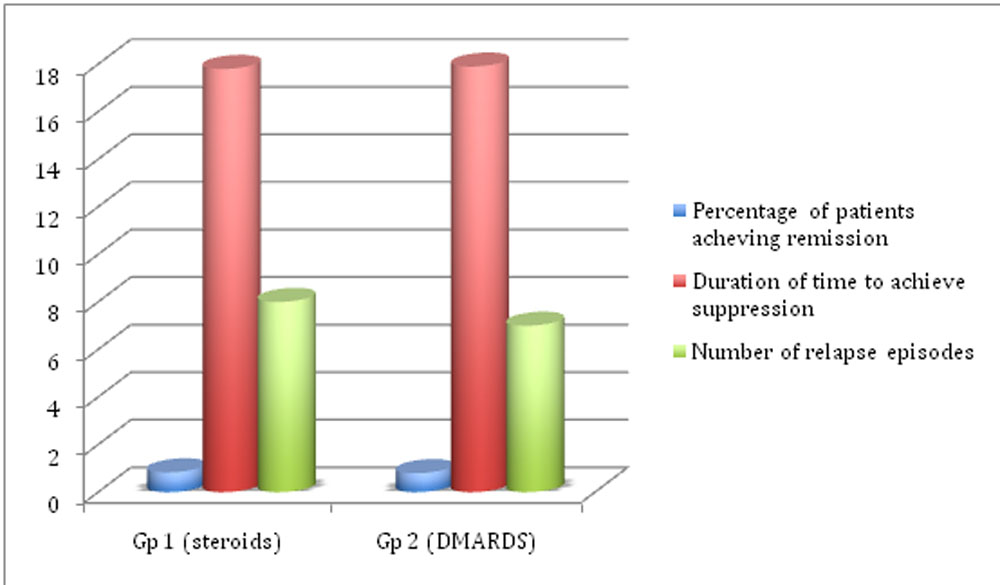
Uveitic treatment success rates did not vary significantly between the two Gps.
DISCUSSION
The treatment of any disease is considered a success not only by changes in clinical parameters, but also by the patient’s perception of the impact in their quality of life (5). The impact of immunesuppression has been studied separately for the usage of steroids (8)(6)as well as DMARDS like antimetabolites (9) and biologics(10) in different types of uveitic entities. Similar studies exist for the use of intravitreal therapies like Fluocinolone(11), dexamethasone (12) and adalimumab.
A knowledge gap existed in comparing the QOL impact of systemic steroids versus DMARDS. Both the therapies require close monitoring by the physician. However the adverse effects of steroids are mostly chronic and more frequent compared to the acute, uncommon but more devastating effects of DMARDS. This leads to an impact on the social, economic and psychological health of patient (13). The adverse effects vary from obesity to sexual dysfunction, and each comes with poor QOL indices. Similarly, the achievement of remission in the disease process itself effects the vision related QOL.
The results of our study demonstrate the efficacy of DMARDS in offering a better QOL, in both the visual and systemic impact. This offers evidence to patients and clinicians in making an informed choice about choosing the therapy for immunesuppression
LIMITATIONS
The study did not consider the life threatening nature of certain adverse effects of DMARDS and steroids, which could influence the choice of therapy. Moreover, a short course of steroids was used as rescue therapy in two patients on DMARDS.
CONCLUSION
DMARDS offer a better QOL, compared to systemic steroids, to patients requiring long-term immunesuppression for uveitis without affecting the management outcomes. We recommend a larger study to pool the data on QOL parameters in patients of uveitis on long termimmunesuppression.
REFERENCES
- Kaleemunnisha S, Sudharshan S, Biswas J. Quality of life in non-infectious uveitis patients on immunosuppressive therapy. Middle East Afr J Ophthalmol. 2014 Sep;21(3):225–31.
- Sen ES, Morgan MJ, MacLeod R, Strike H, Hinchcliffe A, Dick AD, et al. Cross sectional, qualitative thematic analysis of patient perspectives of disease impact in juvenile idiopathic arthritis-associated uveitis. PediatrRheumatol Online J. 2017 Aug 4;15(1):58.
- Jalil A, Yin K, Coyle L, Harper R, Jones NP. Vision-related quality of life and employment status in patients with uveitis of working age: a prospective study. OculImmunolInflamm. 2012 Aug;20(4):262–5.
- Parker DM, Angeles-Han ST, Stanton AL, Holland GN. Chronic Anterior Uveitis in Children: Psychosocial Challenges for Patients and Their Families. Am J Ophthalmol. 2018 Jul;191:xvi – xxiv.
- Maca SM, Amirian A, Prause C, Gruber K, Mejdoubi L, Barisani-Asenbauer T. Understanding the impact of uveitis on health-related quality of life in adolescents. ActaOphthalmol (Copenh). 2013 May;91(3):e219–24.
- Tan P, Koh YT, Wong PY, Teoh SC. Evaluation of the impact of uveitis on visual-related quality of life. OculImmunolInflamm. 2012 Dec;20(6):453–9.
- Burckhardt CS, Anderson KL. The Quality of Life Scale (QOLS): Reliability, Validity, and Utilization. Health Qual Life Outcomes. 2003 Oct 23;1:60.
- Multicenter Uveitis Steroid Treatment (MUST) Trial Follow-up Study Research Group. Quality of Life and Risks Associated with Systemic Anti-inflammatory Therapy versus FluocinoloneAcetonide Intraocular Implant for Intermediate Uveitis, Posterior Uveitis, or Panuveitis: Fifty-four-Month Results of the Multicenter Uveitis Steroid Treatment Trial and Follow-up Study. Ophthalmology. 2015 Oct;122(10):1976–86.
- Niemeyer KM, Gonzales JA, Rathinam SR, Babu M, Thundikandy R, Kanakath A, et al. Quality-of-Life Outcomes From a Randomized Clinical Trial Comparing Antimetabolites for Intermediate, Posterior, and Panuveitis. Am J Ophthalmol. 2017 Jul;179:10–7.
- Sakai T, Watanabe H, Kuroyanagi K, Akiyama G, Okano K, Kohno H, et al. Health- and vision-related quality of life in patients receiving infliximab therapy for Behcet uveitis. Br J Ophthalmol. 2013 Mar;97(3):338–42.
- Sugar EA, Venugopal V, Thorne JE, Frick KD, Holland GN, Wang RC, et al. Longitudinal Vision-Related Quality of Life for Patients with Noninfectious Uveitis Treated with FluocinoloneAcetonide Implant or Systemic Corticosteroid Therapy. Ophthalmology. 2017;124(11):1662–9.
- Squires H, Poku E, Bermejo I, Cooper K, Stevens J, Hamilton J, et al. A systematic review and economic evaluation of adalimumab and dexamethasone for treating non-infectious intermediate uveitis, posterior uveitis or panuveitis in adults.Health Technol Assess Winch Engl. 2017;21(68):1–170.
- Gui W, Dombrow M, Marcus I, Stowe MH, Tessier-Sherman B, Yang E, et al. Quality of Life in Patients with Noninfectious Uveitis Treated with or without Systemic Anti-inflammatory Therapy. OculImmunolInflamm. 2015 Apr;23(2):135–43.
TABLES
Table No 1: Mean QOL scores for Gp1 and Gp 2
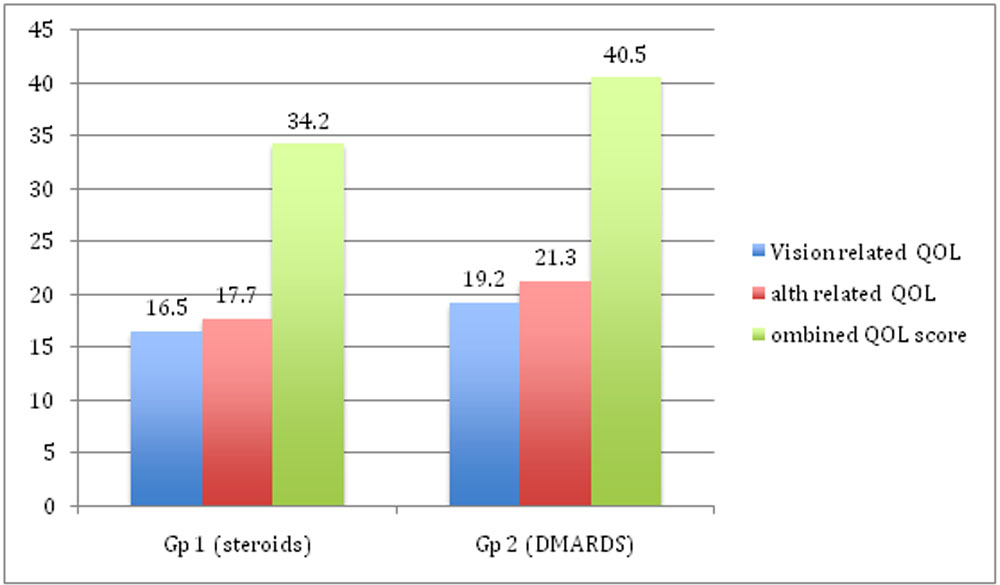
Table No 2: Uveitis treatment success rates
Leave a Comment