

Dr.Mihir Trilok Kothari,Dr.RISHIKA JAIN
Introduction: Daily dose of atropine 0.01% eye drops is an effective first-line treatment in children aged 6 to 12 years with documented myopic progression of -0.5D in the preceding year and advised to be continued for at least 2 years.[1]The incidence of allergy to 0.01% atropine eye drops is 1%.[1]We describe the clinical features of allergy to atropine eye drops in 3 myopic children and provide a clinical algorithm of its management.
Subjects and methods: The allergy was diagnosed on the basis of a history of bothersome itching in the eyes that commenced only after using atropine eye drops and subsided promptly following the cessation of the atropine drops. The patients used 0.01% atropine eye drops topically. Single drop was instilled in the lying down or reclining position in the lower cul-de-sac. The parents were not instructed on the exact technique of the instillation of the eye drop, punctal occlusion and periocular care while instilling the drops.The atropine eye drops were instilled at night and the patients were followed up every 6 months for the evaluation of refractive changes. Once a patient developed bothersome itching following the use of atropine eye drops, the parents were advised to stop the drops immediately in preferably one (more affected) eye or both the eyes. The parents were asked to come to the clinic for a complete ophthalmic examination or send the face photos by email. If the itching reduced and later subsided after cessation of the atropine eye drops, an allergy to atropine eye drops was diagnosed.
Results: Three children developed allergy to 0.01% atropine eye drops (Table 1)
Table 1: General characteristics of the patients with atropine allergy.
| Patient 1 | Patient 2 | Patient 3 | |
| Age in years at the time of diagnosis | 15 | 5 | 14 |
| Gender | Male | Female | Male |
| Duration of use | 1 year | 4 months | 1 month |
| Concentration of atropine used | 0.01% | 0.01% | 0.01% |
| Brand of atropine | Prepared by diluting 1% eye drops Jawa™ to the water for injection. | Prepared by adding atropine injection (0.6mg/1ml) to Moisol™ eye drops (5ml) | Prepared by diluting 1% eye drops Bell pino™ to the water for injection. |
| Frequency of use | Once at night | Once at night | Once at night |
| Pre existing allergic disease | Chronic allergic rhinitis, Chronic allergic conjunctivitis. Had developed allergy to 1% atropine use after 3 years use. | Allergic rhinitis | No history |
The most common symptom of atropine allergy was itching, present in all the patients, followed by persistent burning sensation (Table 2). The most common sign of atropine allergy was periocular redness and the swelling of both the eye lids.
Table 2: Ocular symptoms and signs of allergy to atropine eye drops.
| Patient 1 | Patient 2 | Patient 3 | |
| Itching | + | + | + |
| Burning | + | + | + |
| Swelling of lid | + | + | + |
| Periocular redness | + | + | + |
| Conjunctival congestion | – | + | – |
| Discharge | + | – | – |
| Loss of eyelashes | + | – | – |
| Erosions | + | – | – |
| Exaggerated under eye fold | – | + | – |
| Hypopigmentation | + | – | – |
| Increased vascularity | + | – | – |
In this group of patients, the symptoms of atropine allergy were acute or subacute in onset and rapidly progressed. The symptoms worsened with the continued use.
Discussion:
In this study we found that atropine allergy could affect children irrespective of their age and gender. The incidence and severity of allergy could be higher with higher concentration of atropine, longer use and more frequent application. Manifestations of atropine allergy in the eye can be divided into 1) ocular manifestations, 2) periocular manifestation and 3) mixed manifestations (Table 3).
Table 3: Clinical classification of atropine eye allergy
| Symptoms | Signs | |
| Ocular type | Itching, burning , conjunctival redness, discharge, eyelash matting, light sensitivity | Follicular conjunctival reaction, hyperemia, reduced tear film break up time |
| Periocular type | Swelling, itching ,redness
|
Lid edema, hyeremia, papules, macules,vesicles,excoriation,madarosis,hypopigmentation,dry scaly lichenified plaques |
It is possible that the patients with preexisting ocular or systemic allergy, dry eye disease,meibomeibomian gland dysfunction etc may have a higher incidence if allergies.
We found that the preservative used in current formulations of 0.01% atropine eye drops was stabilized oxychloro complex. In patient 2, Moisol® eye drops was used to prepare 0.01% atropine. The preservative in Moisol® eye drops is BAK, which might have increased the chances of child getting the allergy. In that patient, recurrent lid edema and redness subsided after changing to a BAK free formulation (Myopin® eye drops, Appasamy, Chennai).
When stopped in time, the patients with atropine allergy experience prompt and complete reversal of all the manifestations of ocular allergy. We recommend that the patients suspected to have allergy to atropine eye drops should promptly stop the eye drops in the more affected eye and report the improvement of the symptoms to the treating ophthalmologists within 72 hours.
The ophthalmologists should follow a specific clinical algorithm to diagnose and manage the patients suspected to have allergy to atropine eye drops.
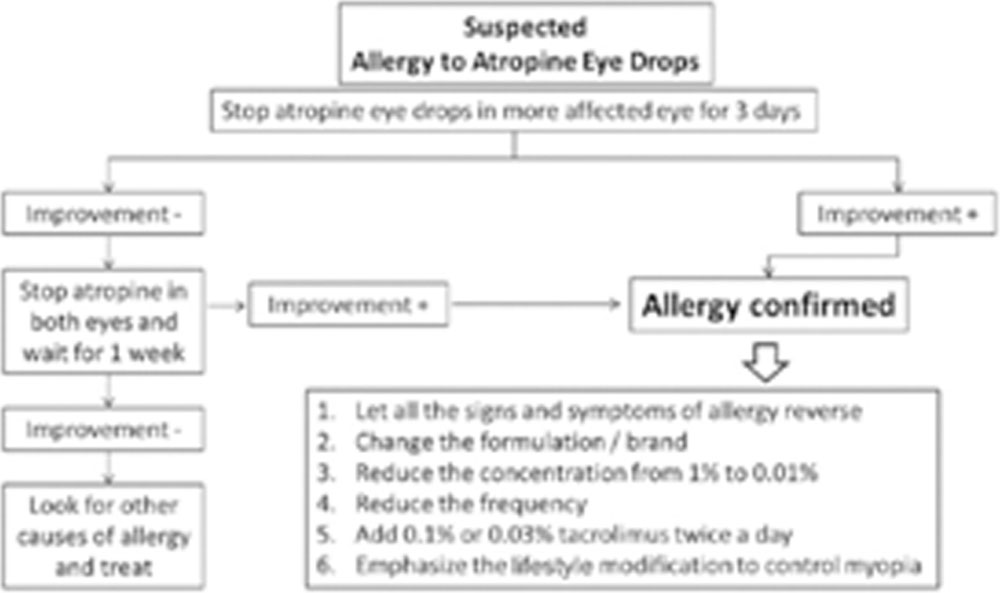
One may restart the eye drops in one eye after a few days or after a patch test and watch for the response. In case of the recurrence, change of formulation, reducing the concentration, or frequency of application and a simultaneous use of immunomodulator viz. Tacrolimus may help. In some cases, where it may not be possible to reinstitute the therapy, life style modifications should be emphasised to slow the progression of myopia.
Changes in Pattern Electroretinogram with 0.01% Atropine eye drops:
We obtained full field ERG (FFERG), PERG and MFERG from the eyes of the authors (subject 1, XY, male, 43 years old, high myope with best corrected vision 20/20 and subject 2, XX, female, 32 years old, emmetrope with best corrected vision 20/20). Both the subjects underwent ERGs on a Roland Consult ERG machine (Brandenburg, Germany) and DTL electrodes using ISCEV standard protocol. After obtaining the baseline ERGs, one drop of 0.01% atropine eye drop (Myopin®, Appasamy, Chennai, India) was instilled four times at an interval of one minute in the right eye of subject 1 and left eye of subject 2. The other eye was used as a “control.”
Forty five minutes after application of 0.01% atropine eye drops, ERGs were repeated using the same protocol. This was immediately followed by anterior segment optical coherence tomography (ASOCT) using Cirrus HD-OCT (Zeiss, Germany) to document the biometric changes. As such, the ERG technician and the electrophysiologist (ZZ) were unaware about which eye had received atropine eye drops.
One week later ERGs were re-recorded. The “control” eye of each subject (as designated above) was dilated with two drops of tropicamide 0.8%-phenylephrine 5% eye drops (Itrop plus®, Cipla, Mumbai, India). After 45 minutes, the ERGs were obtained from both the eyes to assess the effect of mydriasis and loss of accommodation sans “atropine effect”.
No significant changes were found with either Myopin® or Itrop plus® on FFERG and MFERG. PERGs demonstrated profound, reversible reduction in the amplitude of P50 (N35-P50) in the Myopin® treated eyes than Itrop plus® treated eyes.
The biometric changes on AS OCT as well as P50 changes were more profound in subject 1, who had light colored iris compared to subject 2.
Atropine is a potent anticholinergic drug and a variety of vertebrate species possess cholinergic transmitting mechanisms in their retinae.[3-5] The acetylcholine-receptors (AchR) are detected in the
Figure 1: PERGs of subjects 1 and 2 before and after 0.01% atropine eye drops. (a) Baseline PERG of subject 1. (b) After 0.01% atropine eye drops- demonstrating a decrease in P50 amplitude from 2.58µv to 600nv on small checker board pattern. (c) Baseline PERG of subject 2. (d) After 0.01% atropine eye drops- demonstrating a decrease in P50 amplitude from 4.10 µv to 2.51 µv on small checker board pattern. outer and inner plexiform layers of the birds and mammals with a considerable interspecies variability in its distribution.[5]
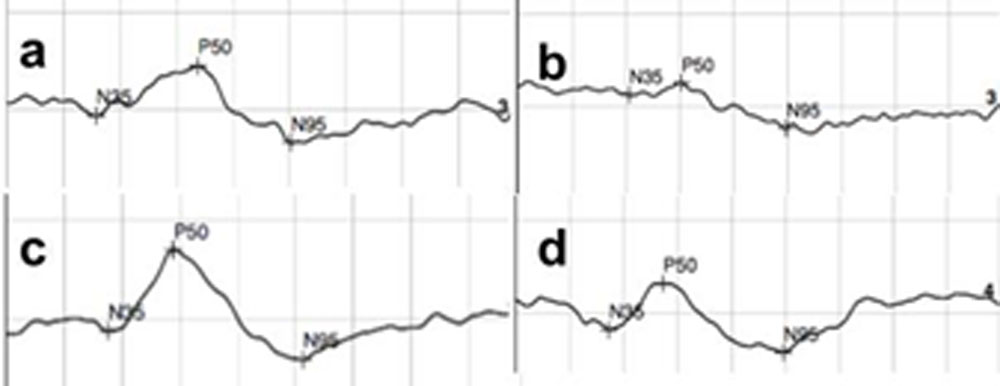
Table1:
Biometric changes (Anterior segment OCT) and changes in PERG after Myopin® eye drops and Itrop plus® eye drops.
| Baseline | After Myopin® | Baseline | After Itrop plus® | ||
| Subject 1 | P50 (microvolt) | 2.58 | 0.6 | 2.83 | 1.05 |
| Pupil (mm) | 3.239 | 6.284 | 3.230 | 6.251 | |
| Anterior chamber volume (mm2) | 24.79 | 28.79 | 24.26 | 29.17 | |
| Subject 2 | P50 (microvolt) | 4.10 | 2.51 | 3.31 | 2.87 |
| Pupil (mm) | 3.264 | 4.396 | 3.790 | 4.861 | |
| Anterior chamber volume (mm2) | 21.20 | 20.27 | 20.94 | 22.58 |
Compared to avian retinae, mammalian retinae have higher cholinergic activity in the inner plexiform layer than the outer plexiform layer. The PERG finding discovered by us could be a result of an alteration in the signal transmission in the retina or due to blurring induced due to cycloplegia and mydriasis or both.
Further studies are necessary to assess the macular functions of children treated with low dose atropine eye drops.
References:
1.Chia A, Chua WH, Cheung YB, Wong WL, Lingham A, Fong A, Tan D. Atropine for the treatment of childhood myopia: safety and efficacy of 0.5%, 0.1%, and 0.01% doses (Atropine for the Treatment of Myopia 2). Ophthalmology 2012;119:347-54.
2.Kothari M, Jain R, Khadse N, Rathod V, Mutha S. Allergic reactions to atropine eye drops for retardation of progressive myopia in children. Indian J Ophthalmol. 2018;66:1446-1450.
3.Luu CD, Lau AM, Koh AH, Chua WH, Balakrishnan V, Tan D. Effects of Long-term Atropine Usage on Retinal Function. Invest Ophthalmol Vis Sci 2003;44,4790.
4.Luu CD, Lau AM, Koh AH, Tan D. Multifocal electroretinogram in children on atropine treatment for myopia. Br J Ophthalmol 2005;89:151-3.
5.Niemeyer G., Cervetto L. (1977) Effects of Atropine on ERG and Optic Nerve Response in the Cat. In: Lawwill T. (eds) ERG, VER and Psychophysics. DocumentaOphthalmologica, vol 13. Springer, Dordrecht.p 307-313.
Leave a Comment