

Dr.Jaydeep Majumder, Dr.Santosh Mahapatra,Dr.Biswajit Dey,Dr.SWATI KUMARI
Aim: To study the effect of addition of citicoline to patching versus patching alone in the management of amblyopia in the age group of 4-8 years.
Materials and Methods: A prospective randomized control trial of 54 patients randomly divided into 2 groups. Group1 containing 26 children received oral citicoline along with patching, Group2 containing 28 children received only patching for 12 months. Both the groups were followed for next 6 months with patching alone. Patients were seen every month for first 6 months then two monthly till 18 months. BCVA using logMAR, lines of improvement, refraction, detailed anterior and posterior segment examination done in every visit. The data was recorded and analyzed.
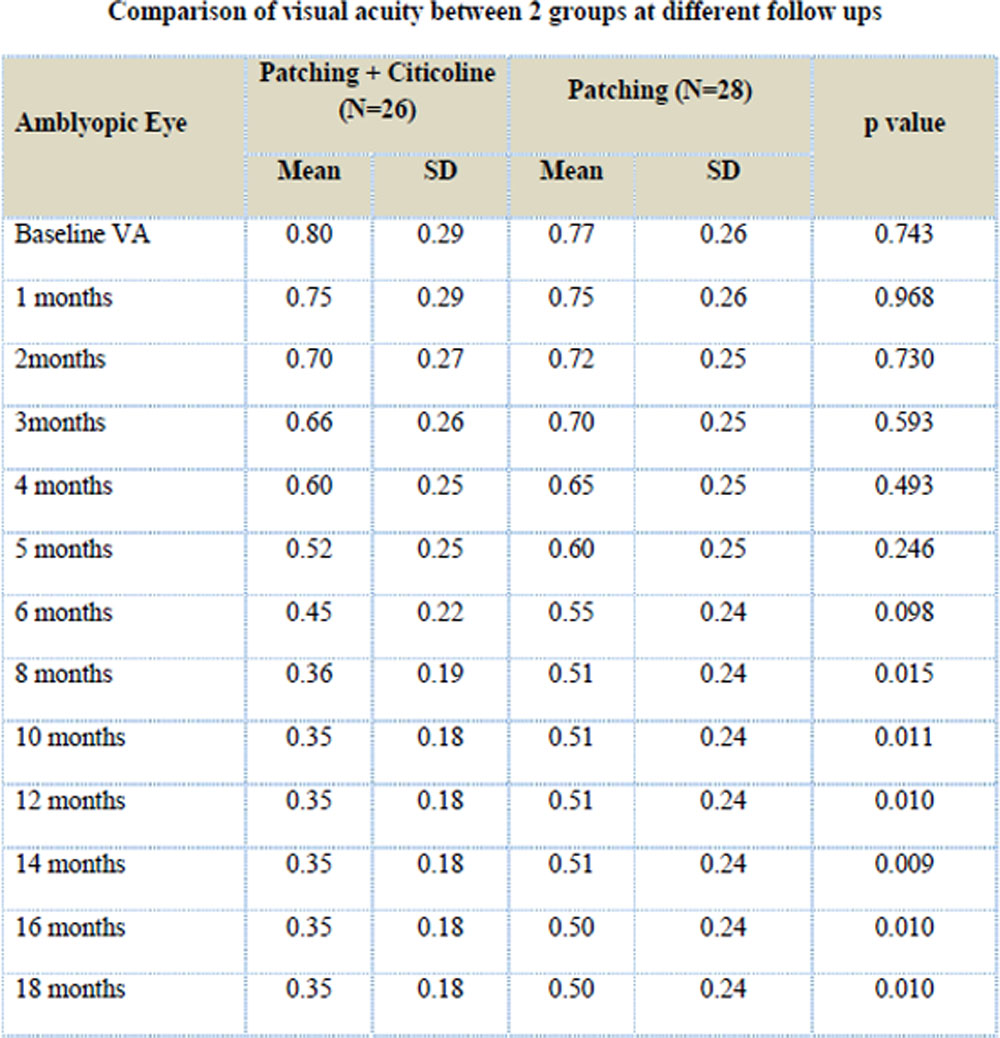
Result: group 1 had visual improvement from 0.80±0.29 to 0.35±0.18 and Group 2 had visual improvement from 0.77±0.25 to 0.50±0.24 at the end of 12 months. Both the groups maintained same VA for next 6 months.
Conclusion: as addition of citicoline offers significant sustained improvement in VA, it can be considered for management of amblyopia along with patching.
Key words: Citicoline, Citicoline vs patching, Amblyopia, Visual maturity age group, CDP-choline.
INTRODUCTION:
The term amblyopia is derived from the Greek language and means dull vision: amblys = dull, ops = eye. Amblyopia is defined as a “decrease of unilateral or bilateral best corrected visual acuity caused by pattern vision deprivation or abnormal binocular interaction for which no causes can be detected by the physical examination of the eye and which, in appropriate cases, is reversible by therapeutic measures.[1] Children are susceptible to amblyopia between birth and 7 years of age.[2] The earlier the onset of abnormal stimulation, the greater is the visual deficit.
The mainstay of treatment of amblyopia is patching and in some places penalization with atropine. These therapeutic approaches have their own drawbacks. Firstly, with occlusion therapy and penalization, there is a risk of overtreatment. Development of strabismus is also a risk. Full-time occlusion carries the greatest risk of reverse amblyopia and of strabismus and thus requires close monitoring.Secondly, lack of adherence to the therapeutic regimen is a common problem that can prolong the treatment period or lead to outright failure.[3] In some patients, skin irritation due to the adhesive may develop. Thirdly, in some cases, even conscientious application of an appropriate therapeutic program fails to improve vision at all or beyond a certain level. Complete or partial unresponsiveness to treatment occasionally affects younger children but more often occurs in patients older than 5 years.[4] Lastly, when amblyopia treatment is discontinued after complete or partial improvement of vision, approximately one-third of patients show some degree of recurrence.[5,6]
All these limitations of ongoing treatment modalities of amblyopia led us to feel theneed for pharmacologic treatment. The possibility of influencing amblyopia with chemicals has long been adream of strabismologists. Nagel wasfirst to use strychnine as a vasodilator inamblyopia.[7]Bietti showed in the 1950s that suppression scotomata could beinfluenced by strychnine, oxygen and nicotinic acid.[8] The above reportedconsiderations suggest a rationale for using CDP-choline in patients suffering fromamblyopia, very similar to the one that previously suggested the use of Levo-DOPAin patients with this pathology. [9,10]
Cytidinediphosphocholine (citicoline) is a mononucleotide consisting of ribose, cytosine, pyrophosphate and choline whose chemical structure corresponds to 2-oxy-4-aminopyrimidine. Citicoline is involved as an essential intermediate in the synthesis of structural phospholipids of cell membranes. [11] Due to its activity on the metabolism of phospholipids, CDP-choline washypothesized to have the capability of opposing or preventing nerve cell damage byacting directly on cell membrane to maintain its anatomical and functional integrity,an essential condition for cell survival. In fact, cell membrane is the cell structurewhere most biochemical reactions occur and the cell can survive only when an intracellularenvironment different from the extra-cellular environment is maintained. Thisis not possible if the turnover of phospholipids is not efficiently maintained and thusthe integrity of the membrane is not assured. [12–17]
Citicoline has been used in treatment of neurological disease with minimal side effects, and it appears to improve functional outcome and reduce neurological deficit in acute stroke.[18] Patients in the studies of neurological impairment also have reported that colours were brighter and that visual contrast was enhanced, which have led to investigations of citicoline in various ophthalmic conditions. Studies in patients with glaucoma have suggested that citicoline repairs damage to the optic nerve and the retina.[19]Recently, an improvement in the retinal and post-retinal response was recorded in patients suffering from glaucoma treated with CDP-choline.[20] In accordance with this theory, it was observed that in rabbits treated with CDP-choline,[21] the concentration of dopamine in the retina increased.
Citicoline is a drug of endless possibilities in the field of ophthalmology.To the best of our knowledge, there are very few studies conducted to evaluate the effect of citicoline in amblyopia in India. Therefore, in this study we try to find out the role of citicolinein the treatment of amblyopia when combined with patching in visual maturity agegroup.
MATERIALS AND METHODS:
The study was conducted in JPM Rotary Club of Cuttack Eye Hospital and Research Institute from July 2016 to December 2017 for the duration of 18 months. Approval from institution ethical committee and scientific committee were taken prior to start of the study. The study population is children attending outpatient department of our hospitaldiagnosed with amblyopia and aged between 4 to 8 years. Samples were takenirrespective of gender, rural orurban area. Total sample size is 54 children. They were divided into two groups; Group 1(Patching with citicoline) contained 26 and Group 2 (patching only) contained 28children.The inclusion criteria were,
Patients with amblyopia from four to eight years of age Patients not suffering from any other ophthalmic morbidity
Patients/Parents willing to participate in the study The exclusion criteria were,
Patients in whom citicoline was contraindicated, such as hypersensitivity to citicoline, history of epilepsy
Not willing to participate in the study, after thorough discussion of treatment and its side effects with the family.
The parents/ guardian of patients who satisfied the inclusion and exclusioncriteria were explained about the clinical trial. Informed consent was taken from thoseconsenting for the study. Then odd numbered patients were allocated in group 1 and the even numbered were allocated in group 2.All the patients suffering from amblyopia were primarily screened for inclusionin the study. Subjects who fulfilled the inclusion criteria were selected for the study.
All patients underwent:
Complete refractive status of both the eyes using cycloplegic drugs and static streak retinoscopy.
Extraocular movements were checked by having the patients look in all directions of gaze without moving their head and checked for any restriction and if they complain of any double vision.
Smooth pursuit was tested by having the patient follow an object moved across their full range of horizontal and vertical eye movements. Convergence test was done by having the patient fixate on an object as it is moved slowly towards a point right between the patient’s eyes.
Cover test was done to detect a heterotropia.
The uncover test was done to detect heterophoria.
Alternate cover test to reveal total deviation.
The prism cover test to measure the angle of deviation.
Worth four dot test.
Test for stereopsis by TNO test.
Direct ophthalmoscopy to detect eccentric fixation in strabismic amblyopia.
Colour vision testing by Ishihara chart.
Forced duction test as per the case, under local or general anaesthesia to
differentiate between restrictive and paralytic squint.
Besides these tests, complete history taking, detailed ocular examination interms of both anterior segment and posterior segment evaluation with slit lamp, indirect ophthalmoscopy, 90D lens were done. In every follow up visit visual acuitytest using Log MAR, Snellen’s chart and full cycloplegic refraction were routinelydone.
Patients were randomly divided into two groups. Out of 54 samples 26 children in group 1 received patchingwith citicoline and 28 children in group 2 received patching alone. The dosage of citicoline[24]are 250mg once daily (for patients below 5 years) and 500mg once daily (for patientsabove 5 years). In the group 1 (the group treated with patching with citicoline) thedrug citicoline was prescribed daily for first 6 months; at the end of this periodciticoline was gradually tapered off by giving half the dose daily for 2 months, then half the dose on alternate days for another 2 months, and then discontinued. Thedrug was totally stopped after 10 months. But the patients kept on using patchingfrom day1 to the end of the observation period at 18 months, whereas patients ingroup 2 received only patching for total duration of study 18 months. The patching schedule followed was age:1, (maximum 6:1).[24]
For example, for a patient of five years, 5:1 schedule was followed (five daysfull time patching for the better eye and one day patching for the worse eye). For apatient of 8 years, 6:1 schedule was followed.
The patients were followed up one-month intervals for first 6 months then attwo months interval till 18 months. The detailed examination of anterior and posteriorsegment of eye along with visual acuity was recorded in every follow-up visit. Visualacuity was converted into the Logarithm of the Minimum Angle of Resolution(LogMAR). The mean LogMAR visual acuity was calculated in both the groups.Lines of improvement were calculated from LogMAR chart at 1,2,3, 6, 12 and 18months. Proportional improvement in the visual acuity, adjusted for fellow eyes, wascalculated using the following formula, suggested by Stewart C E et al.[22]
Proportional improvement = (VAas – VAae)/(VAas – VAfe) Where VAas is theLogMAR visual acuity of an amblyopic eye at the start of the study (baseline); VAaeisthe LogMAR visual acuity of the amblyopic eye at the end of the respective follow upinterval; andVAfe is the LogMAR visual acuity of the fellow eye at the end of therespective follow up interval.
The analysis of variance (ANOVA) was used to test the significant differencebetween the mean LogMAR values. Differences in the proportional improvementswere tested with a nonparametric test like the Mann Whitney U test. Other tests likeChi square test and Z test were also used at appropriate places. The statistical analysis has been conducted using IBMSPSS 24.0 statistics, SouthAsia Private limited.
RESULTS:
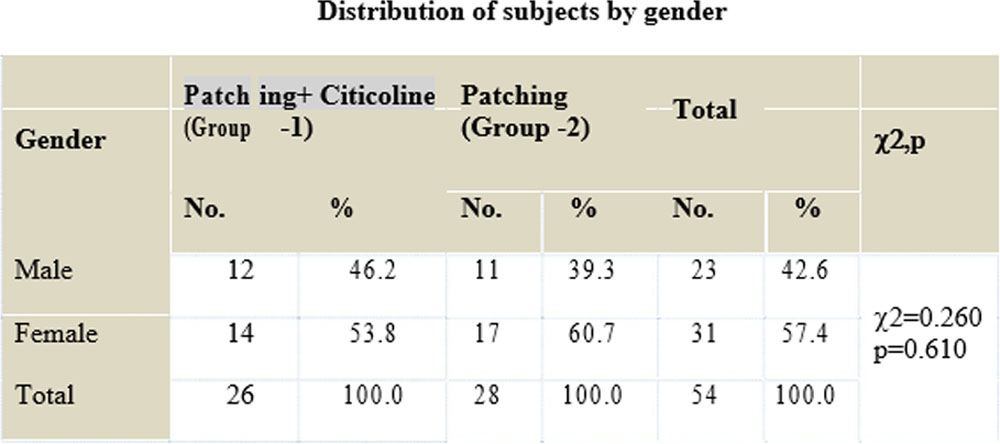
In our study, there was no significant difference in the baselinecharacteristics of patients in the two groups. The mean age of the patients was 5.78±1.284 years. Number of males andfemales were 23 and 31 respectively. Out of 54 patients 20 had strabismic amblyopia,19 hadanisometropic amblyopia and 15 had amblyopia of both strabismic andanisometropic aetiology. Table1.1 and Table 1.2 show the demographic pattern, –
Table 1.1
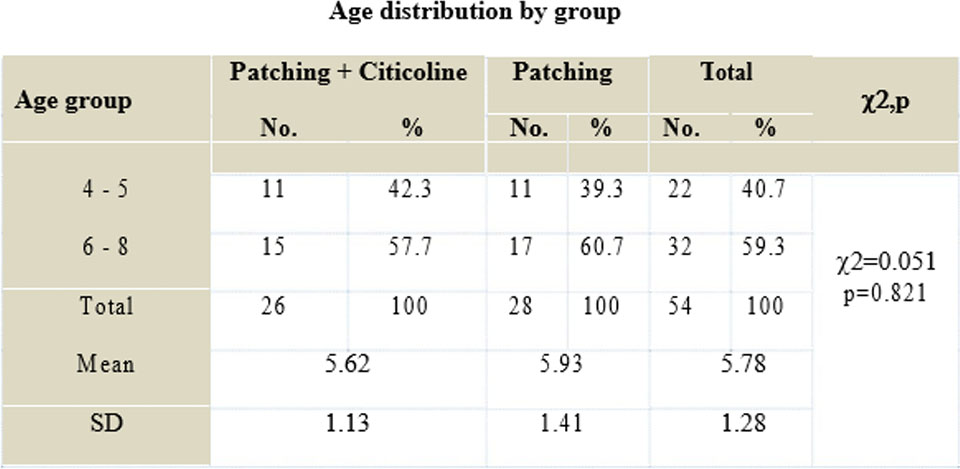
Table 1.2
The treatment outcome was analyzed in terms of visual acuity, lines ofimprovement and mean proportional improvement. At the baseline the mean visualacuity of Group 1 was 0.80±0.29 which improved over each follow up and at the endof 18 months the mean visual acuity was 0.35±0.18. The improvement is almost 56%. For the Group 2 visual acuity improved continuously over the follow ups but the rateof improvement was slower than Group 1. From baseline value of 0.77±0.25, at 18months the mean visual acuity in Group 2 attained was 0.50±0.24. The improvementwas 35%. Table 1.3 and Figure 1.1 show the improvement pattern in LogMAR visual acuity.Table 1.2
Figure 1.1
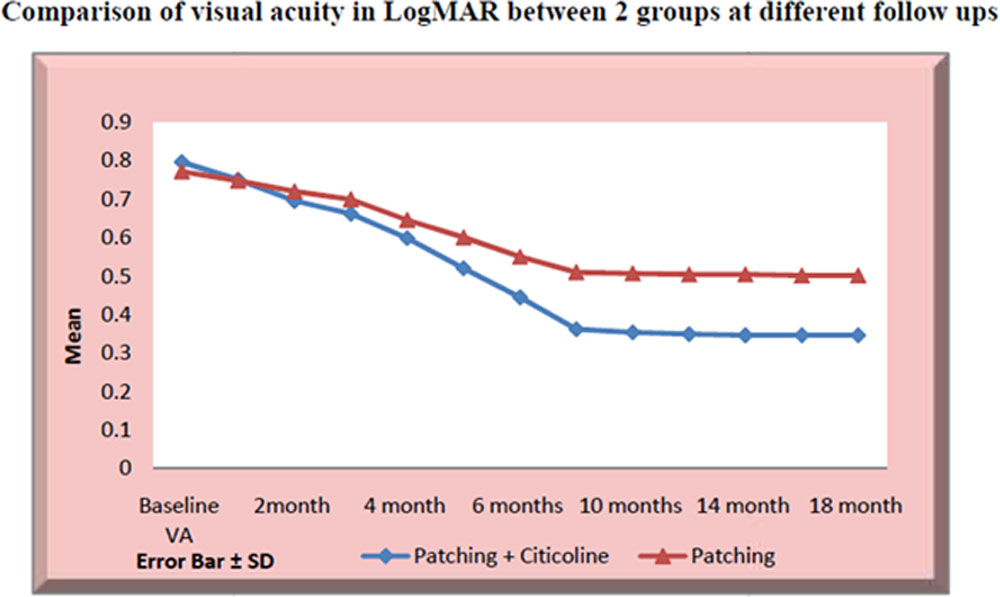
Table 1.3
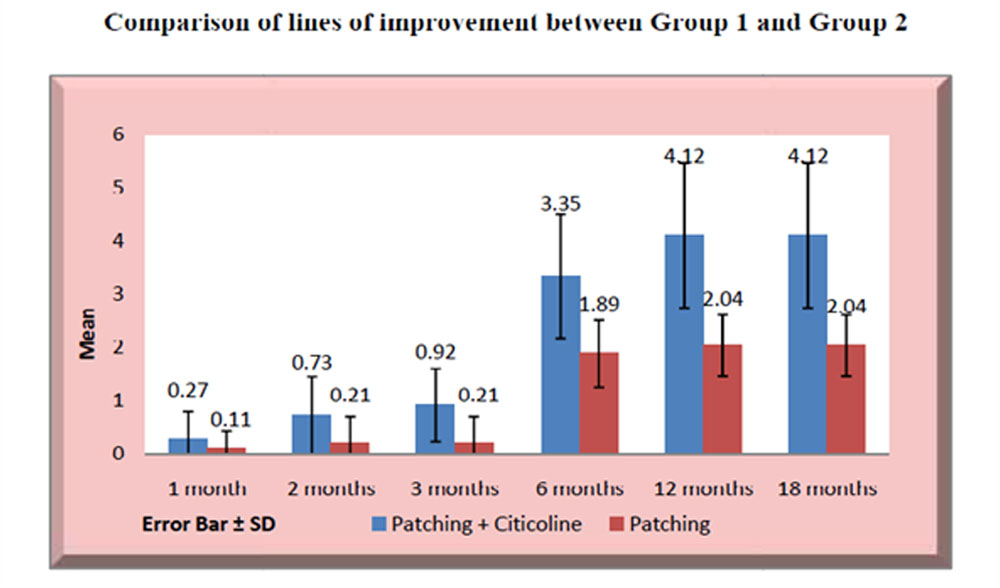
The mean lines of improvement in Group 1 was 4.12±1.37 and in group 2 itwas 2.04±0.576. In both the treatment groups mean lines of improvement of visualacuity was significant; but the improvement in the group treated with patching andciticoline was almost double than the group treated with patching only. Figure 1.2 shows mean lines of improvement in both the groups.
Figure 1.2
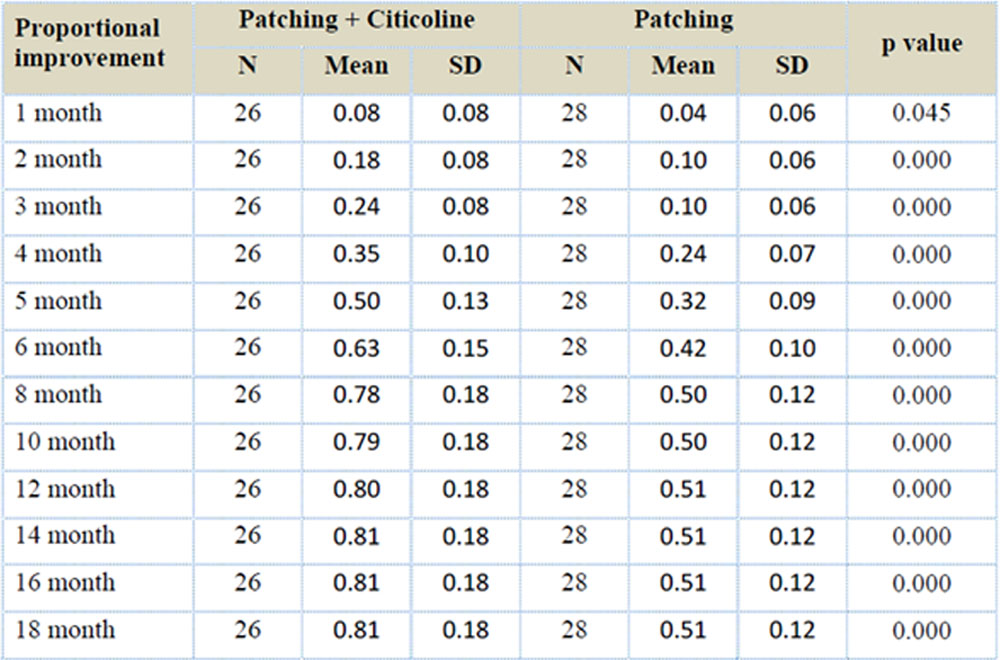
We compared mean proportional improvement also, which is the measure ofimprovement adjusted with the fellow eye. At the end of 18 months the meanproportional improvement in group 1 and 2 are 0.81 and 0.51 respectively. Thisimplied that both the treatments have positive impact but the impact of the treatment“patching andciticoline” was better. Table 1.4 shows comparison between group 1 and 2 of mean proportional improvement.
Table 1.4
Comparison of Mean Proportional Improvement between groups
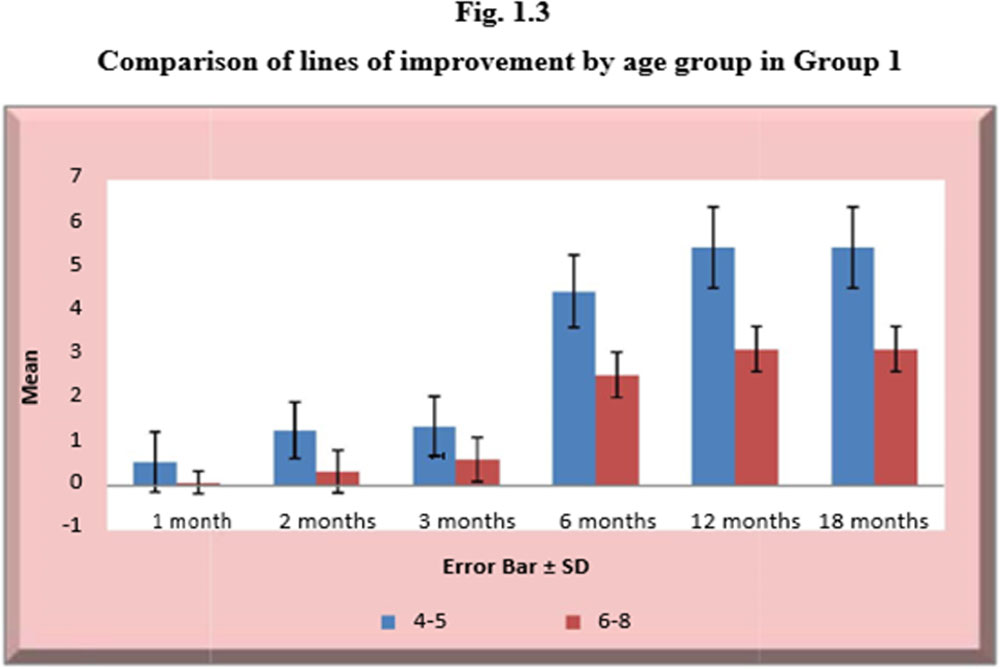
We also assessed the effect of different factors like age, gender and types ofamblyopia on visual outcome. Patients in both groups were divided into two agegroups; one younger age group from 4 to 5 years and one older age group from 6 to 8years. In younger age group, the mean lines of improvement was 5.45±0.93 lines atthe end of 18 months, whereas in older age group it was 3.13±0.52 lines at the end offollow up in group 1 (Figure 1.3). So, age is an important determinant in treatment of amblyopia.Patients of younger age are found to be more benefited by the therapy.
On comparing the effect of treatment of patching with citicoline on differenttypes of amblyopia we did not find any significant difference (Figure 1.4). The mean lines ofimprovement were almost same in strabismic, anisometropic and mixed amblyopia.At 18 months follow up the mean lines of improvement of strabismic amblyopia was 4.00±1.491, for anisometropic amblyopia 4.00±1.225 and for mixed 4.43±1.51(p=0.791).
We also found that, at each follow up the mean lines of improvement betweenmales and females was not significantly different (p˃0.05). At 18 months follow upthe mean lines of improvement for males was 4.09±1.45 and that for females was4.13±1.36 (p=0.94), this difference is statistically insignificant. No adverse effect ofciticoline has been noted.
DISSCUSSION:
The primary objective of our study was to evaluate the effect of addition ofciticoline to patching in treatment of amblyopia in visual maturity age group. we have compared the available literature to our study findings and reporteddifferences if any.
At the end of 18 months, the mean visual acuity in LogMAR scale of thisgroup in our study was 0.35±0.18 which improved from baseline value of 0.80±0.29.So, the improvement is 0.45. In a study by Fresina et al[23] the visual acuity inLogMARimproved from 0.34±0.22 to 0.14±0.15. The mean improvement was 0.20.In our study, the outcome was much better. In a study by Pawar et al[24], the meanimprovement was 0.46, which is almost similar to our study. In terms of mean lines of improvement in our study it was 4.12±1.37 lines. In a study by Porciatti et al [25] where intramuscular citicoline was given, it was 1.4 to 1.5 lines. In our study the mean proportional improvement was 0.81, which is little less than the finding by Pawar et al[24], which is 0.96.
In the meta-analysis of 4 PEDIG studies by Holmes JM et al [26], it was seen that, the younger the age, the more is the effect of treatment in amblyopia; our study also supports that.
On comparing the effect of treatment of patching with citicoline on differenttypes of amblyopia we did not find any significant difference. The mean lines ofimprovement were almost same in strabismic, anisometropic and mixed amblyopia.We concluded that patching with citicoline treatment option is equally effective in alltypes of amblyopia. There was no difference between treatment outcome of males andfemales.
So, the inferences from our study are,
- In amblyopic patients around visual maturity age group the treatment withciticoline and patching is more efficacious than with patching alone.
- The visual improvement attained after treatment with citicoline is stable anddoes not decline with time.
- Younger patients are more benefited by treatment with patching andciticoline.
- Visual acuity in all types of amblyopia patients are equally improved aftertreatment with citicoline.
- Citicoline is a relatively safe drug.
Our study has few limitations. As this is an open label trial, blinding was notdone, which might have affected the outcome. Secondly to know the effect ofciticoline on children beyond the visual maturity age group larger studies with moresample size are needed. So, we finally conclude that, addition of citicoline to patching therapy is aneffective way to improve and stabilize the visual outcome in all types ofamblyopia in visual maturity age group.
REFERENCES:
- Kenneth W. Wright, Peter H. Spiegel Paediatric Ophthalmology andStrabismus. Second edition. Springer 2003. p. 159.
- Keech RV, Kutschke PJ. Upper age limit for the development of amblyopia. JPediatrOphthalmol Strabismus.1995; 32(2):89-93.
- Newsham D. A randomised controlled trial of written information: the effecton parental non-concordance with occlusion therapy. Br J Ophthalmol. 2002;86(7): 787–91.
- Hussein MA, Coats DK, Muthialu A, Cohen E, Payssea EA (2004). Riskfactors for treatment failure of anisometropic amblyopia. J AAPOS. 8:429–434
- Bhola R, Keech RV, Kutschke P, Pfeifer W, Scott WE. (2006) Recurrence ofamblyopia after occlusion therapy. Ophthalmology. 2006; 113(11):2097–2100.
- Holmes JM, Melia M, Bradfield YS et al (2007). Factors associated withrecurrence of amblyopia on cessation of patching. Ophthalmology. 114:1427–1432.
- Nagel A. (1871) Die Behandlung der Amaurosen und AmblyopienmitStricknin. KlinMonatsbiAugenheilkd. 9 : 264-267
- Bietti GB (1957) sur la possibility un traitmentmedicamenteux desphenomenssuppressifsen vision binoculaire dans le strabisme. Probl ActOphthalmol. 1: 391-399
- Gottlob I, CharlierJ , Reinecke RD. (1992) visual acuities and scotomas afterone week levodopa administration in human amblyopia. Invest Ophthal VisSci. 33(9):2722-2728.
- Leguire LE, Rogers GL, Wilson PD et al. (1998) Occlusion and levodopacarbidopatreatment for childhood amblyopia. J AAPOS. 2: 257-264.
- Secades JJ, Lorenzo JL. Citicoline:pharmacological and clinical review, 2006update. Methods Find Exp Clin Pharmacol. 2006; 28 SupplB : 1-56
- Cohen MM. (1973) Biochemistry of cerebral anoxia, hypoxia and ischemia.Monogr Neural Sci. 1:1-49
- Mykita S, Golly F , Dreyfus H , Freysz L, Massarelli R.(1986) Effect of CDPcholineon hypocapnic neurons in culture . J Neurochem. 47:223-231
- SchabitzWR , Weber J, Takano K, Sandage BW, Locke KW, Fisher M.(1996)The effect of prolonged treatment with citicholine in temporary experimentalfocal ischemia. J Neuro Sci. 183:21-25
- Bladergroen BA, Bussiere M, Klein W et al. (1999) Inhibition ofphosphatidylcholine and phosphatidylethanolamine biosynthesis in rat-2fibroblasts by cell-permeable ceramides. Eur J Biochem. 264;152-160
- Rao AM, Hatcher JF, Dempsey RJ. (2001) Does CDP choline modulatephospholipase activities after transient forebrain ischemia? Brain Res. 893:268-272.
- Onal MZ, Tatlisumak T, Locke KW, Sandage BW, Fisher M. (1997)Synergistic effect of citicoline and MK-801 in temporary experimental focalischemia in rats. Stroke. 28: 1060-1065
- Clark WM, Warach SJ, Pettigrew LC et al. A randomized control trial ofciticholine in acute ischemic stroke patients. Citicholine Stroke Study Group.Neurology. 1997, 49:671-8.
- Rejdak R, Toczoowski J, Solski J et al. Citicoline treatment increases retinaldopamine content in rabbits. Ophthalmic Res. 2002; 34: 146-9.
- Parisi V, Manni G, Colacino G, Bucci MG. (1999) citicholine improves retinaland cortical responses in patients with glaucoma. Ophthalmology.106(6):1126-1134.
- Rejdak R, ToczoowskiJ ,Solski J , Duma d , Grieb P. (2002) Citicolinetreatment increases retinal dopamine content in rabbits. Ophthalmic Res. 34:146-149.
- Stewart CE, Moseley MJ, Fielder AR. Defining and measuring treatmentoutcome in unilateral amblyopia. Br J Ophthalmol. 2003; 87: 1229-31.
- Fresina M, Dickmann A, Salerni A et al.2008 Effect of oral CDP – choline onvisual function in young amblyopic patients. Graefe’s Archive for Clinical andExperimental Ophthalmology. 2008; 246: 143-50.
- Pawar et al 2014. Effectiveness of addition of citicoline to patching in thetreatment of amblyopia around visual maturity: a randomized controlled trial.Indian J Ophthal. 2014;62:124-9.
- Porciatti V, Schiavi C, Benedetti P et al.Cytidine-5′-diphosphocholineimproves visual acuity, contrast sensitivity and visually –evoked potentials ofamblyopic subjects. Curr Eye Res. 1998; 17: 141-8.
- Pediatric Eye Disease Investigator Group. Effect of age on response toamblyopia treatment in children. Arch Ophthalmol. 2011 Nov; 129(11): 1451–1457.
Leave a Comment