

Dr.NIVEDHITHA NIKHIL,Dr.Vidhya C
ABSTRACT
Purpose – To compare and analyse the visual outcomes following patching with video games versus patching with amblyopia-i net program for treatment of amblyopia
Methods- 40 children with anisometropic and strabismic amblyopia were selected. 20 were allotted in the Group A- patching with one hour of video games and 20 into group B- where patching with Amblyopia-i-net program were given. The patching hours were given as suggested by PEDIG protocols. The children were followed up every 3 months. BCVA at the end of 6 months taken for analysis.
Results- Mean age of the children in group A and B are 8 and 7.5 years respectively. The mean BCVA at presentation in group A and B are 0.6 and 0.58 LogMAR. BCVA at 3 months follow-up visit were 0.45 and 0.3 in the groups A and B respectively. The BCVA at the end of 6 months in the groups A and B are 0.2 and 0.24 respectively (p value 0.65)
Conclusion-Visual outcomes with patching /video games is same as with patching /amblyopia-I-net program, though the initial improvement is faster with amblyopia-i-net program.
Keywords– Amblyopia, Patching
Amblyopia has been defined as the diminution of vision, unilateral or bilateral, caused by the deprivation of pattern vision or abnormal binocular interaction for which no cause can be detected.[1] Amblyopia is the most common cause of uniocular visual impairment among children, has a prevalence rate of about 0.8-3% worldwide.[2] Treatment regimens include optical correction, patching, atropinisation and vision therapy. Historically, patching has been the mainstay of treatment for amblyopia. Pediatric Eye Disease Investigator Group(PEDIG) conducted a randomised pilot study have shown that patching with one hour of near activity stimulate the visual system and enhance amblyopia outcomes.[3] Common near activites include crafts, reading, writing, computer and video games. Active vison therapy is also supplemental to patching utilizing principles of hand-eye coordination to enhance amblyopia outcome.Active vision therapy for amblyopia is designed to remediate deficiencies in four specific areas: eye movements and fixation, spatial perception, accommodative efficiency, and binocular function.[4]
Although visualacuity is often the focus of management, amblyopia impacts many other elements of the visual system.To tackle these deficiencies, active vision therapy have evolved intreating the underlying binocular dysfunction that accompanies amblyopia.[5] Although studies have been performed to evaluate role of monocular video game play as an adjuvant to patching and effectiveness of vison therapy in amblyopia, none are there comparing the two treatments to the best of our knowledge .[3,7]
We conducted a prospective study to compare the visual outcomes of patching with video games versus patching with vision therapy.
Methods and Materials
The study was approved by the ethics committee of the institution and was conducted as per the tenets of the Declaration of Helsinki. This prospective study included 40 patientsof anisometropic and strabismic amblyopia with the best corrected visual acuity(BCVA) in the amblyopia eye ranging from 2 LogMAR to 0.3 LogMAR. 20 children were allotted in group A where patching with one hour of video games and 20 childrenwere allotted in group B where patching with Amblyopia –I net program were suggested. The patching hours were given as suggested by PEDIG protocols. In Group A, children were asked to play an action video game of their choice in anI-pad or tablet or mobile phone for one hour per day with patching daily. In Group B, Amblyopia-i net software was dispatched for home use after initial training at the vision therapy clinic. Children were then monitored one hour per day for 5 days a week by our orthoptist while performing the activities on the program.
The childrenfrom both the groups were followed up every 3 months and a complete ophthalmological examination was performed. The need for change of glasses was looked into after performing objective and subjective refraction. BCVA at the end of 6 months was taken for analysis in the both groups.
Results:
Mean age in Group A was 8.52 +/- 4.3 years(range 4-16years)
Mean age in Group B was 7.83+/- 4.6 years(range 4-18 years)
In group A, 15 children had anisometropic amblyopia and 5 had strabismic amblyopia
In group B, 10 children had anisometropic, 7 children had strabismic and 3 children had ametropic, as shown in table1
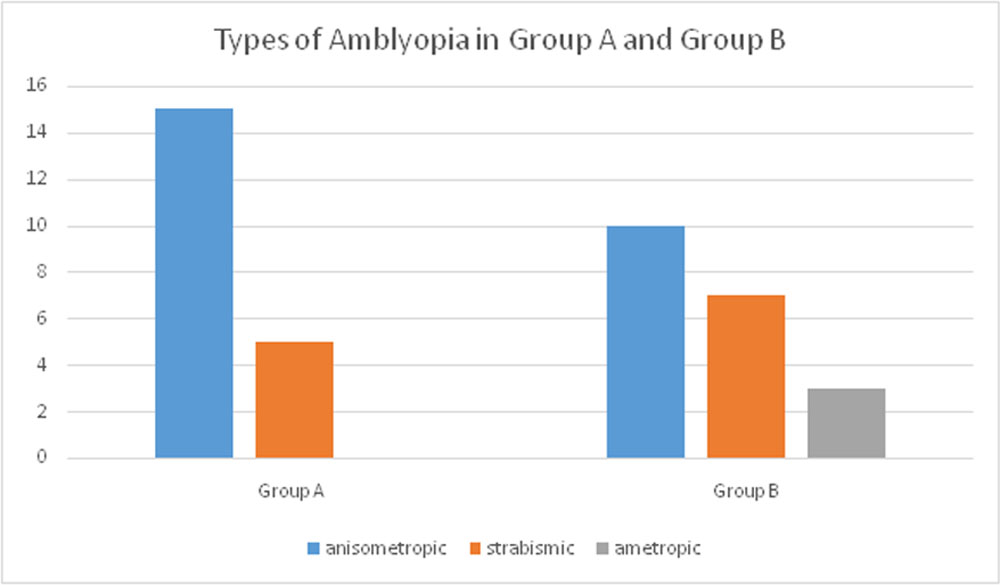
Table 1
Mean BCVA (LogMAR) in Group A and B before treatment, 3 months after treatment and 6 months after treatment were recorded.
Table 2
Measurements of visual acuity (LogMAR) in the Group A and B before treatment, 3 months after starting the treatment, and 6 months after starting the treatment
| Group | Before treatment | At 3 months | At 6 months |
| Group A | 0.6+/-0.29 | 0.45+/-0.26 | 0.2+/- 0.2 |
| Group B | 0.61+/-0.22 | 0.33+/-0.21 | 0.24+/-0.2 |
| P value | 0.65 |
Discussion
In this study we chose video games as hand-eye coordination activity as it is fun and engaging for children and hence more complaint. Video games supplemental to occlusion therapy is shown to enhance the visual recovery as in some studies. [7,8]
Children with anisometropic amblyopia had better visual improvement than strabismic amblyopia in both the groups.
Enhancement of cortical plasticity is one of the most important issues to be addressed in amblyopia. Roger et al in their pilot study showed that action video-game play can induce a substantial degree of visual plasticity in adults with amblyopia. [9]
There was a greater improvement in visual acuity in children doing patching with vision therapy in initial 3 months but at end of 6 months BCVA was comparable in the both groups (p value 0.65). This shows that improvement is faster in vision therapy treatment and hence was shown to reduce the treatment time.[10-12] but the vision therapy program is not affordable to many in a developing country like India.
Similarly patching with video games also gave same improvement in visual acuity in stipulated time period. Hence it is a good alternative to vision therapy as it is feasible, economical, easy to learn, and fun for children, hence more compliant.
Amblyopia impact on vision is more than visual acuity. Patients with amblyopia often have decreased oculomotor and fixation ability, accommodative skills, binocular summation, contrast sensitivity and steroacuity. These deficiencies are tackled by active monocular and binocular therapies. But the degree of effectiveness of active vision therapy has not yet been evaluated in a randomised controlled trial.[13]
No other parameters other than the visual acuity was used to compare between the two groups which is one limitation of this study, the others being a small sample size and short follow up period.
Conclusion
Video games and active vison therapy helps to supplement patching to enhance amblyopia treatment outcomes. As vision therapy treatment is not quite affordable for many, video games proves as a good alternative with patching in being effective in treatment of amblyopia.
References
- Von Noorden G, Campos E. Binocular Vision and Ocular Motility. St Louis: Mosby; 2002
- Wallace DK, Morse CL, Melia M, Sprunger DT, Repka MX, Lee KA, et al., American Academy of Ophthalmology Preferred Practice Pattern Pediatric Ophthalmology/Strabismus Panel. Pediatric Eye Evaluations Preferred Practice Pattern: I. Vision Screening in the Primary Care and Community Setting; II. Comprehensive Ophthalmic Examination. Ophthalmology. 2018;125:P184-P227
- Pediatric Eye Disease Investigator Group. A randomized pilot study of near activities versus non-near activities during patching therapy for amblyopia. J AAPOS. 2005;9:129–36.
- Pediatric Eye Disease Investigator Group. A Randomized Trial of Near versus Distance Activities while Patching for Amblyopia in Children 3 to < 7 years old. Ophthalmology. 2008;115(11):2071-2078. doi:10.1016/j.ophtha.2008.06.031.
- Bedell HE, Flom MC. Monocular spatial distortion in strabismic amblyopia. Invest Ophthalmol Vis Sci 1981; 20:263-8.
- Wick B, Wingard M, Cotter S, Scheiman M. Anisometropic amblyopia: is the patient ever too old to treat? Optom Vis Sci. 1992;69(11):866-78.
- Writing Committee for the Pediatric Eye Disease Investigator Group, Cotter SA, Foster NC, et al. Optical treatment of strabismic and combined strabismic-anisometropic amblyopia. Ophthalmology. 2012;119(1):150-8.
- Singh A, Sharma P, Saxena R.Evaluation of the Role of Monocular Video Game Play as an Adjuvant to Occlusion Therapy in the Management of Anisometropic Amblyopia. J PediatrOphthalmol Strabismus. 2017;54(4):244-249.].
- Dadeya S, Dangda S.Television Video Games in the Treatment of Amblyopia in Children Aged 4-7 Years.Strabismus. 2016 Dec;24(4):146-152
- Li RW, Ngo C, Nguyen J, Levi DM. Video-Game Play Induces Plasticity in the Visual System of Adults with Amblyopia. Fahle M, ed. PLoS Biology. 2011;9(8)
- Callahan WP, Berry D. The value of visual stimulation during contact and direct occlusion. Am Orthopt J 1968; 18:73-4. 144
- Francois J, James M. Comparative study of amblyopic treatment. Am Orthopt J 1955; 5:61-4. 145.
- Von Noorden GK, Springer F, Romano P, Parks M. Home therapy for amblyopia. Am Orthopt J 1970; 20:46-50.
- Chen AM, Cotter SA. The Amblyopia Treatment Studies: Implications for Clinical Practice. Advances in ophthalmology and optometry. 2016;1(1):287-305.
Leave a Comment