

Dr.NIKHIL JAIN, J20287, Dr.S Priya
Purpose: To highlight the importance of a low vision clinic and give a profile of patients presenting to a low vision clinic at a tertiary eye care hospital.
Methods:
Design: Prospective study. Setting: Institutional. Study population: Details of 2,401 subjects who presented to our low vision clinic between June 2012 and June 2015 were analysed. Data obtained include age group, best corrected visual acuity (BCVA), cause of low vision, type of low vision aids prescribed, acceptance of the device and the provision of additional rehabilitation services.
Results: Around 70.7% of patients were found to have low vision and 29.3% were found to have blindness. We note that 65% of the patients were less than 40 years of age. The major causes of visual impairment were retinitis pigmentosa, macular degeneration, diabetic retinopathy, pathological myopia, optic atrophy, glaucoma, albinism and congenital nystagmus. Low Vision Aids (LVA) was prescribed to 1693 individuals. The most commonly prescribed LVA were spectacle magnifiers, hand and stand magnifiers. However, the acceptance rate was just 38%. The rest were given either standard spectacles or were referred to rehabilitation centres if vision was very poor.
Conclusion: There is a young population with visual impairment and highly under-utilized low vision services. Improving the acceptance rate of these devices would help enhance the individual’s quality of life part of which could be done by reducing cost of these devices.
Key words: Low vision, Visual impairment, Low Vision Aids, Rehabilitation
MANUSCRIPT TEXT
Introduction
Around 285 million people are estimated to be visually impaired worldwide; the leading causes being uncorrected refractive errors and cataract.[1] However, these patients are typically not referred to low vision clinics. Only patients with visual acuity <6/18 and non-treatable causes are referred to low vision services.
With improvement in awareness and cataract surgical coverage, the treatable causes of vision loss are being taken care of to a certain extent; however, those with permanent visual impairment are left in limbo with only poor prognosis being explained.[2] Not all are referred to low vision services that might help them manage their daily activities by improving their residual vision.
This article aims to highlight the importance of a low vision clinic by giving a profile of patients presenting to such a clinic and discuss the use of various low vision aids at a tertiary eye hospital.
Materials and Methods
This study was conducted at a tertiary eye care hospital with an exclusive low vision unit in India. Institutional Review Board (IRB) approval was obtained at our institute for this study. This research adhered to the tenets of the Declaration of Helsinki.
Information were obtained in our hospital and recorded on an Excel sheet (Microsoft Inc.).The database included 2401 subjects who presented to our low vision clinic between June 2012 and June 2015.
Data obtained include age group, best corrected visual acuity (BCVA), cause of low vision, type of low vision aids prescribed, acceptance of the device, the provision of additional rehabilitation services and reason for non acceptance.
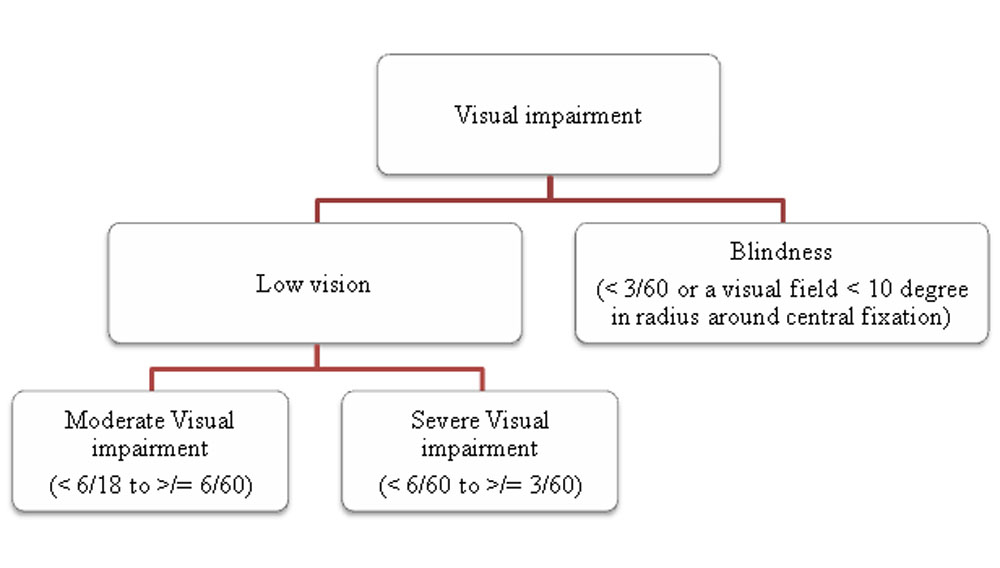
Visual impairment was classified as follows.[3]
Statistical analysis
Categorical variables were given in the frequency tables with percentages. All statistical analysis was done by statistical software STATA 11.1 (StataCorp, College Station, TX).
Results
A total of 2401 subjects were included in the study. Out of the 2401 patients in whom vision was documented, 1693 (70.5%) were found to have low vision and 708 (29.3%) were found to have blindness. Subjects were distributed equally between the age groups < 15, 16-40 and >40 years (Table 1).
The major causes of visual impairment observed in our tertiary centre in southern India were due to retinal conditions like macular degeneration, retinitis pigmentosa, diabetic retinopathy, pathological myopia and albinism. The others being optic atrophy, glaucoma, other causes of childhood blindness like congenital optic atrophy and congenital nystagmus (Table 2).
Out of the 2401 patients who visited LVA clinic, we find that it was prescribed to 1693 individuals (Figure 1). Rest were given either standard prescription spectacles or, if vision was very poor that LVA could not be given, they were referred to rehabilitation centres. Table 3 shows the various LVA prescribed across all age groups.
The most common LVA prescribed were the hand and stand magnifiers that include bar magnifiers, dome magnifiers, book magnifiers, wallet magnifiers and the spectacle magnifiers like aspheric lenses and prismospheres. The other LVA prescribed include telescopes for distance vision, electronic devices like Closed-circuit television (CCTV) and other non-optical aids like long white cane, writing guide, money identifier, signature guide, reading lamps, absorptive glasses, flash light, wide brimmed hat and reading stand.
Among the 1693 individuals in whom the LVA were prescribed, only 646 individuals obtained the device; the acceptance rate being just 38.1% .
Discussion
As per the cumulative official updates to ICD-10 by the WHO in January 2015, a person is said to have low vision if the presenting distance visual acuity is between 6/18 and 3/60. This includes moderate (< 6/18 to >/= 6/60) and severe visual impairment (< 6/60 to >/= 3/60). Blindness is described as a presenting distance visual acuity is < 3/60 or a visual field < 10 degree in radius around central fixation in the better eye. [3]
There have been several studies on the demographics in a low vision clinic.[4-9] Around 65% of our patients were less than 40 years of age. This is in agreement with other studies from developing nations where there is larger proportion of younger individuals with visual impairment as compared to developed countries.[4-7]
Not all who were prescribed LVA would buy them due to various factors such as cost, difficulty in usage, cosmetic reasons, portability issues and we find that the acceptance rate was a meagre 38%. Mohidin et al reported an acceptance rate of 59.5% in Malaysia.[5] Gao et al reported an acceptance rate of 76.1% in China.[6]
Younger individuals seem to accept spectacle magnifiers better probably because both hands are free to move a text book. Hand and stand magnifiers seem to be better accepted across all age groups and are more preferred by the elderly. Telescopes and electronic devices are amongst the least accepted devices.
If the vision was very poor that LVA could not improve the existing vision, the individuals were referred to specific rehabilitation centres. After assessment, children were suggested either integrated education in normal schools or special education in specific schools for the blind. Adults were provided with vocational guidance where they are taught some specific skills which helps in providing employment opportunities and social rehabilitation where they are taught how to manage their day to day activities.
This, being a short term prospective study, has its inherent limitations. The cause of the visual impairment in each of the age group could not be determined. Disease specific LVA could not be noted. Whether the patients who bought the device were actually using it at home could not be ascertained.
In conclusion, hand and stand magnifiers are the most commonly used and the most accepted devices. It would be better to try these first when the person visits a low vision clinic to get them oriented to the devices before trying more cumbersome aids like telescopes and electronic devices. This study likely shows only the tip of the iceberg of visual impairment in the community. In spite of the heavy burden of visual impairment, low vision services are scarce and under-utilized. Either such individuals who need those services don’t visit the hospital, or even if expert opinion is sought, they are explained about the poor visual prognosis but not referred to appropriate low vision clinics. By referring all patients fulfilling the criteria for low vision to low vision clinics, we can have complete utilization of these services. Also increasing awareness to remove stigmas associated with the use of visual aids will reduce the burden of blindness. Probably, if more governmental and non-governmental organizations could be involved, the cost of these devices could be reduced further, thereby improving the acceptance rate of LVA that would help improve the individual’s quality of life.
Tables :
Table 1: Age wise distribution of the subjects
| Age group | No. of subjects | Percentage (%) |
| 0-15 years | 773 | 32.2 |
| 16-40 years | 774 | 32.2 |
| > 40 years | 854 | 35.6 |
| Total | 2,401 | 100 |
Table 2: Causes of visual impairment
| No. | Causes of visual impairment | No. of subjects | Percentage (%) |
| 1 | Retinitis Pigmentosa | 459 | 19.1 |
| 2 | Macular Degeneration | 347 | 14.4 |
| 3 | Other Retinal Diseases (Mainly diabetic retinopathy) | 369 | 15.3 |
| 4 | Optic Atrophy | 210 | 8.7 |
| 5 | High myopia and High Hypermetropia | 179 | 7.4 |
| 6 | Glaucoma | 143 | 5.9 |
| 7 | Albinism | 96 | 4.0 |
| 8 | Congenital optic nerve pathology | 80 | 3.3 |
| 9 | Others | 518 | 21.6 |
| Total | 2401 | 100 |
Table 3: Various LVA* prescribed in different age groups
| 0-15 years | 16-40 years | > 40 years | Total | |
| Spectacle magnifiers | 15 | 129 | 243 | 387 |
| Hand and stand magnifiers | 325 | 237 | 247 | 809 |
| Telescopes | 102 | 54 | 5 | 161 |
| Electronic devices | 15 | 26 | 7 | 48 |
| Non Optical Devices | 103 | 88 | 97 | 288 |
| Total | 560 | 534 | 599 | 1693 |
*LVA : Low vision aids
Table 4: Causes for non acceptance of LVA
|
S.no |
Causes for non acceptance of LVA |
No. of subjects |
Percentage (%) |
| 1 | Social stigma | 711 | 41.9 |
| 2 | Financial constraints | 556 | 32.8 |
| 3 | Dependence on family members | 293 | 17.3 |
| 4 | Denial of magnitude of illness | 133 | 7.8 |
| Total | 1693 | 100 |
References:
- World Health Organization [Internet]. Media centre. Visual impairment and blindness [Updated August 2014].Available from: https://www.who.int/mediacentre/factsheets/fs282/en/
- Thapa SS, Berg RV, Khanal S, Paudyal I, Pandey P, Maharjan N. et al. Prevalence of visual impairment, cataract surgery and awareness of cataract and glaucoma in Bhaktapur district of Nepal: the Bhaktapur Glaucoma Study. BMC Ophthalmol. 2011; 11:2.
- Cumulative Official Updates To ICD-10. World Health Organization. January 2015.
- Olusanya B, Onoja G, Ibraheem W, Bekibele C. Profile of patients presenting at a low vision clinic in a developing country. BMC Ophthalmol. 2012; 12:31.
- Mohidin N, Yusoff S. Profile of a low vision clinic population. Clin Exp Optom. 1998; 81:198-202.
- Gao G, Ouyang C, Dai J, et al. Baseline traits of patients presenting at a low vision clinic in Shanghai, China. BMC Ophthalmol. 2015; 15:16.
- Leat SJ, Rumney NJ. The experience of a university-based low vision clinic. Ophthal Physiol Opt. 1990; 10: 8-15.
- Khan SA. A retrospective study of low-vision cases in an Indian tertiary eye-care hospital. Indian J Ophthalmol. 2000; 48:201-207.
- Al-Wadani F, Khandekar R, Al-Hussain MA, Alkhawaja AA, Khan MS, Alsulaiman RA. Magnitude and Causes of Low Vision Disability (Moderate and Severe Visual Impairment) among Students of Al-Noor Institute for the Blind in Al-Hassa, Saudi Arabia: A case series. Sultan Qaboos Univ Med J. 2012 ;12:62-68.
Leave a Comment