

Dr.Tanmayi Dhamankar, D16092, Dr.Mihir Trilok Kothar
Abstract:
AIM:To present accuracy of an economical hand held autokeratometer SW100 in comparison to Zeiss IOL Master(gold standard). METHOD:Prospective,observational study.Keratometry was done using SW 100 followed by Zeiss IOL Master for 150 eyes of 150 adult patients by the same optometrist.Paired T test, Pearson corelation coefficient, Bland –Altman plots were used to compare readings obtained with the 2 instruments.
RESULTS:Mean age:47.4 years.Means of average K readings obtained from SW100 & IOL master : 43.6D & 43.7D respectively(p=0.42).Mean astigmatism with SW 100 & IOL Master: 0.92 D and 0.97 D respectively(p=0.57), with positive co-relation between average K readings(r=0.96). CONCLUSION: The readings obtained from the 2 instruments were comparable.SW100 is reliable and affordable($1,380) as compared to other handheld keratometers($3,395 – $13,120)& can be useful in children(who are un co-operative for IOL master)in developing countries where cost is a major concern.
Keywords: hand held keratometer, paediatric cataract, autokeratometer, peadiatric keratometry
Introduction:
Paedatric cataract surgery has undergone major changes in recent years, with the trend shifting towards primary IOL implantation even in infants.1-3 Keratometry and axial length measurements have to be taken under general anaesthesia in these patients, for which hand held autokeratometer has to be used. A 1 D error in keratometry leads to a similar error in IOL power calculation in adults,4 but it can lead to a different post operative refractive error than anticipated in children.5 Hence, it is important that any hand held autokeratometer be validated and its reliability checked before being used in paediatric IOL power calculation. Literature is replete with studies reporting the accuracy and reliability of various hand held keratometers like Retinomax K-Plus2 Nidek, IK 4.6-8 The present study aims to determine the accuracy and reliability of a new hand held keratometer SW100 which is significantly less expensive than the earlier hand held keratometers.
Aim:
To determine the accuracy and reliability of SW100 hand held autokeratometer by comparing it with Zeiss IOL Master.
Methods:
This study is a prospective, descriptive study carried out at a tertiary eye care centre in Mumbai, India. Sample size of 150 was calculated for 80 % power of study and 5% level of significance. Keratometry readings were obtained from 151 eyes of 151 patients attending the OPD. A consent for participating in the study was obtained from the patients. Consent of parents/guardians were obtained in case of minors. Eyes having corneal pathologies like keratoconus, keratoglobus, corneal opacities and corneal surface irregularities were excluded. For the sake of standardization, readings were obtained from the right eye of each patient. Keratometry was done using the SW100 hand held autokeratometer followed by Zeiss IOL master for each patient in the sitting position by a single observer. The hand held keratometer was held in the vertical plane and any titling/rotation was avoided. Statistical analysis was performed using Microsoft Excel-2013 (Microsoft Corp., Redmond, WA) for Windows and SPSS-18 (SPSS, Inc., Chicago, IL) for Windows. Paired T test, analysis of variance and Pearson’s corelation coefficient were used to compare the readings obtained with the two instruments. Bland–Altman analysis was performed by plotting the differences between values obtained from the two instruments against their averages. Horizontal solid lines were drawn at the 95% limits of agreement, which were defined as the mean difference ±1.96 × standard deviation of the differences.
Results :
151 eyes of 151 patients (65 females) were studied. Mean age of patients was 47.4 years (range 14-80 years). The mean of average K readings obtained from SW 100 HHK was 43.63 (95% CI +/-3) and that from IOL master was 43.7D (95% CI +/-3). The mean cylinders obtained from SW 100 HKK and IOL Master were 0.92 D (95% CI +/-1.6) and 0.97 D (95% CI +/-1.6) respectively. Paired T test showed no significant difference either between average keratometry readings obtained by the two instruments (p=0.42) or between astigmatism values (p = 0.57). (Table 1).There was positive co-relation between average K readings (r=0.96).(Table 2)
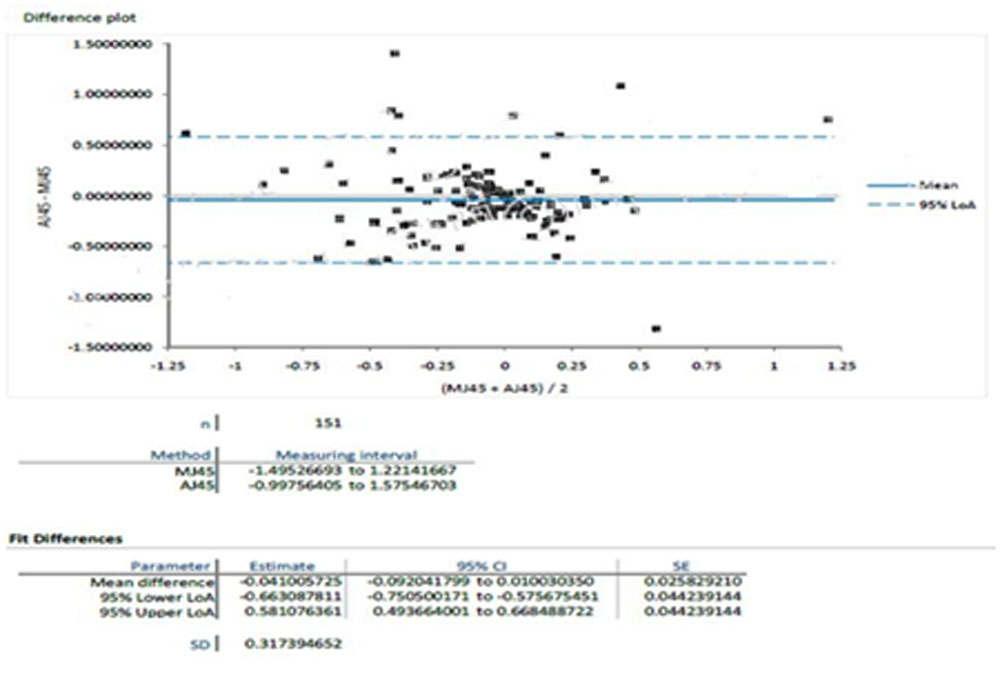
Bland–Altman plots for average K readings, vectors J0 and J45 obtained with the two instruments are shown in Figure 1,2 and 3 respectively. The solid horizontal lines on either side of the mean represent the upper and lower 95% limits of agreement. The scatters tend to be within the limits of agreement. Differences were outside the agreement region in only 12 (7.9%) of 151 eyes in the average K plot.. The J0 & J45 vector plots showed 97% and 95% values within the limits of agreement, respectively.
Discussion:
The present study shows that the keratometry values obtained from the SW 100 Hand held keratometer were comparable to those from the reference standard; the Zeiss IOL Master. In addition, it is significantly cheaper than the other currently available hand held keratometers. While the cost of other currently available hand held keratometers ranges from $3,395 – $13,120, the SW 100 costs merely $1,380. Besides being significantly cheaper, it is also light in weight, runs on standard AA batteries which are easily available and very user friendly. Hence it can be considered for use in paediatric cataracts and contact lens fitting as well as in certain adults who may be unable to sit upright on the IOL Master or manual keratometers due to postural or other issues.
Hand held keratometers would be mainly used in non-fixating, young children under anesthesia in the supine position, while the present study was conducted in fixating eyes of patients in the sitting position. Studies have shown accurate correlation between handheld keratometry measurements before and after anesthesia when no muscle relaxants were used, regardless of posture,9 as also between fixating and non fixating eyes.10
Though further studies using the SW 100 in anesthetized non fixating eyes would be recommended, it would be safe to assume, based on the results of the present and above mentioned studies, that the SW100 can be used for paediatric keraometry especially in developing countries where cost of health care is a major concern.
The authors disclose no financial interest in the product mentioned above.Conflicts of interest: None.
Acknowledgements:
We thank Dr. Gul Nankani and Dr. Sonia Nankani for guiding us through the study,Mr. Mohd. Oliullah Abdal, Mr. Mohd. Talha Mulla, Ms. Jagrirti Singh, Ms. Kanij Fatema, Ms. Richa Roy and Mr. Krishna Samtani for helping with data collection and recording, and Mr, Swatchhanda Kher for helping with the statistical analysis.
References:
- Wilson ME, Bartholomew LR, Trivedi RH. Pediatric cataract surgery and intraocular lens implantation: Practice styles and preferences of the 2001 ASCRS and AAPOS memberships. J Cataract Refract Surg 2003;29:1811-20.
- Wilson ME. Intraocular lens implantation: Has it become the standard of care for children? Ophthalmology 1996;103:1719-20.
- Lambert SR, Lynn M, Drews-Botsch C, DuBois L, Wilson ME, Plager DA, et al. Intraocular lens implantation during infancy: Perceptions of parents and the American Association for Pediatric Ophthalmology and Strabismus members. J AAPOS 2003;7:400-5.
- Shammas JH. Intracolular lens power calculations. Thorofare (NJ): SLACK Inc.;2004:181.
- Eibschitz-Tsimhoni M, Tsimhoni O, Archer SM, Del Monte MA. Effect of axial length and keratometry measurement error on intraocular lens implant power prediction formulas in pediatric patients. J AAPOS. 2008 Apr;12(2):173-6.
- Harvey EM, Miller JM, Schwiegerling J, Clifford-Donaldson CE, Green TK, Messer DH, Dobson V. Accuracy and validity of IK4 handheld video keratometer measurements in children. J AAPOS. 2011;15(4):407-9.
- Noonan CP, Mackenzie J, Chandna A. Repeatability of the hand-held Nidek auto-keratometer in children. J AAPOS. 1998 ;2(3):186-7.
- Liang CL, Hung KS, Park N, Chan P, Juo SH. Comparison of the handheld Retinomax K-Plus2 and on-table autokeratometers in children with and without cycloplegia. J Cataract Refract Surg. 2004;30:669-674.
- Al-Haddad C, Jurdy L, Farhat A, Farah F, Aouad M. Effect of General Anesthesia and Muscle Relaxants on Keratometry Measurements Using a Handheld Keratometer. J Pediatr Ophthalmol Strabismus. 2014; 51: 308-12.
- Rogers DL, Whitehead GR, Stephens JA, et al. Corneal power measurements in fixating versus anesthetized nonfixating children using a handheld keratometer. J AAPOS. 2010;14:11-14.
| SW 100 | IOL MASTER | p value | |
| MEAN K | 43.63 (95% CI +/-3) | 43.7D (95% CI +/-3) | 0.42 |
| MEAN ASTIGMATISM | 0.92 D (95% CI +/-1.6) | 0.97 D (95% CI +/-1.6) | 0.57 |
| MEAN J0 | -0.21 | -0.16 | 0.40 |
| MEAN J45 | -0.10 | -0.06 | 0.27 |
Table 1: Comparison of readings between the two machines:
Table 2:Corelation of readings between the 2 machines:
| PARAMETER | PEARSON CORELATION
(r) |
| FLAT K | 0.95 |
| STEEP K | 0.94 |
| MEAN K | 0.96 |
| MEAN ASTIGMATISM | 0.66 |
| MEAN J0 | 0.66 |
| MEAN J45 | 0.51 |
Figure. 1: Bland-Altman Plot : Differences between the averages of keratometry readings measured with the two instruments plotted against their means.
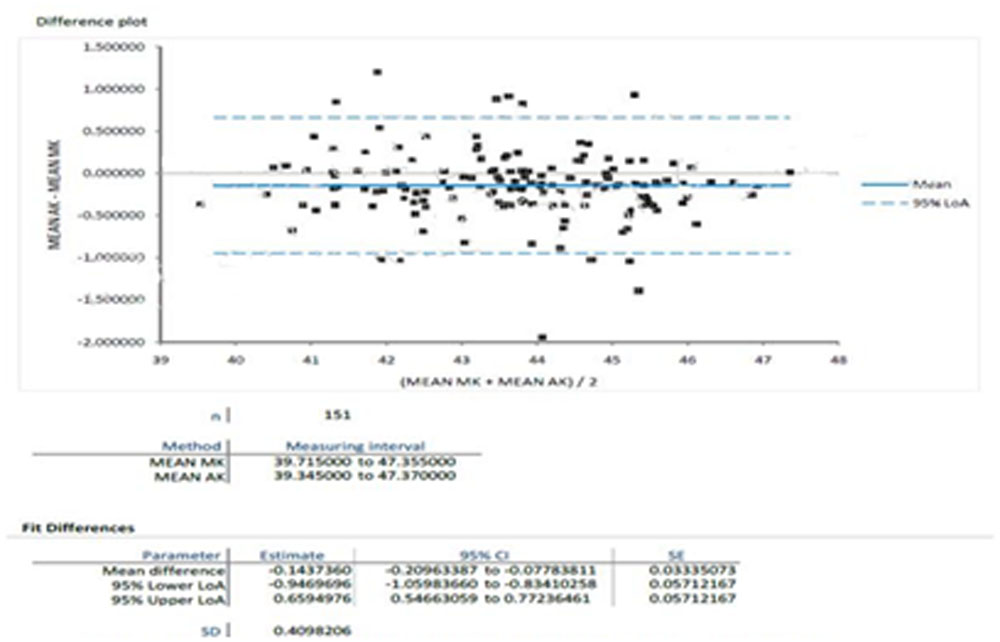
Figure 2: Bland-Altman plot of the J0 values of the two instruments
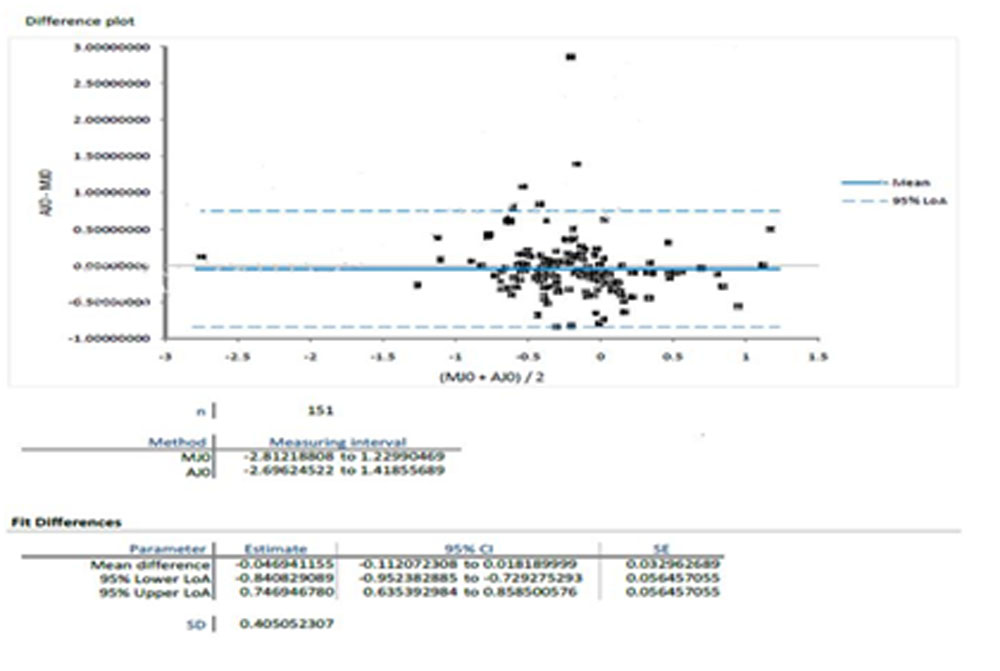
Figure 2: Bland-Altman plot of the J45 values of the two instruments
Leave a Comment