

Dr.Lalgudi Ganesh Vaitheeswaran, V18501, Dr.Pavitra Patel,
Dr.Neeraj A Israni, Dr.Rohit Shetty
AUTHORS:
PURPOSE
Comparingchanges in real-time lens accommodation pre vs post-refractive surgery using a novel dynamic aberrometer OSIRIS-T and correlation to outcomes
METHODS
50 low myopes underwent dynamic accommodation amplitude measurement with Osiris-T pre-operatively and on post-op day 1,7 and 30 following wave front optimized LASIK/ SMILE. They were divided in to 3 groups based on pre-op accommodation amplitude (low-10, normal- 30 and high-10)
RESULTS
All patients attained expected refractive correction. Patients in normal group maintained similar accommodation post-op. Among low or high group, 75% continued to have high accommodation amplitudes till day 7 and 30% continued to have beyond day 30 with 2% developing accommodative spasm
CONCLUSION
Pre-op dynamic accommodative status of the lensplays an important role in post-op quality of vision. Customizing induction of spherical aberration based on pre-op accommodative amplitude can help prevent unhappy patients post refractive surgery.
INTRODUCTION:
Accommodation is an important physiological mechanism which aids in near vision. There is pupillary constriction and anterior movement of lens along with increase in convexity of anterior lens surface bringing the near object in to foveal focus. All this basically induces myopia in refractive terms. The amount of myopia induced depends on the distance of the near target. For an object at 50cm, 2D and for 33cm, 3D myopia is required. The retardation of this process is termed presbyopia. (1, 2)
In myopes, especially low myopes (0.5-3D), there is an inherent ability to focus for near without accommodation because of the myopia. A good percentage of low myopes do not utilise their accommodation to read or focus for near, whereas use only their myopia. This subset can be clinically identified as those myopes who do not wear any refractive correction or those who remove their glasses for reading. These people, once they undergo refractive surgery are made emmetropes and lose their myopia which was giving them near defocus for reading. (3)This leads to significant accommodation issues in such people and are unsatisfied after a perfect refractive surgery.
To measure accommodation, using a ruler to find out the near point of accommodation is subject to reporting and observer bias and is not repeatable. Moreover, it can not give any more details regarding accommodation. Dynamic retinoscopy is also subject to a lot of bias and is affected by patients’ level of varying accommodation during measurement.(4, 5)
I-trace, which is a ray tracing aberrometer(6) can be used to measure the wave front aberrations of the eye at different distance targets which can give an idea about the accommodative state of the eye, but it is difficult to measure and interpret.(7)
Osiris-T, the device utilised in this study is the only available dynamic aberrometer which can measure the ocular wave front in real time during accommodation and give graphical and objective representation of the patient’s accommodation amplitude. It is a non-contact, simple to use aberrometer which requires less than a few minutes for measurement without any induced discomfort. Figure 1 shows the dynamic accommodation graph as given by Osiris.
Fig 1: Dynamic accommodation curve based on dynamic wave front measurement as given by Osiris T. Red line is the accommodative stimulus, blue curve is the accommodative response and green curve is the pupil size measurement. This curve denotes a normal accommodative response in a young adult where the blue curve is just matching up to the amount of accommodative stimulus.
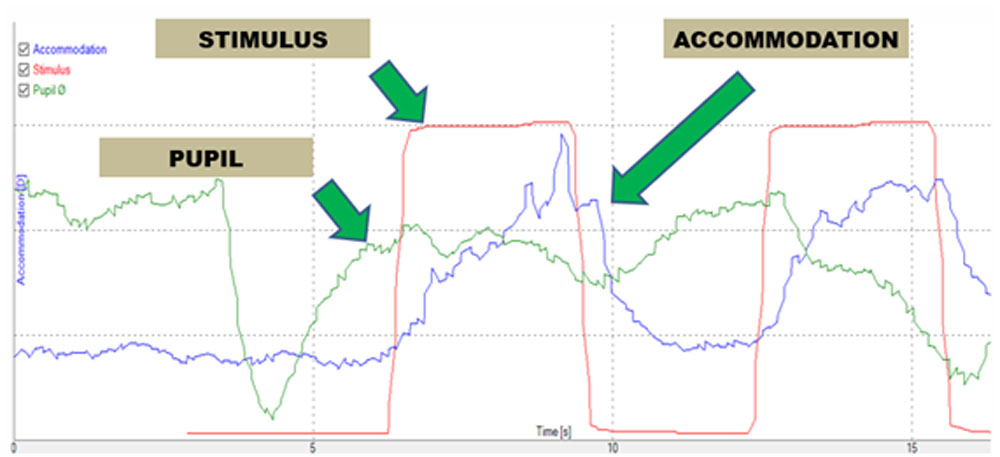
Along this graph, at every time point, the aberrometry of the eye is also given. Measuring the defocus and Spherical aberration change of the eye between resting state and accommodative state can objectively determine the state of lens accommodation. This can be utilised to compare the optics of the same eye pre vs post refractive surgery.
OBJECTIVE OF THE STUDY:
- To determine the change in real time lens accommodation pre vs post refractive surgery for low myopia.
- Compare the differences in objective outcome between different subsets of low myopes based on their pre-operative accommodative amplitudes.
METHODOLOGY:
Low myopes seeking refractive surgery, visiting our centre underwent routine evaluation which included: Detailed slit lamp examination, dilated fundus evaluation, topography, biomechanics and aberrometry (Osiris-T). Uncorrected and best corrected near, intermediate and distance vision was also documented. Post- operatively, aberrometry was repeated at day 1, day 7, day 30 and day 90 during their routine follow ups.Patients who had undergone wave front optimized LASIK (Allegro, Alcon) or SMILE (Visumax, Zeiss) and completed at least 3 months follow up were included in the study with retrospective data collection.
They were divided into 3 groups based on pre-op accommodative amplitudes measured using Osiris-T. Out of 50 patients included, 30 had normal amplitudes, 10 had low and 10 had high amplitudes.
RESULTS:
The patients had all attained emmetropia (considered +/- 0.5 MRSE) post-operatively. The 30 patients who had normal accommodation amplitudes continued to have normal accommodation post-operatively. They had comfortable uncorrected vision of 6/6 for distance and N6 for intermediate and near without any complaints of asthenopia.
Fig2 shows changes in accommodation responses in a patient with low accommodative amplitude t start with pre-operatively. 2a: Pre-op dynamic accommodation curve; 2b: Dynamic accommodation at week 1; 2c: Dynamic accommodation at 1 month.
Figure 2a:
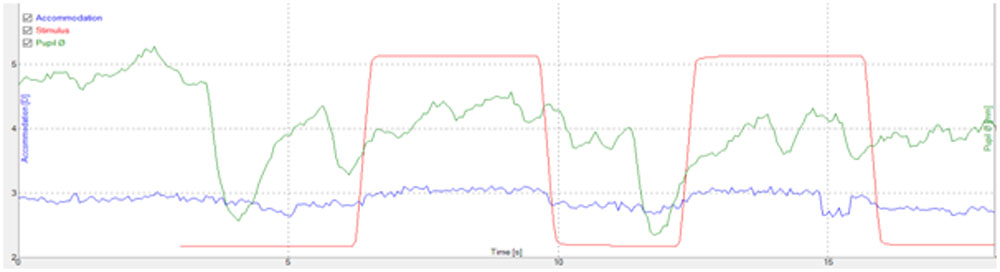
Figure 2b:
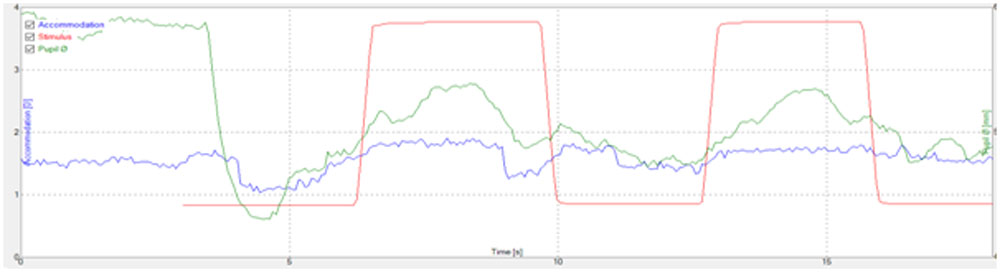
Figure 2c:
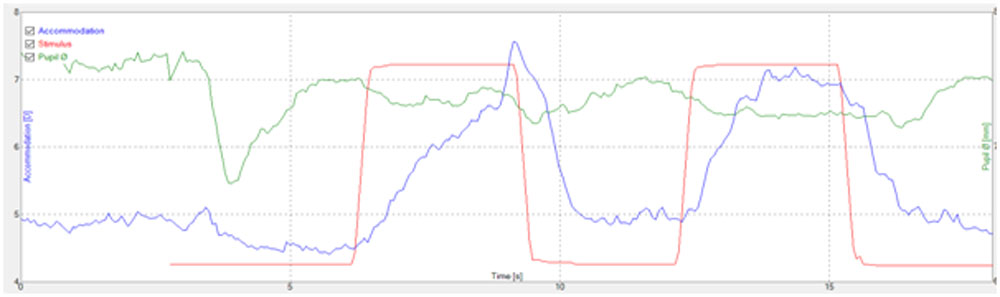
This patient continued to have poor near vision N10 OU till week 1 as denoted by the near flat blue line in figure 2b. At 1 month follow up, his near vision had improved to N6 unaided but distance vision dropped to 6/12 OU. This is documented by the blue curve becoming steeper and crossing the stimulus amplitude raising the baseline accommodation close to 5D. This has caused his near vision to improve, but distance vision is affected. This is typical of accommodative spasm.(8)
By objectively measuring the changes in defocus on dynamic aberrometry between resting and accommodative states, the patients in the low accommodation group had significantly lower defocus change compared to the ones in normal and high groups. (p<0.05).
Near vision subjective complaints was higher in the low accommodation group and their uncorrected binocular near vision was significantly lesser than the normal accommodation group (p<0.05)
DISCUSSION:
Understanding the results, it is clear that near vision issues are common post refractive surgery in myopes. But, for the first time, an objective method and predictor has been put forth to predict the subset of myopes who are going to face risk of poor near vision and risk of pseudo-accommodative spasm post-operatively.
Subjective testing of near point of accommodation or dynamic retinoscopy can give clues to pick these patients early, but they are not definitive and are subject to measurement and patient bias.(5)
But dynamic aberrometry graphs and wave-front changes are objective and give clear understanding of the optics of accommodation change with refractive surgery. (9)Interestingly, in our study, all contact lens users had even pre-operatively fallen in the category of normal accommodation. This is due to the fact that unlike myopes using spectacles, contact lens users cannot afford to remove their contact lenses whenever they want to read. This preserves the accommodative ability of the eye and the neural adaptation to near targets.
Based on this study, it is understood that it is important to start with normal accommodation prior to refractive surgery or else the chances of having near vision complaints post-operatively and risk of developing pseudo accommodative spasm becomes high. Orthoptic exercises(10) or contact lens trial prior to refractive surgery can help prevent these untoward complications.
CONCLUSION:
Pre-op dynamic accommodative status of the lens plays an important role in post-op quality of vision. It is important to regularise accommodation pre-operatively using a trial of contact lenses or orthoptic exercises before taking up myopes for refractive surgery. This is the first ever study to objectively document accommodative amplitude and their significance in routine refractive surgery.
REFERENCES:
- Baumeister M, Kohnen T. [Accommodation and presbyopia : part 1: physiology of accommodation and development of presbyopia]. Ophthalmologe. 2008;105(6):597-608; quiz 9-10.
- Heron G, Schor C. The fluctuations of accommodation and ageing. Ophthalmic & physiological optics : the journal of the British College of Ophthalmic Opticians (Optometrists). 1995;15(5):445-9.
- Fong DS. Is myopia related to amplitude of accommodation? Am J Ophthalmol. 1997;123(3):416-8.
- Goss DA, Rana S, Ramolia J. Accommodative response/stimulus by dynamic retinoscopy: near add guidelines. Optom Vis Sci. 2012;89(10):1497-506.
- Leon A, Estrada JM, Rosenfield M. Age and the amplitude of accommodation measured using dynamic retinoscopy. Ophthalmic & physiological optics : the journal of the British College of Ophthalmic Opticians (Optometrists). 2016;36(1):5-12.
- Ninomiya S, Fujikado T, Kuroda T, Maeda N, Tano Y, Oshika T, et al. Changes of ocular aberration with accommodation. Am J Ophthalmol. 2002;134(6):924-6.
- Pinero DP, Sanchez-Perez PJ, Alio JL. Repeatability of measurements obtained with a ray tracing aberrometer. Optom Vis Sci. 2011;88(9):1099-105.
- Shetty R, Deshpande K, Kemmanu V, Kaweri L. The Role of Aberrometry in Accommodative Spasm After Myopic Photorefractive Keratectomy. J Refract Surg. 2015;31(12):851-3.
- Ninomiya S, Fujikado T, Kuroda T, Maeda N, Tano Y, Hirohara Y, et al. Wavefront analysis in eyes with accommodative spasm. Am J Ophthalmol. 2003;136(6):1161-3.
- Horwood A, Toor S. Clinical test responses to different orthoptic exercise regimes in typical young adults. Ophthalmic & physiological optics : the journal of the British College of Ophthalmic Opticians (Optometrists). 2014;34(2):250-62.
Leave a Comment