

Dr.Tanuja Kate, Dr.Rajiv Choudhary,Dr. LALITA GUPTA,Dr.Divya Patel
Introduction:
Glaucoma is a progressive optic neuropathy and is the leading cause of irreversible blindness worldwide.(1)The treatment of glaucoma aims to lower the intraocular pressure (IOP) by using medications, lasers and incisional surgery.In eyes with refractory glaucoma trans-scleral cyclophotocoagulation(TSCPC)is commonly used to reduce IOP.TSCPC decreases the IOP through the continuous delivery of diode laser to destroy the ciliary body,thereby decreasing aqueous production.(2) Micropulse TSCPC(MP-TSCPC) offers a variation of traditional TSCPC to treat glaucoma.With this system,short bursts of energy (on-cycle)are delivered to the targeted tissue, with the energy bursts sequentially building up to a photocoagulative state in the pigmented epithelium. At the same time,during “off-cycles,” surrounding tissue is allowed to cool and remains below the photocoagulative threshold, thereby,theoretically preventing damage to surrounding tissue.MP-TSCPC has emerged as a new treatment option for glaucoma. The new Cyclo G6, Glaucoma laser system (Diode laser 810nm) is an innovative cyclophotocoagulation system with unique patented Micro Pulse technology.The Micro Pulse technology makes this laser safe and efficacious.The present study was conducted with an aim to evaluate the early results of MicropulseTrans-scleral cyclophotocoagulation(MP-TSCPC)in refractory glaucoma.
Methods:
It was a prospective study of 11 patients of refractory glaucoma who underwent MP-TSCPC at Rajas Eye & Retina Research Centre,INDORE(M.P.)between March 2018 and April 2018.We included refractory glaucoma such as post keratoplasty,chronic angle closure,neovascular,silicone oil induced,failed trab and painful blind eye due to glaucoma.The cases with thin sclera were excluded from the study.Also,during treatment,areas of staphyloma and bleb were excluded.All the patients underwent comprehensive ophthalmic examination.The IOP was recorded by Goldmann Applanation Tonometer and gonioscopy was done by 4 mirror goniolens.All the procedures were performed under peribulbar anaesthesia and in the operating room.We used the new Cyclo G6,Glaucoma laser system (Diode laser 810nm from Iridex) with unique patented Micropulse technology.The laser settings used were 2000mw energy,duty cycle was 31.3% which translated to 0.5 ms of on-time & 1.1 ms of off-time.The laser was delivered over 360 degree except 3 and 9 o’clock position.In each hemisphere,the probe was moved in a gradual sweeping motion for 80 seconds.The probe(Micropulse pars plana probe)was put perpendicular to the globe in such a way that probe notch was towards the limbus.The voice countdown timer feature on the laser makes this process very easy and efficient. At the conclusion of surgery,1% atropine was administered. Post laser treatment regimen included topical steroid in tapering dose for a month. Also,anti-glaucoma treatment was continued and reduced gradually.The subjective assessment of procedural and post laser pain was done as grade 0(No pain),grade1(Mild to moderate pain) and grade 2 (Severe pain).
All the patients were followed up on1stday,1week,15 days and 1month and at every follow up visit pain assessment was done,visual acuity recorded,IOP measured and any other complications were noted.Also,complete slit lamp examination was done.
Results:
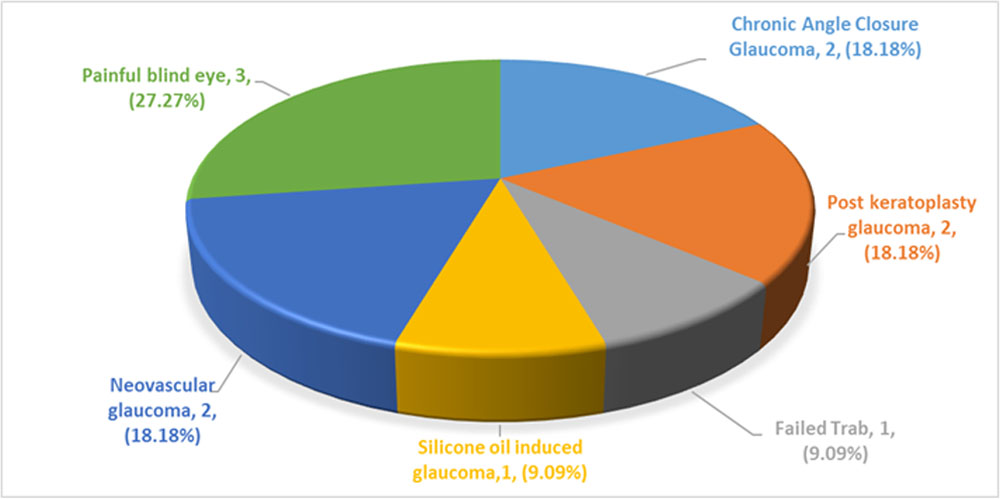
A total of 11 eyes were treated with MP-TSCPC in this study. The mean age of treated patients was 56.73 year(range 45 to 92 yrs).In total,8 patients(73%)were male and 3(27%) female.The distribution of glaucoma diagnoses was as shown in Fig.1
| Mean
(mmHg) |
Std. Deviation | Minimum
(mmHg) |
Maximum
(mmHg) |
Median Absolute Reduction | Absolute reduction in mean IOP | Wilcoxon Signed Ranked Test comparing IOP at different time points with pre-laser IOP | |
| Pre laser IOP | 48.45 | 11.282 | 34 | 75 | 47.00 | ||
| 1st day post laser IOP | 29.82 | 15.999 | 10 | 56 | 25.00 | 18.64 | 0.003 |
| 1 week post laserIOP | 23.64 | 16.317 | 6 | 50 | 18.00 | 24.82 | 0.003 |
| 15 dayspost laser IOP | 24.73 | 14.297 | 10 | 50 | 17.00 | 23.73 | 0.003 |
| 1 month post laser IOP | 24.45 | 13.582 | 10 | 50 | 19.00 | 24.00 | 0.003 |
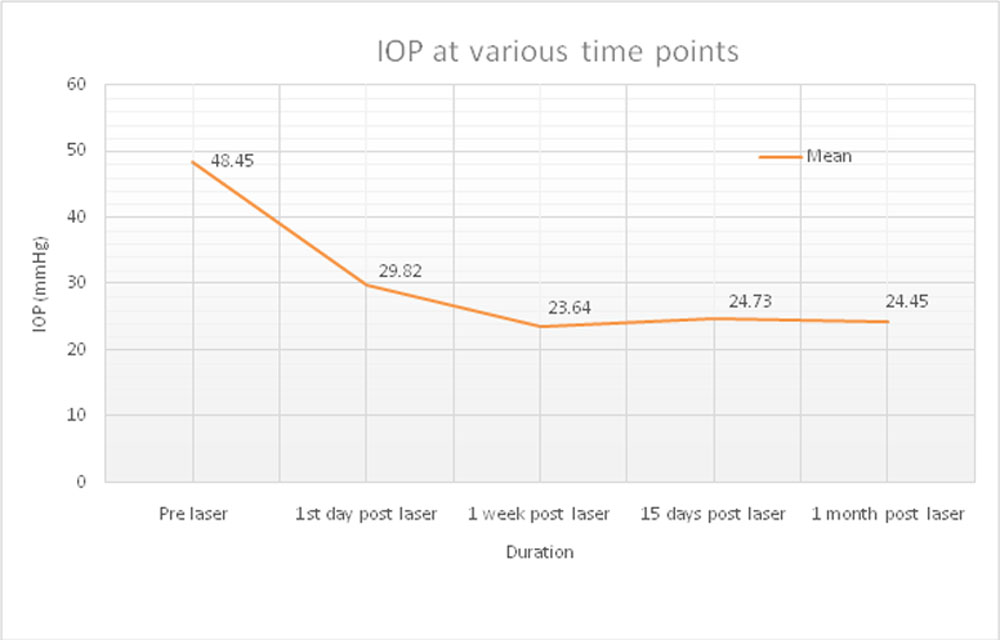
Fig.2
Table 1 shows that for all eyes, mean IOP reduced from 48.45 mm Hg(SD-11.28)pre-laser to 29.82(SD-15.99)1stday post laser,23.64(SD-16.31)1 week post laser,24.73(SD-14.29)15 days post laser and 24.45(SD-13.58)1 month post laser.
| Percentage Reduction in IOP at various time points | |||||
| Mean | Std. Deviation | Minimum | Maximum | Median | |
| Percentage reduction in IOP on Day 1 compared to Prelaser | 39.7108 | 26.22006 | 2.13 | 74.58 | 32.4324 |
| Percentage Reduction in IOP at one Week compared to Prelaser | 53.4767 | 26.83299 | 9.09 | 82.35 | 57.4468 |
| Percentage Reduction in IOP on Day 15 compared to Prelaser | 50.1555 | 22.88641 | 14.89 | 83.05 | 57.4468 |
| Percentage Reduction in IOP at one Month compared to Prelaser | 50.5140 | 20.64494 | 14.89 | 83.05 | 55.3191 |
Table 2: Percentage reduction of IOP at various time points
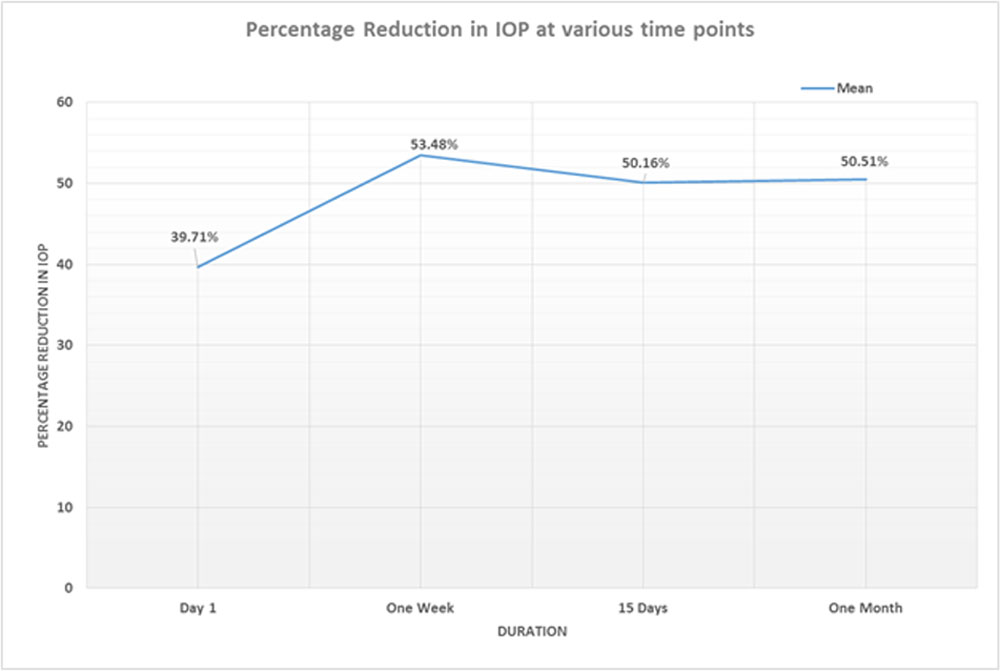
Fig.3
The percentage reduction of IOP(as shown in table 2) compared to pre-laser was 39.71,53.47,50.15 and 50.51% at day1,1 week,15 days and 1 month respectively.The mean number of anti-glaucoma medication reduced from 3.82 pre-laser to 2.45 at 1 week and 2.81at 15days and 1month post laser.As regards procedural pain,3 patients reported grade 1 pain while 8 didn’t report any pain.Post-laser pain assessment is shown in table 4. At 1 month,none of the patients reported pain.(Fig.4)
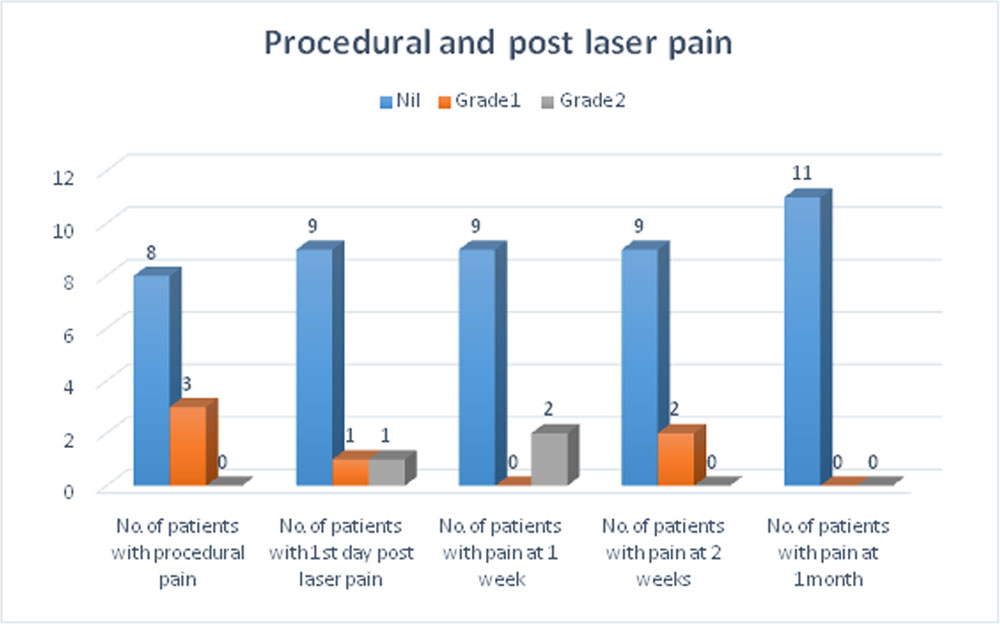
Fig 4: Procedural and post laser pain
As regards visual acuity following MP-TSCPC,there was improvement of vision in one case otherwise the visual acuity was stable.We also did not notice any deterioration of vision.(Table 3)
| No PL | CF | HM | 3/60 | 6/60 | 6/18 | |
| Prelaser | 4 (36.40%) |
1
(9.10%) |
3
(27.30%) |
1 (9.10%) |
1
(9.10%) |
1
(9.10%) |
| 1st day post laser | 4
(36.40%) |
1
(9.10%) |
3
(27.30%) |
1
9.10% |
1
(9.10%) |
1
(9.10%) |
| 1 week post laser | 4
(36.40%) |
1
(9.10%) |
3
(27.30%) |
1
9.10% |
1
(9.10%) |
1
(9.10%) |
| 15 days post laser | 4
(36.40%) |
0
|
3
(27.30%) |
2
18.20% |
1
(9.10%) |
1
(9.10%) |
| 1 month post laser | 4
(36.40%) |
0
|
3
(27.30%) |
2
18.20% |
1
(9.10%) |
1
(9.10%) |
Table 3: Visual acuity
As regards complications,in this small study,one patient developed bullae otherwise no significant complications were noted.Statistical analysis:
Statistical analysis was done by Wilcoxan signed ranked test comparing IOP at different time points with preoperative IOP and the P value was 0.003 at all time points which was significant.
Discussion:
Micropulse diode trans-scleral cyclophotocoagulation has emerged as a new treatment optionfor glaucoma.Instead of the conventional,continuous train of high intensity energy application,a series of repetitive short pulses of energy with rest period in between is delivered in a micropulse mode. Early works of Tan,Chew et al.found it effective & safe in lowering IOP by ≥30% with consequent reduction in medications. It is possible that the MP3 device, which uses a laser application mode that may inhibit thermal spread and collateral thermal damage, works through a different mechanism by increasing uveoscleral outflow.Because, the surgery is non-penetrating and does not induce conjunctival scarring, infection is unlikely, and the need for intense early follow up is significantly reduced. Additionally,bleeding risk related to the procedure itself is low compared to other incisional glaucoma surgeries.A study by Sarah D Kuchar et al showed 39.1% reduction in IOP at last follow up (Mean 50.1 days).No patient reported greater than mild pain beyond first post-operative day.
As regards visual acuity,5 patients gained 1 line of vision and 5 lost 1 line of vision.The no. of medication pre-laser was 2.54 and it reduced to 1.77post laser.There were no cases of prolonged inflammation or pthisis.(3)In our study,there was 50.51% reduction in IOP at 1 month follow up.Also,none of the patients reported severe procedural pain or pain at 1 month.However, till 2 weeks,2 patients reported grade 1-2 pain.This difference could be because we had 3 cases of painful blind eye in our series.As regards visual acuity,we noticed improvement in one case and none of the patients had any deterioration.The no.of medication in our study reduced from 3.82 pre-laser to 2.81post laser which was similar to the study by Sarah D Kuchar et al.
Another study by Arthur F Resenda et al showed that mean IOP reduced from 31.1 to 13.4 mmHg at 1 month.The no.of medications reduced from 2.1 ± 0.8 to 1.1 ± 0.9 at 1 month.One patient experienced hypotony and another one persistent inflammation.In our study,the mean IOP reduced from 48.45 to 24.45 mmHg.The mean IOP was higher as,we had 3 cases of painful blind eye with absolute Glaucoma with IOP as high as 55-75 mmHg.If we exclude painful blind eye with absolute glaucoma cases,the mean IOP reduction was from 44.5 to 19.37 mmHg.In our study,the no.of medication reduced from 3.82 pre-laser to 2.81 at 1 month similar to what Arthur F Resenda et al reported.As against the study by Arthur F Resenda et al,in our series we didn’t notice any persistent inflammation/hypotony.
Another study by Shen Lin et al showed IOP reduction from
21.84±1.2 to 16.96±1.6 mmHg.The no.of medication reduced from 3.3±0.2 to 3±0.3. However,in our study,the no.of medication reduction was better i.e.from 3.82 to 2.81.And similar to the study by Shen Lin et al,we also found no major complications.
A study by Nathan Redcliffe et al showed that mean percentage change in IOP was 21.6% at 1 week and 30 % at 1 month.The mean no.of medication at baseline was 3.3 ± 0.3 and it reduced to 2.4 ± 0.3 at 3 months.No other significant complications were noted.We also found almost similar reduction in no.of medication(from 3.82 to 2.81) and no major complications.However in our series,the percentage change in IOP was far better and it was 53.47% at 1 week and 50.51% at 1 month.
Conclusion:
The outcomes of our study are promising, with good evidence of the IOP lowering effects of MP-TSCPC and decreased need for ocular antihypertensive medications postlaser.So,MP-TSCPC is an effective modality of managing Refractory Glaucoma cases without significant side effects as used to be seen with age old continuous pattern trans-scleral cyclophotocoagulation.
References:
1.Quigley HA,Broman AT.The number of people with glaucoma worldwide in 2010 and
2020.BrJOphthalmol 2006;90:262–267.
2. Pastor SA,Singh K, Lee DA,et al.Cyclophotocoagulation: a report by the American
Academy of ohthalmology.Ophthalmology. 2001;108:2130–2138.
3.Kuchar S,Moster MR,Reamer CB,et al.Treatment outcomes of Micropulse transscleral
cyclophotocoagulation in advanced glaucoma.Lasers MedSci.2016;31:393–396.
4.Tan A, Chockalingam M, AquinoM, Lim Z, et al. Micropulse trans-scleral diode laser
cyclophotocoagulation in the treatment of refractory glaucoma.Clin Experiment
Ophthalmol. 2010;38(3):266-72.
5. Aquino MCD. Micropulse versus continuous wave trans-scleral diode
cyclophotocoagulation in refractory glaucoma: a randomized exploratory study.Clin
Experiment Ophthalmol. 2015;43(1):40-46.
6. Melissa M Toyos and Rolando Toyos Clinical outcomes of micropulse transscleral
cyclophotocoagulation in moderate to severe glaucoma. Journal of clinical and
experimental ophthalmology
7. Maslin J, Noecker R 2016: Micropulse Trans-scleral Cyclophotocoagulation for the
treatment of Glaucoma. ARVO
8. National University Hospital Singapore Prospective Clinical Study
Leave a Comment