

The type of manuscript: Original article
Title of the manuscript: Ignorance about Diabetes is not always bliss!
Running title: Ignorance about Diabetes
Authors:
Dr. Radhika Krishnan, M.D.
Dr. Astha Jain, M.S.
Ms. Ashwini Rogye, B.Sc. (Optometry)
Ms. SiddhitaNare, M.Sc.
Dr. HarinderVirdi, BDS, M.P.H.
Prof. Dr. S. Natarajan, D.O.
Institute: Aditya Jyot Foundation for Twinkling Little Stars, 153, Major Parmeshwaran Road, Opp. SIWS college, Wadala (West), Mumbai – 400031
Corresponding author:
Name: Dr. Radhika Krishnan
Address: Aditya Jyot Foundation for Twinkling Little Stars, 153, Major Parmeshwaran Road, Opp. SIWS College, Wadala (West), Mumbai – 400031
Email: drradhika.ajftle@gmail.com
Phone: 022 – 24177600 – 904
Total number of pages: 4
Word count for the abstract: 333
Word count for the text: 955
Word count for introduction + discussion: 648
The manuscript has been read and approved by all the authors, the requirements for authorship as stated earlier have been met, and each author believes that the manuscript represents honest work.
MANUSCRIPT PAGE
Abstract
Title: Ignorance about Diabetes is not always bliss!
Introduction: As per 2015 data India has 69.2 million diabetics, of which WHO estimates that 36 million remain undiagnosed. An AIOS study estimates the prevalence of DR in known diabetics to be around 21.7%acros-s the nation and since it will only increase with the increase in diabetic cases it makes it even more important-t for all diabetics to undergo routine eye examination.
Methods: AJ DRUMMS is an ongoing population based cross sectional study conducted in the slums of Mumbai. As a part of this study we assessed the knowledge of diabetic retinopathy among the diabetic patients an-d their major hurdles in seeking eye care .1373 eligible subjects were enrolled in the study after screening the general population (above 30 yrs of age) for diabetes. Their response was noted for two questions:
- Why would you being a diabetic, not go for an eye examination.
- How did you come to know that diabetes can affect the eye
The responses received were correlated with the literacy status, gender, income, age of the patient.
Results: we found that the major cause for the DM patients not to undergo an eye examination was, lack of awareness (49.2%), followed by causes like financial constraints (22.5%), busy schedule (15.5%) thought that it was a waste of time (12.8%). Out of all the methods of awareness available to them we found that majority of them were made aware of this by community health workers (73.49%), compared to all other sources combined (26.51%).
Conclusion: We found that the major cause of diabetic patients in the slum population not seeking eye care services were lack of awareness with financial constraint being the 2nd highest cause. The most effective mode of patient education was found to be through community health workers and therefore we suggest that there is a need to increase our efforts to train and incorporate diabetes screening in the NHM through ASHA workers to reduce the cases of vision loss due to diabetes.
Keywords: Diabetes Mellitus, Diabetic Retinopathy, awareness
Introduction
Background:
Diabetes mellitus (DM) is a non-communicable complexly origin disease and most challenging health problems rising in alarming rate in the developing and developed countries. Diabetes is a lifestyle disorder that affect various body parts and causes complications after long term progression of diseases. Diabetes mainly classified into three types: Type I and type II and Gestational. . Globally, a delay in the diagnosis of diabetes puts most of the population at the risk of the complications. Increasing urbanisation and life style modifications has increased the burden of diabetes since last few decades. Change in dietary pattern, modernisation and increase in stress level has intensified the problem of chronic diseases like diabetes further. Low physical activity, unhealthy diet and a sedentary lifestyle increases the risk of diabetes. Classically, diabetes mellitus affects the adult and elderly population however it is now seen to affect the younger population also. Currently there are about 366 million people suffering from this condition. DM is estimated to rise to 629 million by 2045 from 425 million in 2017[1]. According to International Diabetes Federation (IDF) 2017 report, 159 million in Western Pacific and 82 million in South East Asian adults are living with DM [1]. China, India, Indonesia, and Pakistan represent 48% of the global burden [1]. With the incidence of DM increasing at an alarming rate, the number of people with a micro- vascular complication, is expected to surge from 126.6 million in 2010 to 191.0 million by 2030[2]. Diabetic Retinopathy (DR) is the most common complication of Diabetes and which is the fifth most common cause of global blindness[3] (moderate and severe vision impairment) accounting for 4.8% of the cases of blindness throughout the world[4].
Blindness due to diabetic complications:
International Diabetes Federation’s most recent estimates indicate that 8.3% of adults – 382 million world-wide people have diabetes, the number of people with the disease is set to rise beyond 592 million in less than 25 years [1]. Yet, with 175 million of cases currently undiagnosed, a vast amount of people with diabetes are unaware that they are progressing towards its complications. Moreover, with 80% of the total number affected living in low- and middle-income countries, greatest number of people with diabetes is between 40 and 59 years of age where the epidemic is gathering pace at an alarming rate. More than 65 million people are living with Diabetes in India and the estimated prevalence of Diabetic Retinopathy is 18% among the Diabetics. Hence over 65 million Diabetics need to be screened in India.
DM and its complications like DR impose a huge economic burden on the global healthcare. Patients with DM having retinal complication spent approximately INR 13922 per month [5]. For a chronic disease like DM and hence DR, there is an unmet urgency for creating awareness about the diabetes and its complications.
As per 2015 data India has 69.2 million diabetics, of which WHO estimates that 36 million remain undiagnosed [6]. An AIOS study estimates the prevalence of DR in known diabetics to be around 21.7%acros-s the nation and since it will only increase with the increase in diabetic cases it makes it even more important for all diabetics to undergo routine eye examination. Hence, the aims of this study it to assess the knowledge of diabetic retinopathy among the diabetic patients and their major hurdles in seeking eye care.
Methods:
Study design: Aditya Jyot Diabetic Retinopathy Urban Mumbai Slum Study (AJDRUMSS) is an ongoing population based cross sectional study conducted in the slums of Mumbai.
The objective of the study is to evaluate the prevalence of Diabetes and its eye complications among urban slum dwellers. We also aimed to create awareness among community to prevent the progression of disease.
As a part of this study, we assessed the knowledge of diabetic retinopathy among the diabetic patients living in slums of Mumbai. We also tried to find out major hurdles in seeking eyecare among these population. After screening of general population (above 30 years of age) for diabetes, 1373 eligible subjects were enrolled in the study.
Data collection: Data about knowledge among Diabetic patients was collected in the form of questionnaire. Their response was noted for two questions:
- Why would you being a diabetic, not go for an eye examination?
- How did you come to know that diabetes can affect the eye?
After data Collection, responses received were correlated with demographic variables such as literacy status, gender, income and age of the patient.
Results:
Table 1 shows that the major cause for the DM patients not to undergo an eye examination was, lack of awareness (49.2%).
Financial constraints (22.5%) and lack of time (15.5%) were other major reasons for not seeking eye care. Around 13% of the respondents were thought that it was a waste of time (12.8%).
Table1: Various reasons for DM patients not undergone for an eye examination
| DM patients not undergone for an eye examination | Lack of awareness | 49.2% |
| Financial constraints | 22.5% | |
| Busy schedule | 15.5% | |
| Thought that it was a waste of time | 12.8% |
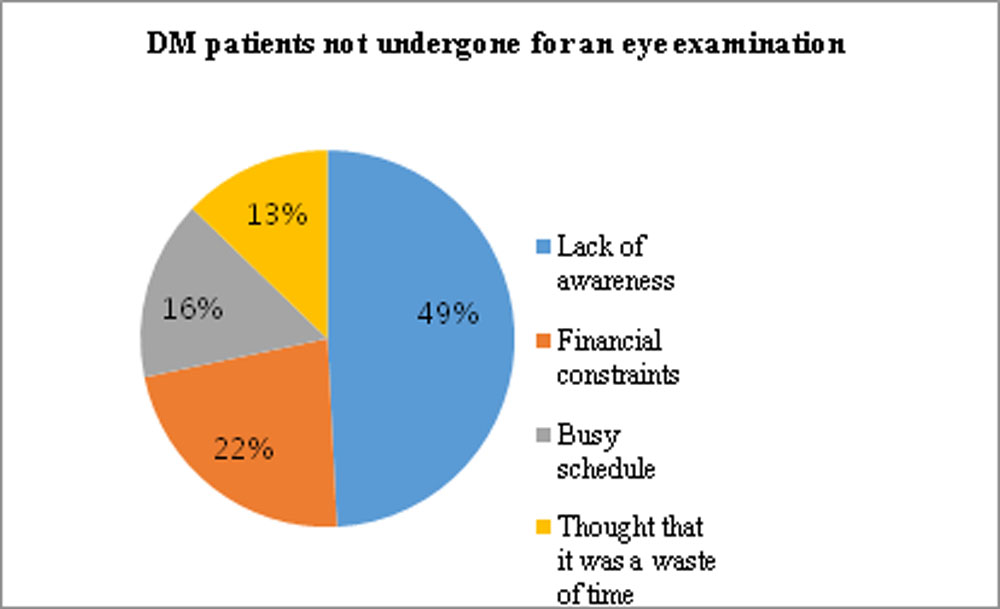 Fig1. DM patients not undergone for an eye examination
Out of all the methods of awareness available to them, we found that majority of them were made aware of this by community health workers (73.49%), compared to all other sources combined (26.51%).
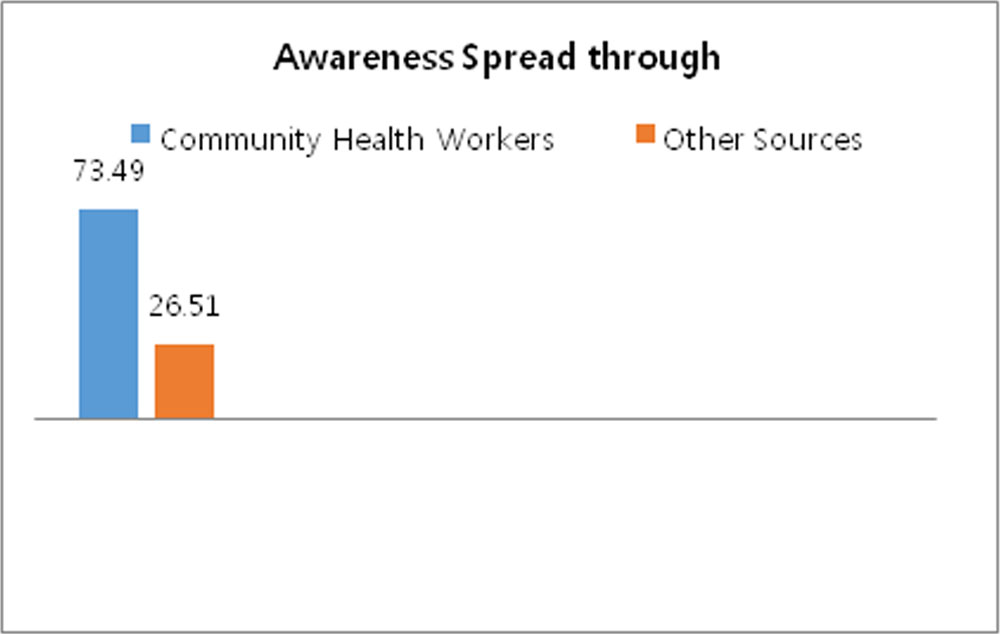 Fig 2. Awareness Spread through
Discussion:
Diabetes is a chronic disease with various complications. As disease progress, it becomes
important for patient to know about aetiology, symptoms, risk factor, possible complications and various methods of self-care to cope with it. Correct knowledge plays an important in developing skills for self-care practices. Having adequate does not necessarily help in behavioural change. There are social, cultural and other structural factors that have an impact on understanding of disease and its management. Knowledge about diabetes need to be look through people’s perception about of diabetes.
Diabetic retinopathy screening is important in remote areas since people with diabetes usually remain asymptomatic until advanced stage of Diabetic Retinopathy (DR). Therefore, screening for sight threatening complications is necessary to initiate timely treatment. Prevalence of blindness due to Diabetic Retinopathy has decreased in the Western world due to effective population-based screening programs. Patients with moderate and severe form of Diabetic retinopathy come for examination but those who do not come for screening due to lack of awareness and affordability are missed. Huge numbers of asymptomatic cases for screening are also missed.
Prevailing situation in India
- Lack of access to early screening for a variety of chronic eye diseases
- Indirect increase in expense on tertiary care
- Increasing prevalence of preventable blindness
- Inefficient utilization of our healthcare resource
There is a huge shortage of trained ophthalmologists which results in a delay in regular eye check-ups and routine ophthalmic care. In India, there is a significant unmet need for accurate and resource friendly screening modalities that can be utilised to screen people with diabetes. In order to overcome practical challenges like remote locations, transportation, low ophthalmologist to population ratio and poverty, there is a need for improvement in the practical aspects of remote ophthalmic diagnosis and care.
Conclusion: We found that the major cause of diabetic patients in the slum population not seeking eye care services were lack of awareness with financial constraint being the 2nd highest cause. The most effective mode of patient education was found to be through community health workers and therefore we suggest that there is a need to increase our efforts to train and incorporate diabetes screening in the NHM through ASHA workers to reduce the cases of vision loss due to diabetes. An increase in knowledge relating to diabetes is most likely to propel people to seek treatment and as such avoid the complications. There is need to improve the awareness and self-care practices in the multiple domains which include food choices,
physical activity, proper medications intake and blood glucose monitoring from the patients. People with diabetes can live longer and happily however they must be diligent in their care. People with diabetes can live longer and happily however they must be diligent in their care. Furthermore, it is also the responsibility of the state to provide effective as well as efficient public health facilities to cater to the needs of even those in the lower socio-economic class of the urban population.
References:
- IDF. IDF Diabetes Atlas – 8th Edition; 2017.
2.Congdon N, Zheng Y, He M. The worldwide epidemic of diabetic retinopathy. Indian J Ophthalmol [Internet]. 2012;60(5):428. Available from: https://www.ijo.in/text.asp?2012/60/5/428/100542
- Lee R, Wong TY, Sabanayagam C. Epidemiology of diabetic retinopathy, diabetic macular edema and related vision loss. Eye Vis [Internet]. 2015;2(1):17. Available from: https://www.eandv.org/content/2/1/17
- Resnikoff S, Pascolini D, Etya’ale D, Kocur I, Pararajasegaram R, Pokharel GP, et al. Policy and practice. Bull World Health Organ [Internet]. 2004;82(11):844–51. Available from: https://eutils.ncbi.nlm.nih.gov/entrez/eutils/elink.fcgi?dbfrom=pubmed&id=15640920&retmode=ref&cmd=prlinks%5Cnpapers2://publication/uuid/BAA31E85-D8BD-4CD4-A484-651963213B14
- Kumar J. Economic burden of diabetes. Med Updat [Internet]. 2013:205–8. Available from: https://www.apiindia.org/medicine_update_2013/chap45.pdf
- https://www.searo.who.int/india/mediacentre/events/2016/en/
Leave a Comment